LLMs.txt and AI Sitemaps: A Practical Setup Guide for 2026


Introduction
AI-driven search has moved from a side experiment to a primary way people get answers. Instead of scanning ranked links, users now expect AI-generated answers that summarise, compare, and explain in one step. confirms this shift at scale, with generative AI becoming a default layer in search experiences rather than a novelty.
This change has altered how AI search engines surface information. Traditional search engines still crawl and index the web, but AI-powered search systems increasingly decide what to show based on clarity, structure, and context, not just rankings. For many in , this blurs the line between traditional SEO and newer ideas around AI visibility, leaving the average website owner unsure what actually matters.
Part of the confusion comes from vague promises around “AI optimisation.” is clear that AI features build on existing search fundamentals, not secret new rules. At the same time, shows AI Overviews now appear across a meaningful share of queries, reinforcing why this topic can’t be ignored.
This guide clarifies what LLMs.txt and so-called “AI sitemaps” can influence in retrieval, citation, and content selection in 2026; and just as importantly, what they cannot replace.
How AI Search Engines Generate Answers in 2025–2026
Modern AI search engines no longer work by simply matching keywords to pages. At their core sit large language models, a type of language model trained to predict and generate text based on patterns in vast datasets.
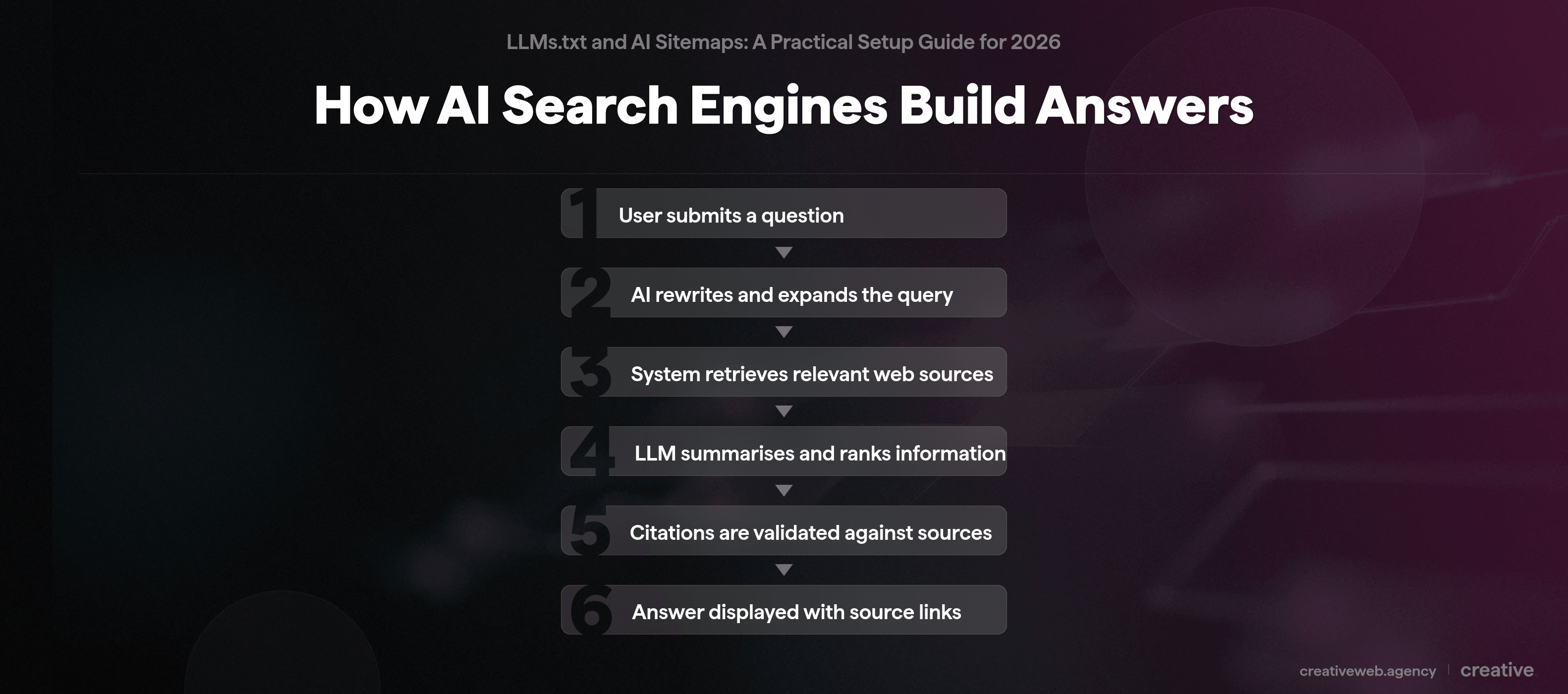
These AI models do not “understand” content in a human sense. Instead, they analyse signals, relationships, and probability to produce AI outputs that read as coherent answers.
The critical shift for site owners happens around those models, not inside them.
Traditional bots and crawlers still discover and index pages, but generating AI responses is a separate step. Increasingly, an AI system retrieves a small set of relevant documents first, then uses those sources to ground its AI-generated responses.
This approach reduces hallucinations by anchoring answers in external material rather than the model’s memory alone.
That retrieval layer reshapes what effective content looks like.
Models consistently struggle with:
Noisy layouts and repeated template elements
JavaScript-heavy pages that obscure core information
Long pages where key details are buried without clear structure
By contrast, they perform far better when content is easy to extract and summarise. Clear headings, concise sections, and well-defined page purpose make it easier for models to isolate what actually answers a question. Context matters as much as content: what the page is about, how sections relate, and which parts carry authority.
There are also practical limits to keep in mind. Google has stated that and should be verified against source pages, reinforcing why attribution and structure remain critical for anyone aiming for inclusion and citation inside .
At the same time, into conversational tools like shows that these systems often decide when to search dynamically, running multiple retrievals before producing an answer rather than relying on a single pass.
The implication is straightforward. AI search rewards sites that are easy to retrieve from and easy to summarise, not those trying to game the model itself.
AI Overviews vs Traditional Search Engines
AI Overviews represent a structural shift in how search results are presented. Instead of ranking pages and asking users to evaluate links themselves, Google’s AI Overviews generate at the top of the page, supported by a small set of cited sources.
The goal is resolution, not exploration. That change alone alters how value is distributed across the results page.
In traditional search engines, success was largely a function of ranking position. Higher placement in search engine results usually translates into more clicks and clearer attribution. With AI Overviews, visibility isn’t determined solely by where a page ranks, but by whether it is clear, extractable, and trustworthy enough to be referenced inside an answer.
This is why optimisation priorities are shifting. Rather than rewarding pages that simply match keywords well, AI-driven search favours content that is easy to interpret and summarise.
In practice, that means:
Structure matters more than density
Context matters more than coverage
Explainability matters more than clever targeting
Commercially, the impact is significant. Citation increasingly replaces clicks as the first meaningful win. show that when AI Overviews appear, organic click-through rates can drop even if rankings remain stable, raising the stakes for being cited rather than merely listed.
At the same time, AI Overviews now trigger across a meaningful share of queries, making this behaviour systemic rather than an edge case. This is where comes into play: designing content to be referenced inside answers, not just ranked beneath them.
The practical takeaway is simple: ranking still matters, but clarity now determines whether your content is used at all.
What Is an LLMs.txt File?
An is a proposed, voluntary way to signal which pages should be prioritised during AI retrieval and citation. Placed at the site root, it acts as a curated index that points large language models toward your key content and key pages, rather than leaving them to infer importance from navigation menus, templates, or noisy layouts.
The problem it attempts to solve is practical. Modern sites often overwhelm models during extraction. Heavy JavaScript, repeated components, and sprawling page structures make it hard for bots and models to isolate authoritative information.
LLMs.txt addresses this by offering a concise, human-curated map of the pages you would want an AI system to reference when generating answers.
At a format level, the spec is intentionally simple. The file is and follows a predictable structure:
A clear title
A short summary
A list of relevant URLs (sometimes paired with clean Markdown versions of pages for easier parsing)
This simplicity is deliberate. The goal is readability and prioritisation, not technical enforcement.
What LLMs.txt does not do is just as important:
It does not control crawling or indexing in the way robots.txt or an XML sitemap does.
It does not guarantee inclusion in AI-generated answers.
It is not a ranking factor for Google search or Google’s AI Overviews, which continue to .
Even adoption remains limited. shows that only a small fraction of sites have published an LLMs.txt file so far, and real-world testing has found little evidence of consistent AI crawler usage.
In short, LLMs.txt is best understood as a low-cost signalling layer for prioritising content, not a switch you flip for instant AI visibility.
What People Mean by “AI Sitemaps” (And Why There’s No Single Standard)
“AI sitemaps” is not a formal technical standard. It is a catch-all phrase that has emerged to describe several different ways people try to influence which content is discovered, selected, and reused by AI systems. This is where much of the confusion begins, particularly in digital marketing, where the term is often used as if it refers to a single file or protocol.
At the foundation is the XML sitemap, a long-established, standardised format that helps discover URLs and understand site structure. Alongside that sits , which describes what a page is about rather than which pages exist, enabling machines to interpret entities, relationships, and attributes more accurately.
What people now label an “AI sitemap” usually falls into one of three patterns:
A curated index like LLMs.txt, positioned as a “treasure map” for AI models rather than a crawl directive, a framing popularised in industry coverage by .
Non-standard discovery hints, such as custom directives added to robots.txt that point to LLM-focused files, despite not being part of any official protocol.
Early, draft-stage proposals for AI-specific indexes, including JSON-based patterns discussed in , which are exploratory rather than adopted standards.
This lack of consensus is why “AI sitemap” should be treated as a conceptual bucket, not a deliverable. Terms like AI optimisation, generative engine optimization, and answer engine optimization describe approaches to being retrieved, cited, and reused in AI-driven systems, not a single file you can deploy.
The practical takeaway is this: XML sitemaps enable discovery, schema and structured data support understanding, and experimental files like LLMs.txt influence prioritisation during content selection. Collapsing these into one “AI sitemap” obscures their distinct roles and leads to poor implementation decisions.
Get Found by AI Search Engines
Our GEO services help your content appear in AI Overviews, ChatGPT, and other AI-powered search results.
Explore GEO ServicesWhen LLMs.txt and AI Sitemaps Are Worth Implementing
Not every website owner needs to rush into LLMs.txt or experimental AI sitemap patterns. These approaches are most effective in specific scenarios where prioritisation and accuracy genuinely matter, rather than as a blanket upgrade for all sites.
They tend to make the most sense for:
Docs-heavy sites, where large volumes of technical documentation, help centres, or knowledge bases need to be interpreted correctly by AI systems. These environments benefit from clearer signals for retrieval accuracy and citation selection that highlight authoritative sources and current versions.
High-stakes accuracy content, such as pricing, legal explanations, compliance guidance, or product specifications, where incorrect summarisation can cause real-world issues for users and brands.
Fast-changing key pages, including service descriptions or feature pages that evolve frequently and need clear ownership over what should be referenced.
In these cases, LLMs.txt acts as a lightweight prioritisation layer, complementing existing structure rather than replacing it.
Automation is critical here. Most site owners will only sustain this approach if updates happen reliably without manual intervention, which is why is often favoured in practice.
However, many organisations should deprioritise this entirely. If your site is small, rarely updated, or already struggles with basic technical hygiene, the return is limited. Even industry analysis remains cautious, framing rather than a requirement, with validation and monitoring essential before attributing any impact.
The key is context. Each AI platform behaves differently, and none guarantee consistent usage of these files. Implement them where clarity and control justify the effort, not as a default checklist item.
How to Implement LLMs.txt in WordPress
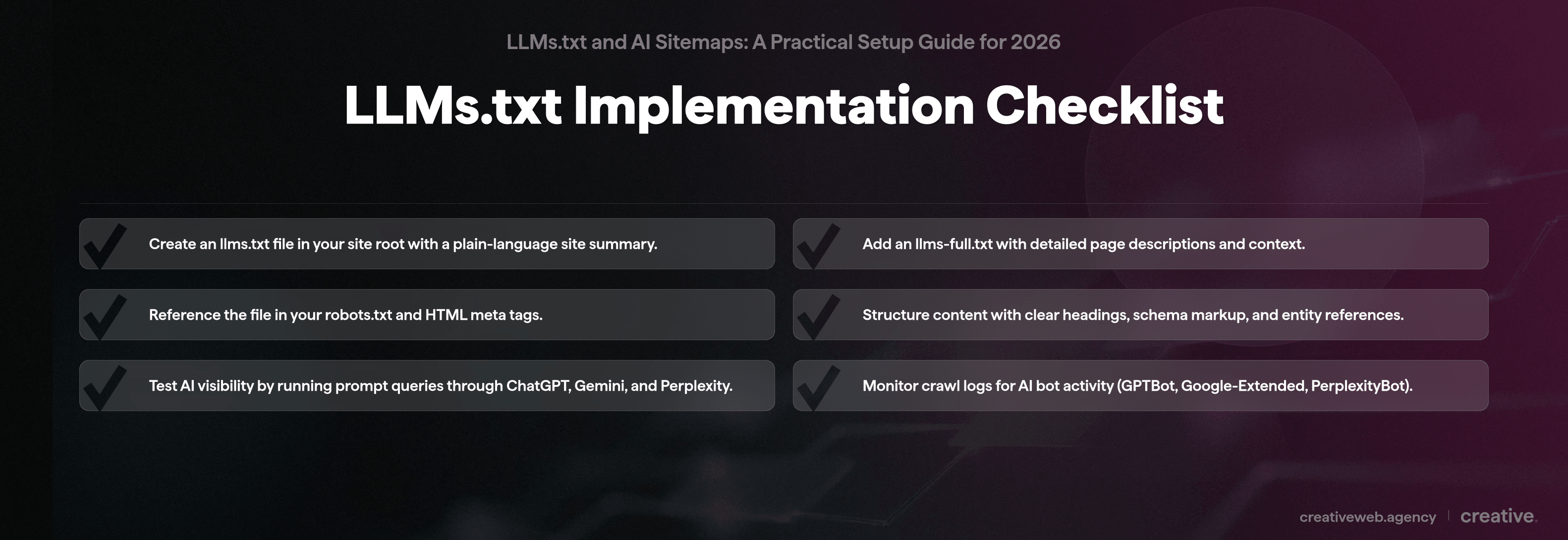
For most WordPress sites, the most reliable path is a plugin-based tool, not manual file handling. This reflects real operating conditions: content changes frequently, ownership is shared, and automation reduces both risk and maintenance overhead.
1. Use a plugin-based setup (recommended for most site owners)
Modern SEO plugins now host LLMs.txt generation directly, which removes the need to touch server files.
lets you toggle LLMs.txt from the dashboard. Once active, it automatically creates the file at the root of your site, updates it on a scheduled basis, and prioritises cornerstone content to surface the most important pages first.
offers similar functionality, with controls to define which URLs appear and keep the file aligned as content changes over time.
Expert insight: Treat plugin output as a baseline, not a finished strategy. Review which pages are included and ensure your actual business-critical content is what gets prioritised, not just what was updated most recently.
2. Manual setup via file manager (advanced use only)
Manual creation is possible, but it introduces operational friction.
You’ll need access to a file manager or SFTP to place llms.txt in the site root.
Any content changes require manual edits to keep the file current.
Conflicts can arise if a plugin is enabled later without removing the manually created file.
documents this approach clearly, but also highlights why it’s best suited to developers managing controlled environments rather than marketing teams.
Expert insight: If you can’t confidently explain who owns updates and how often they happen, manual setup is a liability rather than an optimisation.
3. Validate safely with Google Search Console
You won’t see direct confirmation that LLMs.txt is being “used,” but validation still matters.
Use the to confirm normal discovery hasn’t been disrupted.
Check the robots.txt report to ensure experimental changes haven’t blocked important paths or files.
This mirrors the correct mindset: publish, confirm accessibility, and monitor for errors rather than expecting immediate feedback.
4. Monitor outcomes in Google Analytics, not vanity signals
There is no dedicated LLMs.txt . Instead, use Google Analytics to watch broader trends.
Link GA4 with Search Console to understand which landing pages continue to attract organic visibility.
Track assisted conversions and engagement, not just last-click traffic, as AI-driven journeys are increasingly indirect.
Expert insight: The success signal here is stability. If your key pages remain discoverable, accurate, and referenced over time, the infrastructure is doing its job.
How to Implement LLMs.txt on Bespoke Builds
On bespoke stacks, technical implementation is less about setup and more about control. You are responsible for where the file lives, how it updates, and who owns changes over time.
1. Handle the file at the root, deliberately
LLMs.txt should sit at the site root and follow the Markdown-first structure defined in the proposal. Keep it explicit and minimal so models can parse it cleanly without ambiguity.
2. Automate updates and assign ownership
Manual edits do not scale. Tie updates to release workflows so changes to key pages trigger regeneration. An AI-powered tool can which URLs deserve inclusion, but editorial ownership must remain internal to avoid drift.
3. Integrate with CI/CD pipelines
Treat LLMs.txt like configuration, not content. Generate it during deploys, validate formatting, and prevent stale references from shipping. This is where bespoke builds outperform plugins when done well.
4. Monitor access via logs, not assumptions
Verification happens in server logs. Track whether bots and models request the file and how often, accepting that behaviour varies by AI platform and is not guaranteed.
Expectation check: Google has stated it reinforcing that this is prioritisation infrastructure, not a ranking lever.
Common Mistakes and Misconceptions About LLMs.txt and AI sitemaps
Most failures around LLMs.txt and “AI sitemaps” come from misunderstanding what these mechanisms are designed to do. Avoiding a few common errors protects both effort and credibility.
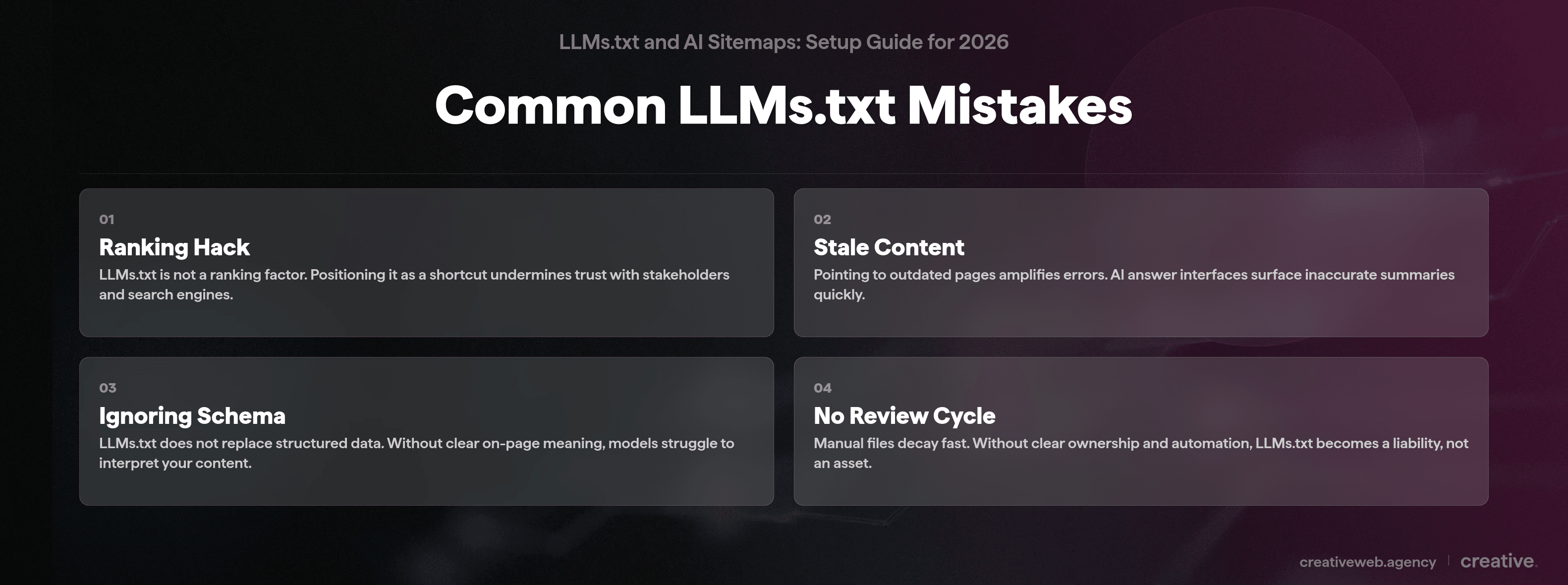
1. Treating this as a ranking hack
Some AI tools flag missing LLMs.txt files as a risk signal, implying immediate ranking impact. This framing is misleading. Search engines have been explicit that these files are not ranking factors, and positioning them as shortcuts undermines trust with stakeholders.
2. Listing outdated or low-quality content
An index that points to stale pages does more harm than good. In AI-powered search, answer-first interfaces amplify errors quickly. If your file highlights outdated pricing, deprecated features, or superseded guidance, you increase the risk of inaccurate summaries being surfaced.
3. Ignoring schema and structured content
LLMs.txt does not replace schema or structured data. Without clear on-page meaning, models struggle to interpret what a page represents, even if it is prioritised. Effective AI optimisation programmes still start with clean HTML, consistent entities, and well-maintained markup.
4. Forgetting ownership and review cycles
Manual files decay fast. Without clear ownership, review cadence, and automation, LLMs.txt becomes a liability. This is why production-ready setups rely on governed generation rather than ad hoc edits, a principle echoed in WordPress automation approaches.
The common thread is restraint. These tools enhance clarity when used deliberately, but they fail when treated as magic levers.
How to Measure Impact and Validate AI Visibility
Measuring impact in AI-driven search is indirect by nature. There is no single metric that confirms whether your content shaped AI answers or influenced AI-generated answers, so validation relies on a small set of practical checks rather than vanity signals.
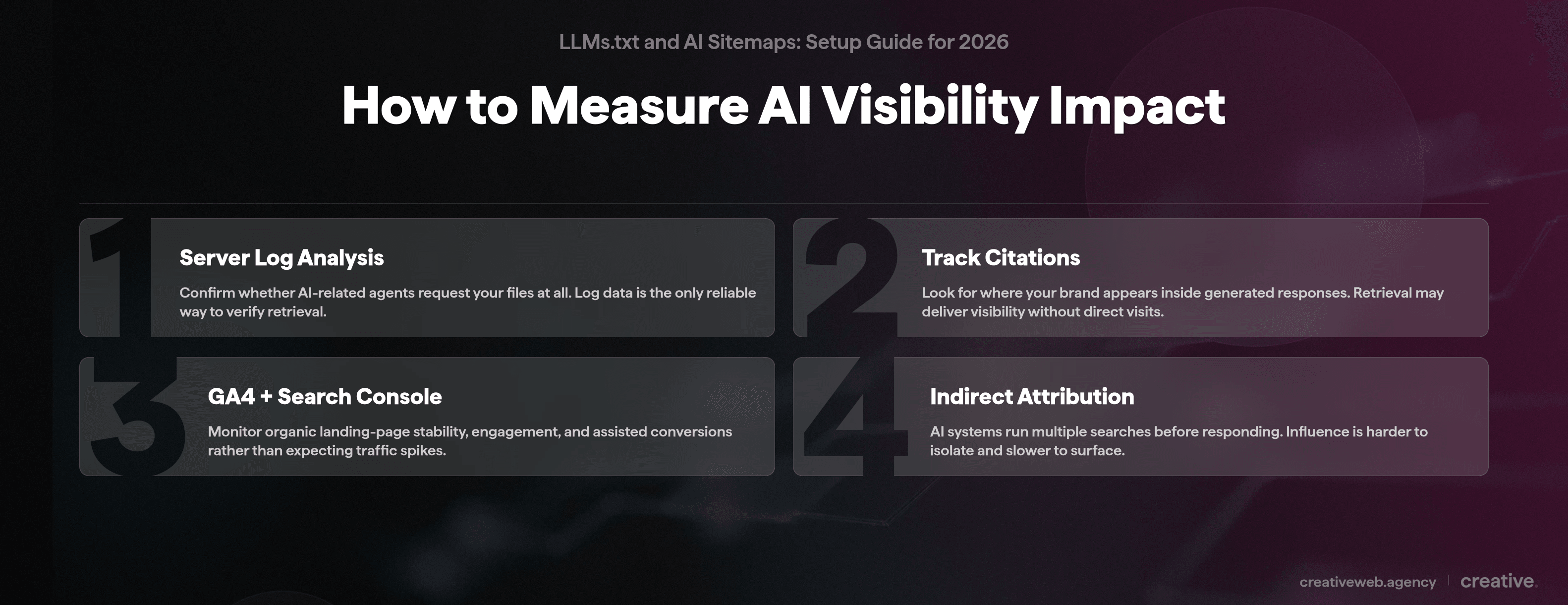
Start with server log analysis. Before interpreting any outcomes, confirm whether AI-related agents request your files at all. Log data is the only reliable way to verify retrieval behaviour and avoids false assumptions about impact.
Track citations and references along with clicks. Look for where your brand or content appears inside generated responses. This reflects how AI interaction works in practice: retrieval and synthesis may deliver visibility without a direct visit.
Connect visibility to business outcomes in Google Analytics. Use Google Analytics to monitor organic landing-page stability, engagement, and assisted conversions rather than expecting immediate traffic gains. Linking GA4 with Search Console provides a clearer view of ongoing discoverability.
Plan for indirect attribution and delayed signals. Conversational systems often run multiple searches before responding, making influence harder to isolate and slower to surface.
The goal here is confidence in long-term clarity and access, not short-term spikes.
Ready to Build an AI-Ready Website for 2026?
The biggest shift in search is not new files or formats. It’s how answers are assembled. AI-driven systems increasingly select a small set of sources to retrieve, summarise, and cite before a user ever clicks.
That means clarity, structure, and prioritisation now determine whether your content is used at all, not just where it ranks.
LLMs.txt and related “AI sitemap” ideas sit in that context. They don’t replace SEO fundamentals, but they reflect a broader move toward governed, explainable infrastructure. The practical next step for most teams is not deploying every new file, but auditing whether their most important pages are easy to extract, clearly scoped, and consistently maintained.
AI-ready websites in 2026 are built the same way resilient ones always were: with clean , defined ownership, and content designed to be trusted and reused. That is what allows both search engines and AI systems to reference your site with confidence over time.
FAQ
-
What is an LLMs.txt file?
-
A plain-text file in your site root that describes your content in a format AI models can easily parse. It helps AI search engines understand what your site covers.
Did this answer your question? YesThat’s great glad we could help! Start a ProjectNoNo problem, one of our experts can give you a more in-depth answer. Ask our Experts -
Do I need LLMs.txt to rank in AI search?
-
No. LLMs.txt is not a ranking factor. Clean structure, schema markup, and quality content matter more. LLMs.txt adds clarity for AI systems but is not required.
Did this answer your question? YesThat’s great glad we could help! Start a ProjectNoNo problem, one of our experts can give you a more in-depth answer. Ask our Experts -
Is there a standard format for AI sitemaps?
-
Not yet. There is no single AI sitemap standard. LLMs.txt is the closest proposal, but approaches vary between platforms and are still evolving.
Did this answer your question? YesThat’s great glad we could help! Start a ProjectNoNo problem, one of our experts can give you a more in-depth answer. Ask our Experts -
How do I check if AI bots are crawling my site?
-
Check your server access logs for user agents like GPTBot, Google-Extended, and PerplexityBot. Most hosting panels give you access to raw log files.
Did this answer your question? YesThat’s great glad we could help! Start a ProjectNoNo problem, one of our experts can give you a more in-depth answer. Ask our Experts -
Can I add LLMs.txt to WordPress without a plugin?
-
Yes. Upload the file directly to your site root via FTP or file manager, or use a snippet in functions.php to serve it dynamically.
Did this answer your question? YesThat’s great glad we could help! Start a ProjectNoNo problem, one of our experts can give you a more in-depth answer. Ask our Experts