Your 2026 Guide To Google AI Overviews vs Answer Engines


Google is shifting from classic search results to systems that explain the web for you, and that’s where Google AI Overviews and modern answer engines start to diverge. AI Overviews sit inside Search and generate a short AI overview of a topic using a handful of cited sources. Answer engines such as ChatGPT Search, Bing Copilot, and Perplexity work differently. They skip the results page and deliver a direct response in one step.
That distinction matters. When AI Overviews appear, click-through rates on informational queries fall sharply; Ahrefs reported an average drop of 34.5% when the module shows up. Pew Research found the same pattern: users click less when an AI summary is present. For UK businesses that depend on organic visibility, that change is already altering how audiences discover brands.
At CreativeWeb, we see this shift across every industry. Clear structure, strong definitions, and predictable information hierarchy now influence whether an AI search system cites your content at all.
This guide explains how Google AI Overviews vs answer engines differ, why the gap matters for AI visibility, and what teams can do to remain discoverable as AI-led discovery becomes the norm.
What Are Google AI Overviews?
Google AI Overviews are short, machine-generated summaries that sit at the top of Search and pull together information from several sources to help users grasp a topic quickly. Google describes them as “AI-generated summaries in Search designed to help users quickly understand information from a range of sources.” They are part of Google’s broader shift from static search results towards dynamic AI features.
Rollout: The feature began life as the Search Generative Experience (SGE) in 2023, later rebranded to AI Overviews in 2024 and expanded across more queries in 2024–2025. It still functions inside traditional Google Search rather than operating as a separate AI platform or “Google AI Mode,” which is a different interface entirely.
How it behaves: AI Overviews appear most often on informational queries, something confirmed in Semrush’s analysis of more than 200,000 results. The system retrieves relevant pages, synthesises them using a retrieval-augmented process, and presents a short paragraph supported by 2–5 citation tiles. According to seoClarity, these summaries now surface for roughly 30% of US desktop keywords as of early 2025.
For most of the businesses we work with at CreativeWeb, this feature tends to show up on the same pages that previously brought in top-funnel traffic, which is why its behaviour has such a direct impact on visibility.
In a nutshell, Google AI Overviews:
- Summarises content across multiple sources
- Appears mainly for informational queries
- Uses retrieval-augmented synthesis
- Displays 2–5 citations or tiles
- Lives inside traditional Google Search, not a separate AI platform
How Do AI Overviews Generate Answers?
AI Overviews rely on a retrieval-augmented generation (RAG) process. In practice, it works a bit like Google skimming a stack of relevant pages, blending the key points into one short recap, and attaching citations so users can check the sources for themselves.
It starts by interpreting the intent behind the query. From there, the system retrieves multiple sources, pulls out the most relevant passages, and produces AI-generated summaries that sit at the top of the page. These AI-generated answers are usually supported by 2–5 citation tiles, though users often read the summary without clicking; one reason zero-click behaviour keeps rising.
A distinctive behaviour here is Google’s ability to jump people straight to a highlighted section of a cited page. SMU Libraries documented this “scroll-to-text” pattern during the SGE rollout, where users land directly on the matching passage rather than the top of the article.
From our own client audits at CreativeWeb, the content pieces that surface most often in these summaries tend to have tight definitions, short clauses, and well-structured paragraphs; formats the retrieval system can extract cleanly.
What Are Answer Engines? (ChatGPT Search, Copilot, Perplexity)
An answer engine is an AI system that gives you a direct, consolidated answer before showing any links. Tools like ChatGPT Search, Bing Copilot, and Perplexity fall into this category, and they behave very differently from both traditional search engines and a Google AI Overview.
Where Google still anchors everything to SERPs, an AI answer engine acts more like a conversational adviser. It skims far more material than a human could reasonably check, then produces a single narrative response. BCG found that modern LLMs routinely draw on 30 or more independent sources, compared with the three or four most people scan when researching something manually. That breadth of retrieval is a key part of how an AI search engine reaches its conclusions.
Unlike traditional search engines, answer engines tend to:
- Provide a direct answer immediately, rather than ranked blue links
- Synthesise insights from multiple sources, not a fixed SERP
- Keep users inside a chat-style interface instead of redirecting to webpages
Perplexity is the clearest real-world example. Zapier describes it as an “answer engine designed to find and summarise content from the web.” The platform performs live retrieval, cites its sources openly, and gives users a blended summary rather than a long list of pages. Even the recent Britannica lawsuit refers to Perplexity explicitly as an AI answer engine, which tells you how firmly the category has taken hold.
From a marketer’s viewpoint, the shift feels immediate. Many clients now drop their questions into an answer engine before they even open Google. For some teams, it feels less like “searching” and more like speaking to a single, confident assistant who has already done the comparison work.
Differences Between AI Overviews and Answer Engines
When you line them up side by side, the real distinction is how each system handles the work of “answering”. Google AI Overviews behave like an extension of the search results page; still rooted in Google’s ranking ecosystem, still shaped by the underlying Search Generative Experience (Google SGE) models. Answer engines, by contrast, feel like a separate layer of the web altogether, where the model makes the judgement call rather than a traditional ranking system.
The practical gap shows up in four places web teams care about:
- How sources are gathered
- How explanations are written
- How links are shown
- How much user behaviour shifts as a result
AI Overviews rely heavily on Google’s existing quality signals and draw from a narrow set of high-confidence pages. Answer engines cast a much wider net, often building a response from far more documents than a search user would reasonably check in a browser session.
Another point marketers notice is tone. AI Overviews keep to a concise, almost clinical style because they sit inside Google Search and must remain neutral. Answer engines produce something closer to a guided explanation: longer, conversational, and shaped by the assistant’s internal logic. That style difference alone can change how a brand appears, either as a tile in a grid or as a threaded citation woven into a paragraph.
The table below captures the core differences in a way that mirrors how teams experience them day to day.
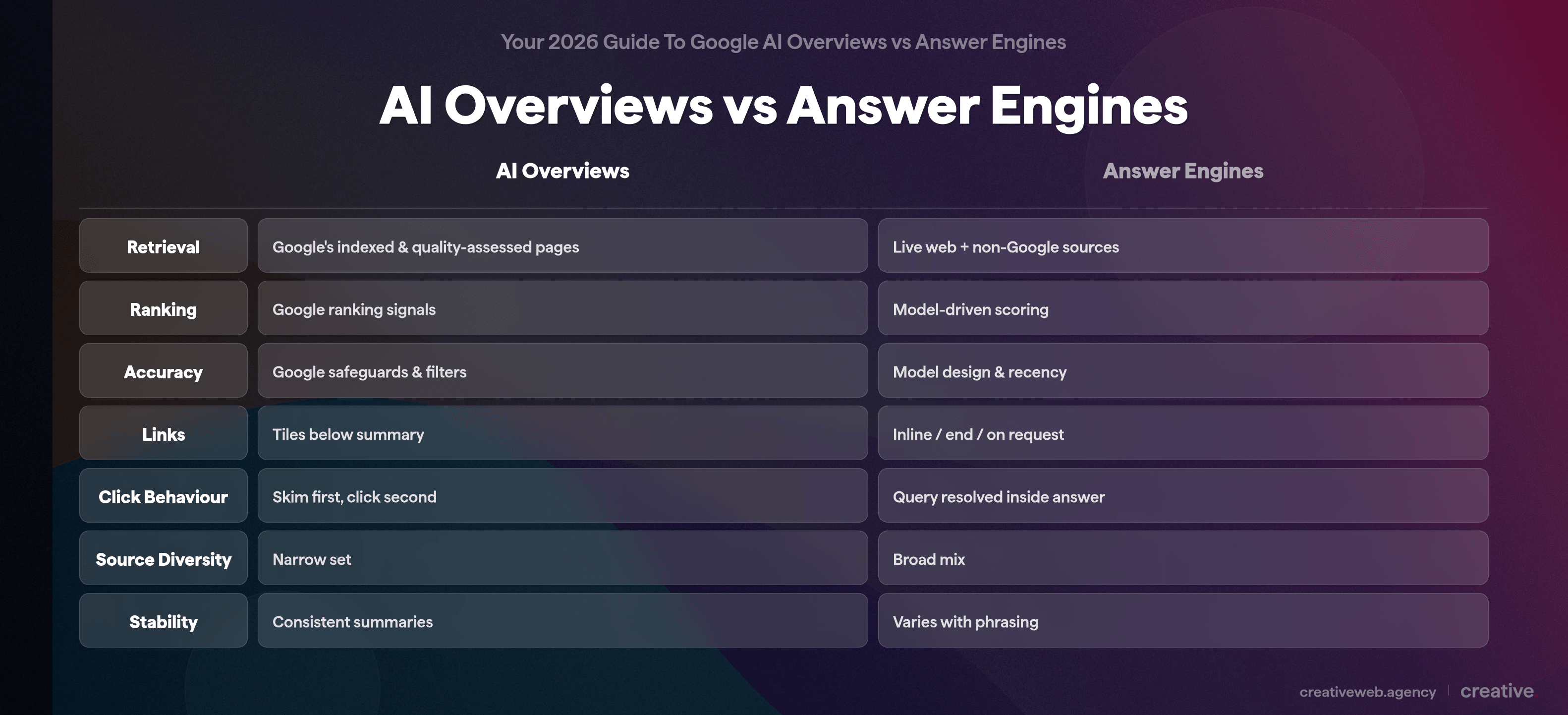
In short, AI Overviews act as a structured search feature, while answer engines function as self-contained systems that decide what the answer should be and how it is presented. For content teams, this means preparing for two entirely different reading environments: one that still resembles classic search, and one that behaves more like a knowledgeable assistant summarising the web for you.
Get support with your AI visibility strategy
If you want help reviewing how AI Overviews or answer engines affect your site, our team can walk you through the changes to prioritise.
Book a callHow Do AI Overviews Affect Traditional SEO?
Google AI Overviews have changed how traditional SEO performs for informational queries. They haven’t killed SEO, but they have altered what counts as success. You can rank well in the search results and still see fewer visits because the summary at the top already answers the question.
For site owners reading GA4 or Google Search Console, the pattern is familiar: impressions climb, clicks fade, and pages that used to drive steady discovery suddenly feel unpredictable. This happens because visibility now happens on two layers:
- Layer 1: the classic list of ranked links in traditional search engines.
- Layer 2: the AI-generated summary sitting above them.
To appear in that second layer, pages need clearer structures: short definitions, tight summaries, logical subheads, and clean HTML that makes the content easy to reuse. The intent type matters too. Informational queries face the heaviest disruption, while local or transactional queries usually behave more like they always have.
Rankings still matter because Google uses them as its retrieval pool, but ranking alone is no longer the finish line. It’s step one. Step two is being chosen as the source that the model trusts enough to reference in the summary itself.
How to Optimise for AI Visibility (2025/2026)
Preparing a site for AI visibility now sits alongside traditional optimisation, not beneath it. GEO (Generative Engine Optimisation) and AEO (Answer Engine Optimisation) build on the foundations of your existing SEO strategy, but they push you to structure content in a way that AI engines can interpret, cite, and lift without friction.
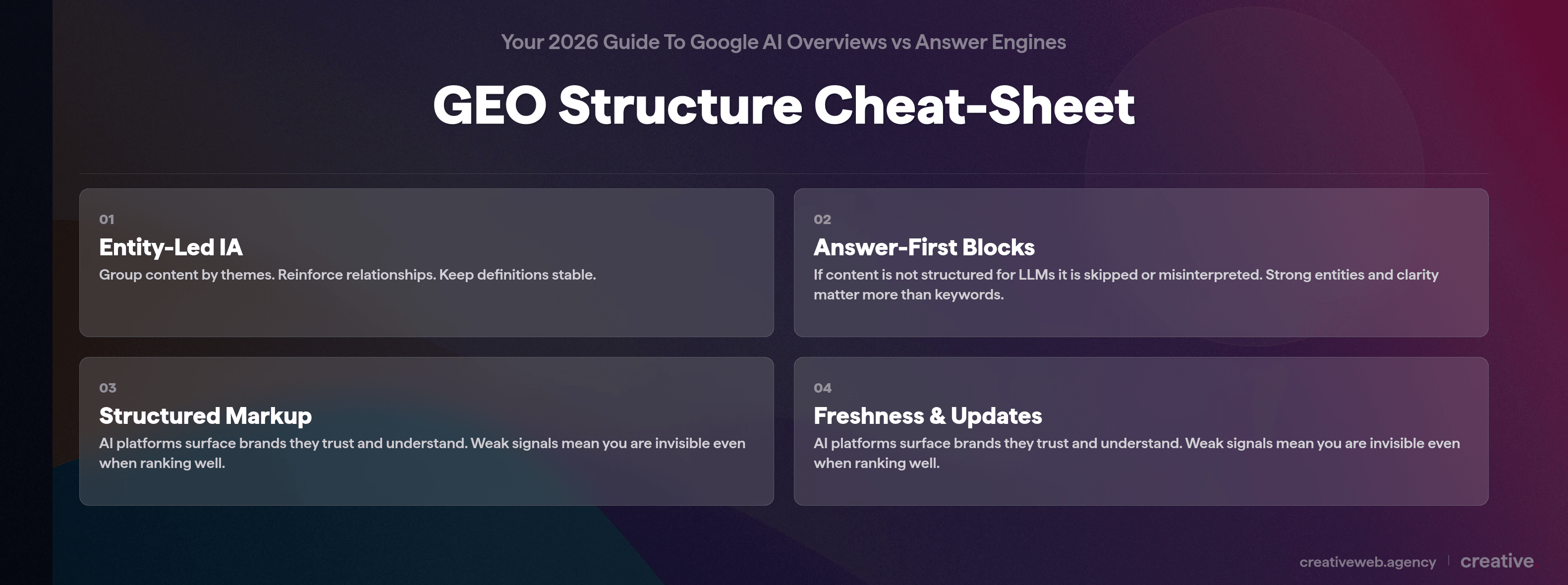
Entity-Led Information Architecture
Google’s retrieval systems work on entities and relationships rather than isolated keywords. For most teams, this means tightening the way topics are grouped across the site.
- Do: organise content around defined themes (e.g., “web design”, “SEO services”).
- Effect: AI search engines recognise clear topical boundaries, which increases the chance of your content being used as a source.
Answer-First Content Blocks
Pages that provide the key takeaway early tend to perform better in AI summaries. Your /services/ page or a pricing explainer should open with a short, factual line that answers the main question before diving deeper.
- Do: add a concise definition or statement at the top of each major section.
- Effect: AI tools can extract the precise snippet they need without misinterpreting context.
Structured Markup and Clean HTML
Tables, lists and short FAQs create predictable patterns LLMs can parse. Clean semantic tags make it easier for retrieval systems to map meaning.
- Do: add structured markup where it’s genuinely useful (e.g., FAQ schema on a help guide, Article schema on a blog).
- Effect: retrieval systems interpret the structure correctly, rather than guessing what the page is trying to say.
- It depends: not every page needs the same depth of schema; use it where it clarifies intent rather than bloating the template.
Freshness and Updates
AI Overviews and answer engines prefer current sources, especially for informational queries that change quickly. Pages that haven’t been touched in years drop out of the candidate pool.
- Do: refresh key content quarterly with new data points and refined explanations.
- Effect: the page remains eligible for selection in AI summaries that prioritise recency.
Practical Optimisation Checklist
- Add question-led H2s and H3s
- Provide a clear answer at the top of each section
- Use HTML tables for comparisons
- Add short, on-page FAQs
- Maintain consistent entity definitions across the site
This is the work that now moves a page upward in AI-powered search, reducing ambiguity and making your content the easiest option for an LLM to quote when generating an answer.
How To Track Performance in Google Search Console
It’s blunt, but true: Google Search Console doesn’t show a separate report for AI Overviews. All AI features are bundled into the standard “Web” category, including traffic influenced by AIO modules. That means anyone working in AI search has to read between the lines rather than rely on a clean, dedicated tab.
How to Infer AI Overview Impact:
- Export query data by page and look for rising impressions paired with flat or falling clicks across informational clusters.
- Flag queries with strong visibility but weak CTR, a pattern that often emerges after AIO expands in a niche.
- Group keywords that are known to trigger AI Overviews using trends from Semrush’s live dataset, then compare their behaviour to non-AIO queries.
- Track shifts over time rather than week-to-week noise; AIO impact tends to show up gradually.
Across client accounts, we see this a lot: impression graphs climb as summaries appear more often, yet session numbers barely move. That’s where newer AI visibility metrics become useful. Teams now monitor citation presence, share of voice in AI answers, and how frequently a brand is referenced across AI platforms, not just how it ranks in Google Search Console.
Examples Of AI Overviews
Imagine a page that tries to answer a broad question but hides the key point somewhere in the fourth paragraph. Most AI systems will skim it, struggle to extract the intent, and move on. Now imagine the same topic laid out with a clear question, a short answer, and a few supporting points. That version is far more likely to surface as a cited block inside AI Overviews or any modern AI platform.
You see this most clearly on pages that use structured FAQ sections. A simple “What does this include?” followed by a two-sentence reply often becomes the snippet an AI assistant reaches for. The same happens with pages that use tight comparison tables rather than abstract prose; tools can interpret patterns more reliably than they can interpret long, reflective paragraphs. SMU Libraries highlighted this behaviour when examining passage-level citations in early SGE rollouts.
Before and after examples tell the story well.
- Before: “Our platform offers a wide range of features designed to meet organisational needs across multiple touchpoints…”
- After: “What does this platform include? A core feature set covering X, Y, and Z.”
In our experience, the sites that get cited most often are the ones that make life easier for both readers and machines, not the ones trying to impress search engines with density alone.
Ready to Optimise for AI-First Visibility?
AI Overviews and answer engines now sit between your site and your audience, which means your SEO strategy has to account for how each AI search engine interprets structure, entities and clarity. Preparing for that shift isn’t optional any more; the sites that surface most often are the ones built with answer-ready blocks and dependable information architecture.
If you want your next build shaped for AI search from day one, CreativeWeb’s web design and SEO team can structure it for visibility across both traditional results and modern AI platforms.
FAQ
-
How does Google decide which sources appear in an AI overview?
-
Google selects pages that offer clear, well-structured explanations that match the intent of the query. The system favours concise definitions, stable entities, and content that it can turn into AI-generated answers without heavy rewriting. Freshness and clarity make the difference.
Did this answer your question? YesThat’s great glad we could help! Start a ProjectNoNo problem, one of our experts can give you a more in-depth answer. Ask our Experts -
What’s the difference between a search engine and an answer engine?
-
A search engine shows a ranked list of links, while an answer engine generates a direct response before presenting any sources. That shift means the model chooses what to summarise, not the user, which changes how brands are discovered.
Did this answer your question? YesThat’s great glad we could help! Start a ProjectNoNo problem, one of our experts can give you a more in-depth answer. Ask our Experts -
Will Google AI Overviews replace traditional SEO?
-
No, but they change what success looks like. Rankings still matter for retrieval, yet an AI overview can satisfy the query before a click happens. You probably don’t need to overhaul everything; prioritise informational pages that drive early-stage research.
Did this answer your question? YesThat’s great glad we could help! Start a ProjectNoNo problem, one of our experts can give you a more in-depth answer. Ask our Experts -
How do I optimise my site for answer engine optimisation?
-
Create clean, answer-ready sections with short definitions, structured headings and reliable entities. This helps an AI answer engine extract the right snippet and increases your chances of appearing in conversational results across modern platforms.
Did this answer your question? YesThat’s great glad we could help! Start a ProjectNoNo problem, one of our experts can give you a more in-depth answer. Ask our Experts -
Why do AI Overviews reduce clicks in search results?
-
Because the summary resolves the user’s intent inside the results page. When the search results already contain the explanation, there’s little incentive to visit the source. Clear structure helps ensure your page is the one being cited, not skipped.
Did this answer your question? YesThat’s great glad we could help! Start a ProjectNoNo problem, one of our experts can give you a more in-depth answer. Ask our Experts