Entity-Based SEO for AI Search (2026 Agency Playbook)


AI search has moved beyond matching keywords to scanning the entities that define who you are, what you offer, and how those elements connect.
This shift sits at the heart of any entity-based SEO for AI search agency playbook, because platforms such as Google’s AI Overviews and assistants like ChatGPT and Copilot now extract entities, relationships, schema markup, and structured HTML directly from your pages to compose answers at speed. According to Google’s 2024 Search Quality evaluation update, AI Overviews favour content with clearly defined entity relationships and well-structured schema.
For businesses, the implication is simple: traditional search engine optimisation is no longer enough. You need entity clarity across your content architecture so AI systems can recognise and reuse your material.
In this guide, you’ll learn how entity SEO works, how to structure your site around entities, where schema adds weight, and how to measure your visibility across modern AI search ecosystems.
What Is Entity SEO?
Entity SEO describes an approach where the unit of optimisation is an entity rather than a keyword. An entity is a clearly defined person, organisation, product, or concept that a system can identify without ambiguity. In practice, entity-based SEO focuses on establishing who you are, what you offer, and how those ideas connect. This is a shift from traditional keyword-led optimisation to semantic SEO, where meaning, context, and entity relationships carry more weight than phrasing alone.
Search engines and AI systems lean on structures such as Google’s Knowledge Graph to validate these connections and map related entities across the web. When your content aligns with that graph, AI can pick out entity definitions quickly and match them to user intent. This is one reason models favour material with consistent terminology, clear scope, and stable links to corroborating sources.
Entity SEO goes further by addressing how systems perform entity extraction to parse names, attributes, and relationships from structured and unstructured text. Understanding how your core topics sit alongside related entities helps strengthen those signals and increases entity authority over time.
Agencies that treat entity optimisation (and “entity optimisation” for US systems) as a structural discipline rather than an editorial add-on generally see stronger alignment with AI-led interpretation.
How AI Systems Extract and Rank Entities (AI Overviews Explained)
AI systems no longer scan pages for matching phrases. They assemble an AI overview by identifying entities, confirming their attributes, and stitching those signals together into an AI-generated answer.
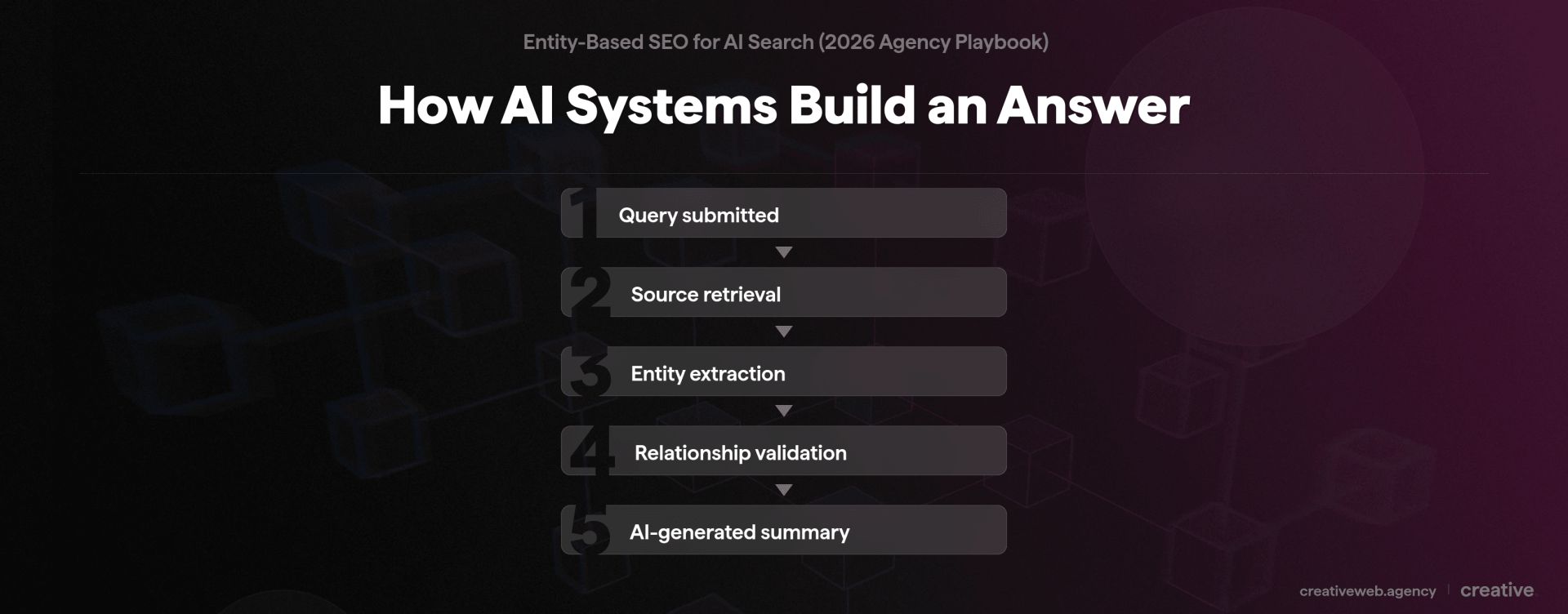
Google’s AI Overview pipeline mirrors this workflow. When someone submits a query, the system fans out the request, pulls from ranked sources, and extracts the entities and relationships needed to compose a coherent summary.
This behaviour now shows up across generative engines. ChatGPT, Gemini, and Perplexity use their own retrieval layers to:
- Locate entity definitions
- Validate those definitions against corroborating sources
- Map people, brands, and concepts into an internal knowledge structure
Those structures resemble knowledge panels and knowledge graphs. They form the backbone of any AI answers module, whether it appears inside a search result or as a standalone explanation.
AI systems also lean heavily on schema markup when verifying an organisation or service. Clean, accurate schema helps generative tools interpret who you are and how your pages relate. It reduces ambiguity and strengthens entity authority, which affects how often your site is cited.
Perplexity observed that improved entity clarity can increase citation likelihood by roughly 20% in its internal testing (2025). That pattern tracks with broader trends across AI platforms: clear signals raise confidence, and confident systems cite you more often.
How to Build a Knowledge Graph Foundation for Your Brand
If entity SEO is the framework, your knowledge graph is the scaffolding that holds every signal together. Google assembles an entity by corroborating information across your site and across trusted external sources, cross-checking names, roles, locations, and associations before deciding what appears in a knowledge panel.
That profile is strengthened by structured data and by the wider network of related entities that point back to your brand. Both pieces matter: the on-site clarity and the off-site corroboration.
This is where schema markup becomes essential. Properly implemented schema helps Google’s Knowledge Graph understand who you are, what you offer, and how your pages connect. The most useful formats for establishing clear entity definitions include:
- Organisation
- LocalBusiness
- Product
- Service
- FAQ
- HowTo
These act as machine-readable signals that strengthen entity coverage across your site and reduce ambiguity when Google validates your brand.
Consistent naming conventions, unified bios, and stable NAP details then give Google enough evidence to verify your identity across the open web. That consistency is a prerequisite for reliable entity optimisation.Local signals play a role as well. A complete Google Business Profile improves corroboration for local SEO and helps validate your entity against external references. This alignment supports stronger entity authority and increases your likelihood of appearing in AI summaries.
Checklist for strengthening your brand’s entity foundation
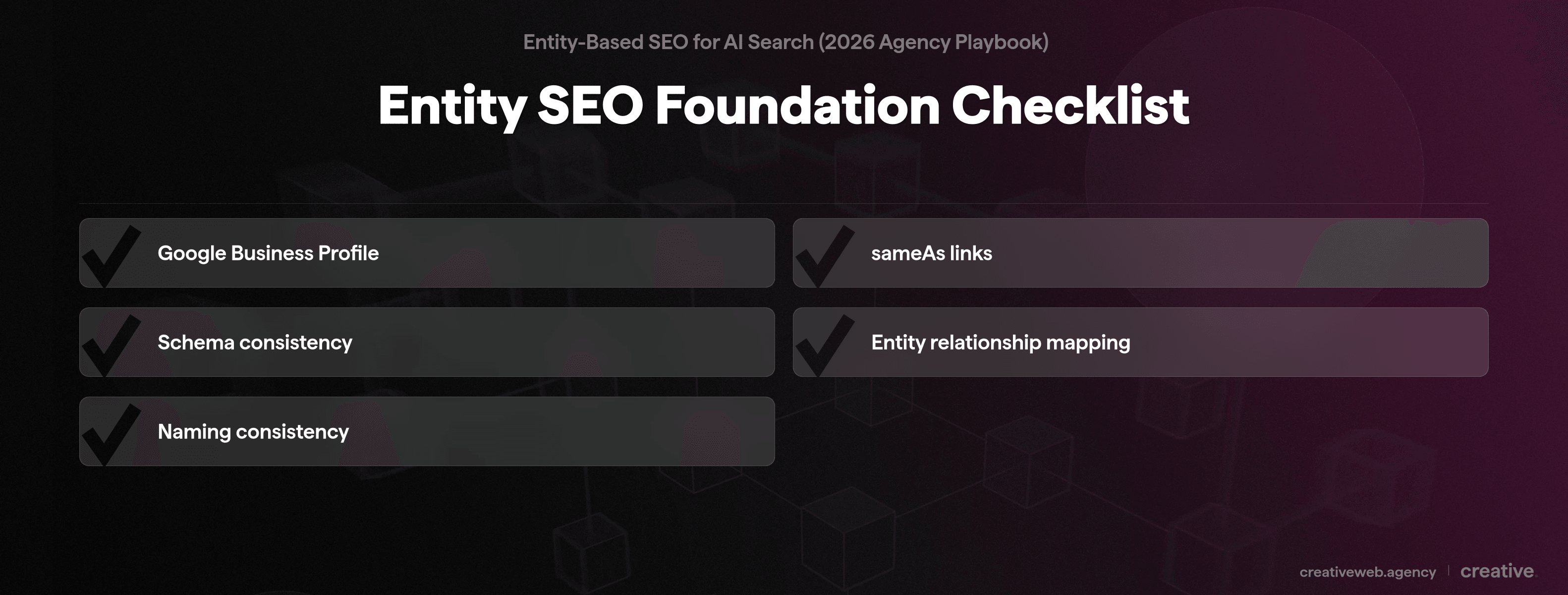
- Claim and align your Google Business Profile with accurate NAP and categories.
- Add sameAs links to authoritative profiles that support Google’s Knowledge Graph.
- Review and unify all schema across core templates.
- Map related entities to clarify product/service/location relationships.
- Maintain consistent naming across every page to avoid dilution of entity coverage.
Apply entity-based SEO with GEO
Explore how Generative Engine Optimisation (GEO) uses entities, structure, and schema to improve visibility in AI search.
Explore GEO servicesAgency Playbook: Architecting an Entity-First Website
An entity-first website demands more than tidy copy and a polished layout. It requires a structural approach that lets search engines recognise how your topics, services, and people connect. This is where technical SEO, semantic SEO, and a disciplined content strategy merge into a single framework.
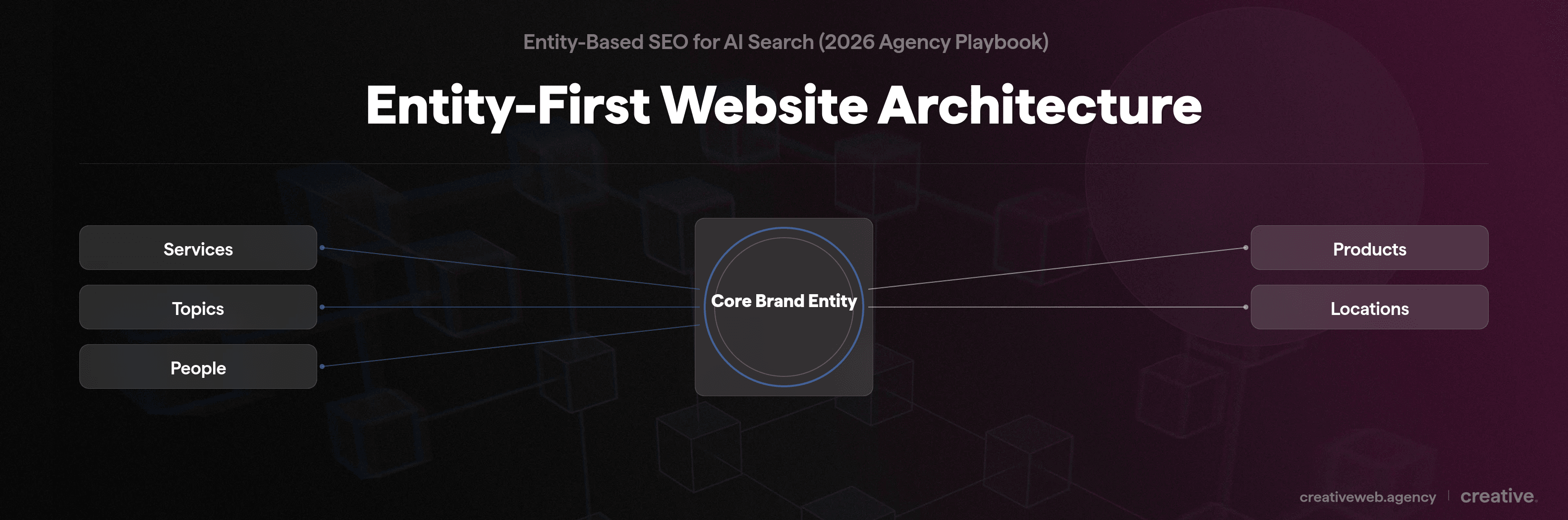
When you plan your architecture around entities rather than isolated keywords, you give AI systems a coherent map to follow. Traditional search engine optimisation was never designed to provide that level of interpretability.
A practical starting point is to map your entity clusters before any design work begins. Treat each cluster as a self-contained theme with clear relationships to the next. URL paths should mirror these groups, reinforcing hierarchy for both crawlers and AI models.
Content modules then need to be built for AI readability. That usually means:
- Short, explicit definitions
- Digestible summaries
- HTML structures that support clean information extraction
Service pages benefit from componentised Entity Summaries that spell out what the offering is, who it serves, and how it relates to the wider set of services.
Internal linking is the next lever. Links act as signals of proximity, helping search engines infer entity relationships more reliably than keyword repetition ever could.
Schema completes the picture. Embedding Organisation, Service, FAQ, and Article schema across your templates gives generative systems machine-readable context when forming their understanding of your brand.
Designing Content Modules AI Can Read
Readable content for humans isn’t always readable for AI tools. To satisfy semantic SEO principles, each module should clarify its purpose and the entity it describes. Definition boxes, FAQs, and structured lists help search engines parse meaning, while short contextual summaries ensure your intent is not lost within long-form prose.
This approach aligns with how semantic SEO prioritises concepts over exact matches, emphasising clarity around relationships rather than density. Scannable pages also support usability; a principle backed by extensive research from the Nielsen Norman Group, which shows that structured layouts consistently improve comprehension in digital environments.
A strong Entity Summary block typically includes:
- A concise definition of the service
- Its primary purpose and audience
- How it connects to adjacent services or categories
This modular consistency makes extraction easier for AI systems and strengthens your topical authority.
Internal Linking to Strengthen Entity Relationships
Internal linking is one of the simplest ways to signal meaning to search engines, yet it is often underused. When links follow the shape of your entity clusters, they reinforce how each concept relates to the next. This is how you move beyond flat navigation and build a woven semantic network across your pages.
Search engines interpret these links as evidence of relevance and hierarchy. Topic clusters, hub pages, and service-to-service links all contribute to a more coherent model of your site. Research into entity clustering underscores this point: structured, interlinked clusters increase the system’s ability to understand topical depth and relationships.
A clean internal linking strategy tends to include:
- One primary hub for each entity cluster
- Supporting pages linked both upward (to hubs) and laterally (to siblings)
- Contextual links placed where meaning is strongest, not forced at random
Validating Entities in Google Search Console
Once your structure is live, Google Search Console becomes your feedback loop. The goal is to confirm that Google interprets your site the way you intended. Look for impressions tied to entity queries, shifts in brand associations, and patterns that suggest increasing alignment between your topics and user intent.
Entity fragmentation (where Google treats similar concepts as disconnected) often shows up as inconsistent impressions or unusual query associations. If this occurs, revisit your schema, naming conventions, and internal linking to re-establish coherence.
Useful metrics to monitor include:
- Queries that reference your brand alongside core service entities
- Pages gaining traction as definitional resources
- Rising impressions for semantically related themes
How to Optimise Content for AI Search (2026 Rules)
AI search optimisation in 2026 revolves around clarity, structure, and entity prominence. Generative systems rank material by how easily they can extract definitions, relationships, and factual statements rather than how closely text mirrors a keyword. That reality rewards content built on tight explanations, consistent naming, and clean hierarchy supported by schema and well-designed internal linking patterns.
At a practical level, optimisation centres on seven principles:
- Surface the primary entity immediately. Open each page with a clear definition or summary so retrieval systems can identify what the content represents.
- Rewrite sections for extractability. Use short, declarative statements that AI tools can safely quote when producing an AI-generated answer.
- Standardise naming across the site. Consistency prevents entity fragmentation and helps semantic retrieval match the page to the user’s intent.
- Maintain predictable heading structures. AI models rely on headings to map concepts and determine section relevance.
- Strengthen factual density. HubSpot’s 2025 State of AI Content found that structured, definition-led pages were twice as likely to appear in AI answers.
- Prioritise core service pages. They handle high-intent queries and contain the clearest entity relationships, making them foundational for AI search optimisation.
- Avoid keyword stuffing. Generative systems use semantic search; redundant phrasing adds no authority.
Support these principles with structured components (short summaries, FAQ blocks, definitional modules) that map cleanly to user intent and provide unambiguous cues to AI engines.
Common Mistakes That Hurt Entity Visibility
Most visibility problems in AI search stem from structural weaknesses rather than poor writing. The same patterns recur across mid-market and enterprise websites, and they directly limit how search engines interpret entities, relationships, and authority:
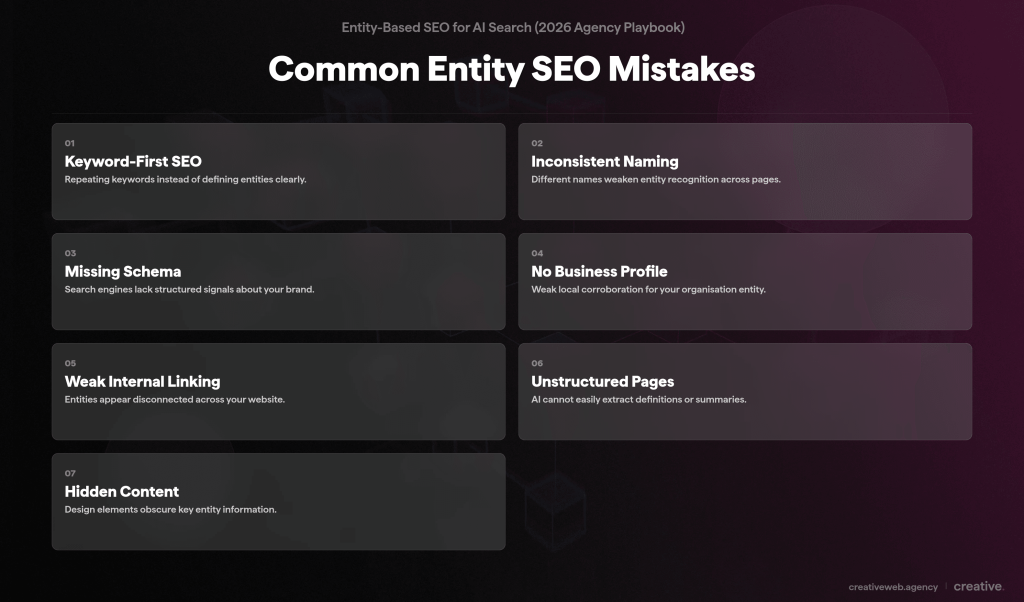
- Over-reliance on keywords instead of entities. Pages repeat phrases without defining the underlying concept or linking it to related entities, reducing semantic clarity.
- Inconsistent naming conventions. Variations in service names, brand descriptors, or staff bios cause entity fragmentation across Google’s Knowledge Graph.
- Missing or incorrect schema. Weak or mismatched schema forces engines to infer meaning rather than read explicit entity definitions.
- No Google Business Profile. Absence of GBP undermines local SEO signals and prevents stable entity corroboration.
- Fragmented internal linking. Disconnected pages prevent search engines from recognising entity relationships and topical structure.
- Overly long, unstructured service pages. AI systems struggle to extract clean summaries without definitional blocks and clear hierarchy.
- Design elements that obscure text. Carousels, accordions, or image-heavy layouts hide key entity definitions from parsers, weakening machine readability.
Ready to Build an AI-Visible, Entity-First Website?
Entity SEO has become a core requirement for visibility in AI search. Brands that organise their content around clear entities, coherent relationships, and structured design are the ones most likely to surface in AI-generated answers. This shift rewards semantic clarity, not keyword repetition. CreativeWeb builds websites and SEO strategies that follow these principles from the ground up, combining technical structure with conversion-focused design to improve your AI visibility.
Explore how our website design and SEO services can help you create an AI-ready, entity-driven digital presence built for the next era of search.
FAQ
-
What is entity-based SEO?
-
Entity-based SEO is a method of structuring content so search engines and AI systems can clearly identify the people, brands, services, and concepts on your site. Instead of relying on repeated keywords, it focuses on well-defined entities, clean relationships, and consistent signals that help models interpret who you are and what you offer.
Did this answer your question? YesThat’s great glad we could help! Start a ProjectNoNo problem, one of our experts can give you a more in-depth answer. Ask our Experts -
How does entity SEO help with AI Overviews?
-
Google AI Overviews compile responses by matching entities, schema, and corroborated facts across multiple sources. When your pages define entities clearly and connect them logically, they are more likely to be selected for AI-generated answers because the model can interpret your information with higher confidence.
Did this answer your question? YesThat’s great glad we could help! Start a ProjectNoNo problem, one of our experts can give you a more in-depth answer. Ask our Experts -
How do I use schema markup for entity optimisation?
-
Schema markup expresses entities in structured form so search engines can validate your brand, services, and related topics. Using Organisation, LocalBusiness, Product, Service, FAQ, and HowTo schema helps clarify meaning and reduces ambiguity. Valid, consistently applied schema strengthens entity recognition across Google’s systems.
Did this answer your question? YesThat’s great glad we could help! Start a ProjectNoNo problem, one of our experts can give you a more in-depth answer. Ask our Experts -
What is a knowledge graph in SEO?
-
A knowledge graph is a structured network of entities and their relationships. Google’s Knowledge Graph contains billions of facts about people, organisations, and concepts. When your content aligns with that structure, AI tools can interpret it more easily and link it to authoritative sources.
Did this answer your question? YesThat’s great glad we could help! Start a ProjectNoNo problem, one of our experts can give you a more in-depth answer. Ask our Experts -
How do AI systems extract entities?
-
AI systems identify entities by analysing patterns in your HTML, headings, schema, and contextual cues. They cluster related terms, validate them against external sources, and map them into a broader graph of known relationships. Clear, explicit definitions increase the odds of accurate extraction
Did this answer your question? YesThat’s great glad we could help! Start a ProjectNoNo problem, one of our experts can give you a more in-depth answer. Ask our Experts -
What affects entity authority?
-
Entity authority grows when multiple trustworthy sources present consistent information about your brand. Elements such as structured data, factual accuracy, external corroboration, Google Business Profile completeness, and strong internal linking all contribute. Authority rises when search engines can verify your entity across several high-quality references.
Did this answer your question? YesThat’s great glad we could help! Start a ProjectNoNo problem, one of our experts can give you a more in-depth answer. Ask our Experts -
How do I build entity relationships on my website?
-
You build relationships by grouping related topics into clusters, linking them in predictable patterns, and reinforcing meaning with schema. Service pages, glossary entries, FAQs, and case studies all help AI systems understand how your core subjects relate to one another. Consistency across these assets matters more than volume.
Did this answer your question? YesThat’s great glad we could help! Start a ProjectNoNo problem, one of our experts can give you a more in-depth answer. Ask our Experts -
Does entity SEO replace traditional SEO?
-
No. Technical SEO, content quality, backlinks, and performance still matter. Entity SEO adds a structural layer that makes your information interpretable for both search engines and generative AI. Think of it as extending traditional search engine optimisation rather than replacing it.
Did this answer your question? YesThat’s great glad we could help! Start a ProjectNoNo problem, one of our experts can give you a more in-depth answer. Ask our Experts -
What tools can I use to check entity coverage?
-
Specialist tools such as InLinks, Schema App, and Ryte can analyse entity coverage and schema performance. Platforms like Ahrefs and Semrush also show how well content maps to recognised topics. These tools surface gaps in definitions, relationships, and corroboration so you can strengthen your entity footprint.
Did this answer your question? YesThat’s great glad we could help! Start a ProjectNoNo problem, one of our experts can give you a more in-depth answer. Ask our Experts -
How does CreativeWeb implement entity SEO?
-
We design websites and content systems around entity clarity from the start. That includes structured templates, schema-ready modules, topic clusters, and internal linking models that support AI interpretation. Our approach blends technical SEO, semantic SEO, and conversion-led design so brands surface consistently across Google, AI Overviews, and generative AI assistants.
Did this answer your question? YesThat’s great glad we could help! Start a ProjectNoNo problem, one of our experts can give you a more in-depth answer. Ask our Experts