The Real Cost of a Website in 2026: What Drives Prices Up or Down


Asking what a website costs in 2026 is similar to asking how long a piece of string is. It all depends on what you need.
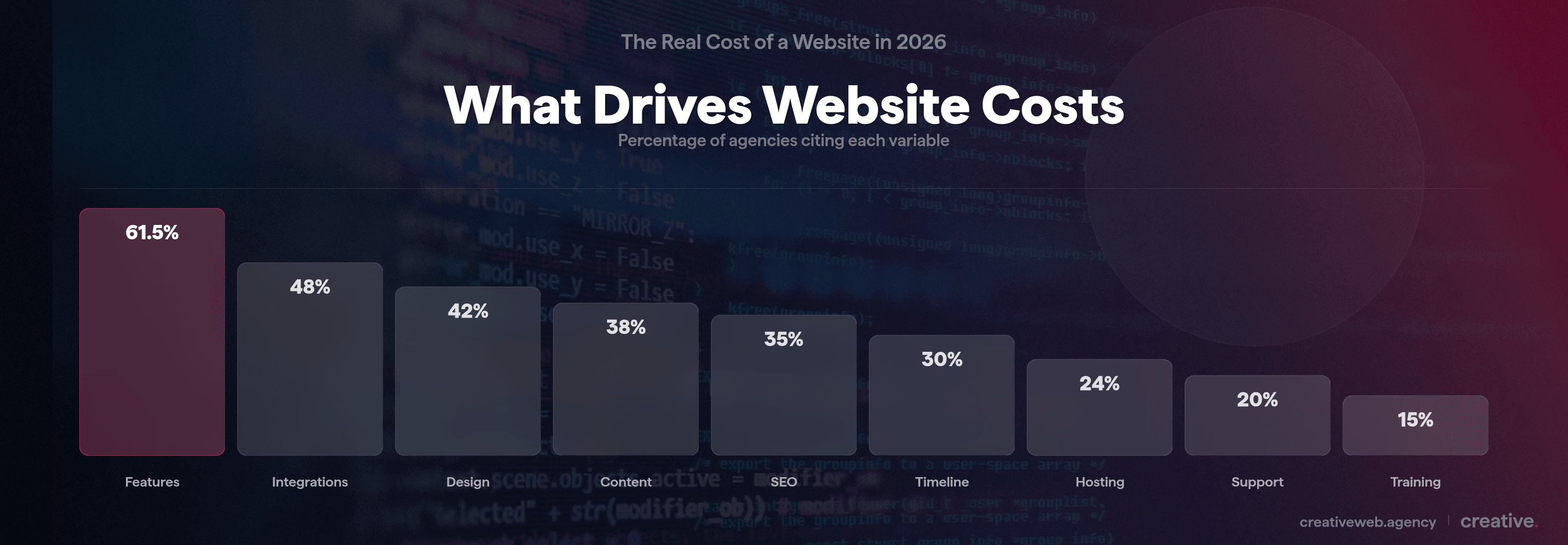
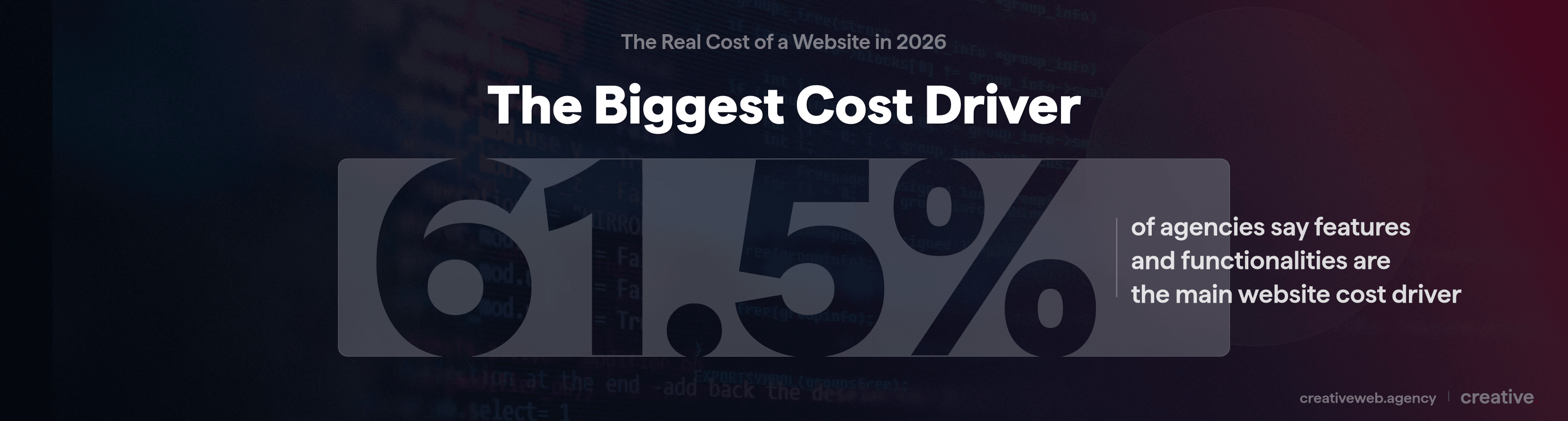
For example, if you want to connect it to a customer portal, CRM, or an email newsletter, you’ll need a bigger budget. Basically, the more moving parts involved, the more development time is needed. In fact, a survey completed among over 200 web design agencies found that 61.5% of the time, features and functionalities are the main .
Source:
That said, some features are crucial to ensure flawless technical functionality. If you cut these to save money, it could end up costing you more in the long run. To help you understand how your web design decisions can affect the pricing, here’s an overview of the key factors that impact cost.
9 Main Variables Impacting Website Cost
CMS choice
Your content management system (CMS) will impact your upfront build costs, but also maintenance and scalability. For example, an open-source platform like WordPress is essentially free. However, you’ll likely require plugins, security upgrades, and performance optimisation which become an ongoing expense you’ll need to cover.
At CreativeWeb, we specialise in enterprise WordPress CMS. We’ll recommend going this route, because it offers excellent flexibility and scalability as well as many SEO tools (like Yoast SEO) to ensure better SEO performance.
On the other hand, with popular solutions like Webflow or Contentful, you’ll have to budget for monthly subscription fees. That said, you’ll save on custom development and the more customisation a CMS needs to match your workflow and needs, the more time will be needed for web development.
An intuitive CMS can also lower your website cost in the long run and improve your marketing efforts. If it’s easy for the rest of your team to publish, update, and manage content, your website will stay relevant and you won’t have to budget for extra support or struggle with slower content updates.
Source:
When you’re working with a website design agency, CMS training and technical support might be included, a value-added service not to be taken lightly. If not, training your employees to use the website after launch will become an added expense you’ll need to include in your budget.
Integrations
While integrations work invisibly in the background, their impact on website design cost doesn’t go unnoticed. Out-of-the-box integrations require little customisation and will add minimal cost. However, as soon as integrations need to handle complex workflows or large data volumes, the costs rise.
The benefit of integrations is that you can connect it with business systems like your email marketing software, accounting software, sales tools, or CRM. This can streamline operations and provide valuable customer data, which, in return, can help you drive revenue more efficiently through your website.
For example, e-commerce websites that leverage CRM integration, can connect website behaviour with purchase history to personalise the content. This way, their calls to action and messaging become more relevant which will boost conversions.
Content volume
The number of web pages, copy, media, and other assets your website needs is also a consideration. More content almost always means more work.
If you have fewer pages, you can often reuse design templates. However, if you have dozens of pages, matters like navigation, internal linking, and just overall consistency becomes more challenging and fast.
Plus, there’s the actual content creation process to consider. Creating a large volume of website copy is time-consuming. Even if you use AI tools, you’ll need human help to edit it.
Source:
Design complexity
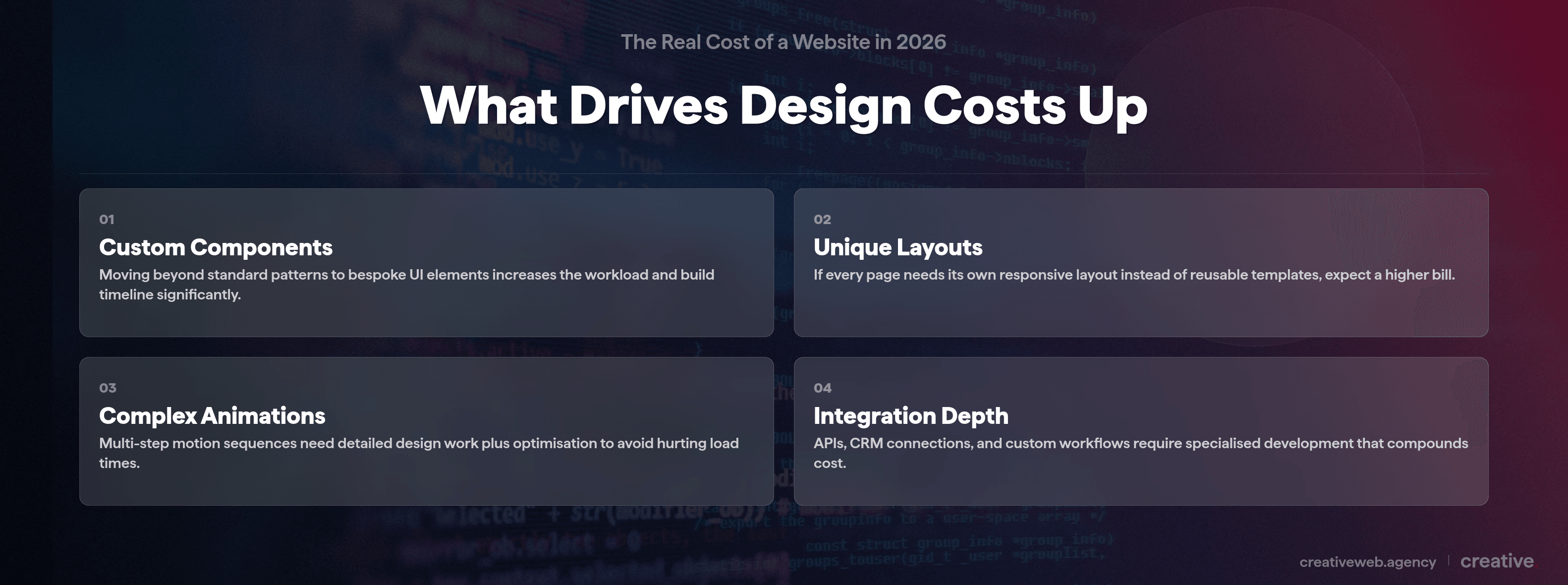
Two websites might look similar, but their costs can be widely different. That’s because their level of design complexity, hidden to the untrained eye, can increase the workload and timeline.
Find Out What Your Website Would Cost
Get a quick estimate based on your specific requirements with our cost calculator.
Try the Cost CalculatorAs soon as your web design moves away from standard patterns to custom components, it will be reflected in the bill. You can keep the cost down and still receive a beautiful, functional website by using a few repeatable design templates. However, if each page needs to have a unique responsive layout, the cost will go up.
Technical SEO
When you’re designing your website, you should design for visibility too. By treating technical SEO as a necessary expense, your website will appear higher in the search engines (maybe even on the first page) which is a sure way to increase its traffic volume.
As technical SEO focuses on aspects like site structure, responsive design, security implementation, and mobile optimisation, it makes sense to address it during the initial web design instead of an add-on during a website redesign. That said, it’s important to understand that it isn’t a one-time task. It requires ongoing monitoring and adjustments to stay aligned with evolving and ensure any new content uploaded since launch won’t slow down the site speed.
Get a free SEO check
Animations
While your website’s functionality doesn’t depend on animations (like in the case of integrations, for instance), they’re still a good investment. Subtle transitions and can offer real value. They make the user experience more engaging, help guide users, and improve the overall usability.
As with other aspects of website design, animation costs depend heavily on the level of complexity. For example, simple micro-animations like button transitions are relatively quick to design. However, more advanced animations like multi-step motion sequences require detailed design work and additional optimisation to ensure they don’t slow down the load times. That’s why the can be over £100 per hour — three times the average rate charged for simple graphic design projects.
Conversion rate optimisation (CRO)
Website design costs usually concentrate on design and development. However, investing in a service like conversion rate optimisation (CRO) from the outset will improve the value your website ultimately delivers. A small improvement in conversion rates can, for example, lower the cost per lead and make your digital marketing efforts more effective which can offset the cost.
Essentially, you’ll be paying for research, strategy, and analysis. This includes activities like user journey mapping, analysing heatmaps and user behaviour, and A/B testing. It also requires continuous work such as post-launch testing and reporting which typically happen monthly or quarterly.
Aside from paying for the CRO specialists’ expertise, the cost can also be driven up by third-party tools. CRO often relies on analytics platforms and testing software which can also introduce ongoing subscription costs.
Hosting
The type of hosting you choose has a direct impact on cost as well as performance. For example, while shared hosting is a budget-friendly route, you could experience slow site speed and expensive disruptions.
Your hosting choice will also affect your security, an area on which you don’t want to skimp. At the minimum, you’ll need an SSL certificate to encrypt data and keep sensitive details safe. For e-commerce websites, this is a must.
A popular option is to invest in . When you go this route, the contract could have a minimum term, introducing another recurring cost you’ll need to keep in mind. For example, we charge no setup fees if you want to move your website to our hosting, but you’ll have to sign a minimum 12-month contract.
Website maintenance
What happens after launch can also have a significant impact on the website cost. Instead of seeing it as an optional expense, view it as an ongoing investment. From software updates to security patches to bug fixes to backups, the scope of maintenance can cover various critical services needed to ensure smooth performance and reliable security.
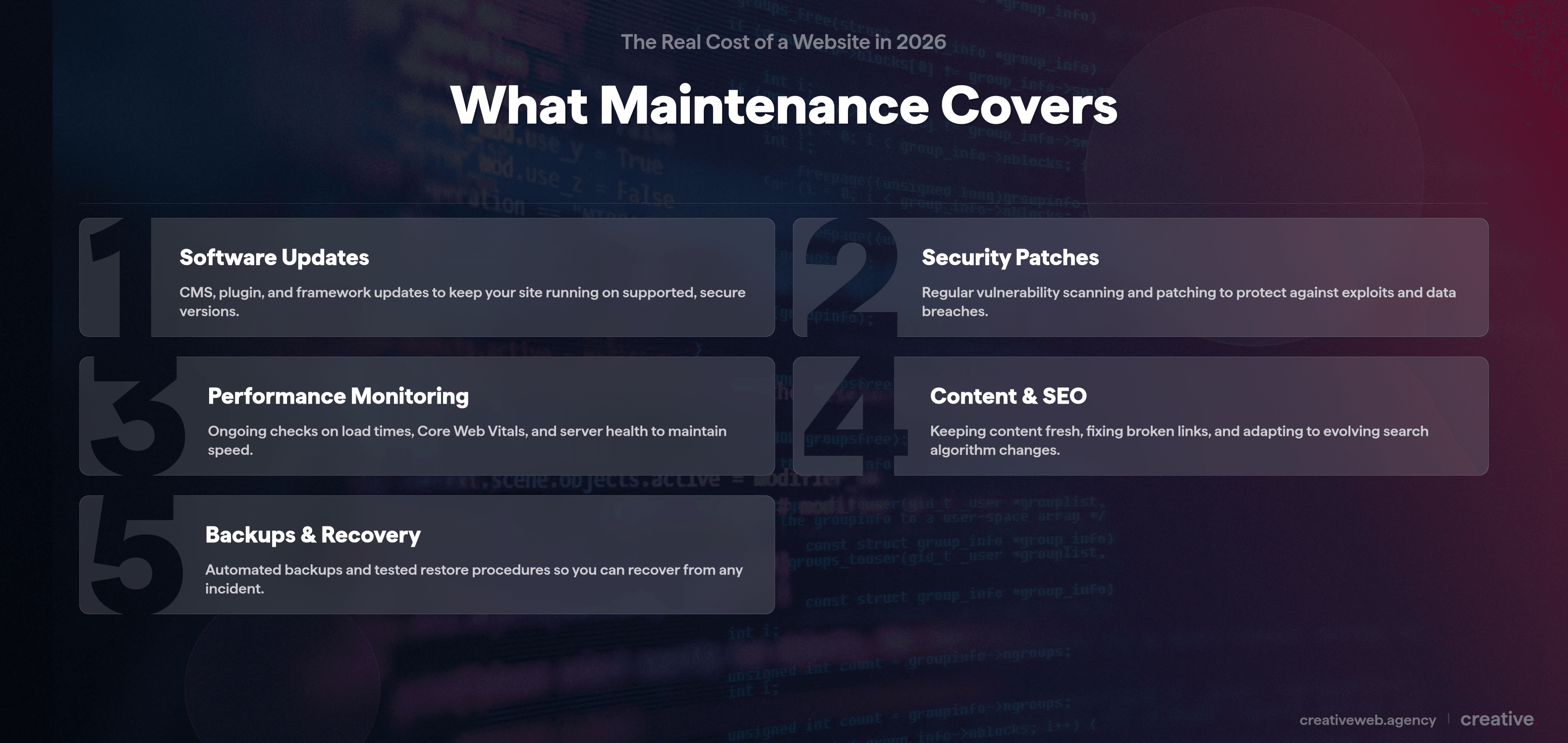
Yes, it’s a recurring cost, but it will save you money over time. Regularly updating your website will prevent major issues. What’s more, it can extend the lifespan of your website. If you neglect maintenance, it can make future changes more costly.
What you’ll end up paying will greatly be impacted by the complexity of your website. A simple portfolio website with static content, for example, will need less maintenance than a complex custom website with multiple features and integrations.
Source:
To illustrate this, you can take a look at our maintenance plans. For personal sites like portfolios and websites for small businesses, we’ve created our maintenance plans to include monthly CMS and plugin updates, while for large, high-traffic sites the frequency changes to weekly.
Still unsure? Use our
FAQ
-
What are common hidden costs when building a website that businesses often overlook?
-
Businesses typically fall into the trap of seeing only the upfront design and web development expenses and often overlook costs linked to training, content creation, technical SEO, and necessary third-party tools like payment gateways. Then, ongoing costs like security plugins, hosting, and subscriptions are also often forgotten.
Did this answer your question? YesThat’s great glad we could help! Start a ProjectNoNo problem, one of our experts can give you a more in-depth answer. Ask our Experts -
How can businesses reduce website costs without compromising quality?
-
To lower your website costs, avoid adding unnecessary complexity. Start with a clear strategy and the core functionality needed to support your main goals. Then, select a CMS and integrations that match your team’s skills.
Did this answer your question? YesThat’s great glad we could help! Start a ProjectNoNo problem, one of our experts can give you a more in-depth answer. Ask our Experts -
What is the average cost of creating a website?
-
Web development costs vary significantly, making it hard to give an average cost. You can expect to pay anything from £10,000 to over £120,000. If your website needs complex functionality and a high degree of customisation, the higher the price will be.
Did this answer your question? YesThat’s great glad we could help! Start a ProjectNoNo problem, one of our experts can give you a more in-depth answer. Ask our Experts -
What are the cons of using a website builder?
-
While using a website builder is cheaper than hiring a professional web designer, you might not get the exact design you have in mind. Designing your website can also become time-consuming if you don’t use a website builder often.
Did this answer your question? YesThat’s great glad we could help! Start a ProjectNoNo problem, one of our experts can give you a more in-depth answer. Ask our Experts