Introduction
Website design budgeting for SMEs in 2026 has become a small business headache: five quotes on the table, none alike, and every scope hiding a surprise. Most marketing leaders and finance teams enter budget planning with clear business goals, yet discover the numbers don’t quite line up with the strategy they’re trying to execute.
That tension pulls people into this topic every year. The truth is simple enough: website budgeting feels opaque because scopes vary, pricing models swing wildly, and hidden costs stack up in the background like a bad game of Tetris. This guide breaks it down so you can plan with confidence instead of guesswork.
Why Website Budgeting Matters More For SMEs in 2026
Most SMEs arrive at website planning with a number in mind but no scope behind it, which is exactly why website design budgeting for SMEs in 2026 matters more than it ever has. The website now sits at the centre of a small business’s marketing strategy, not as decoration but as infrastructure. When the site underperforms, every campaign built on top of it underperforms too.
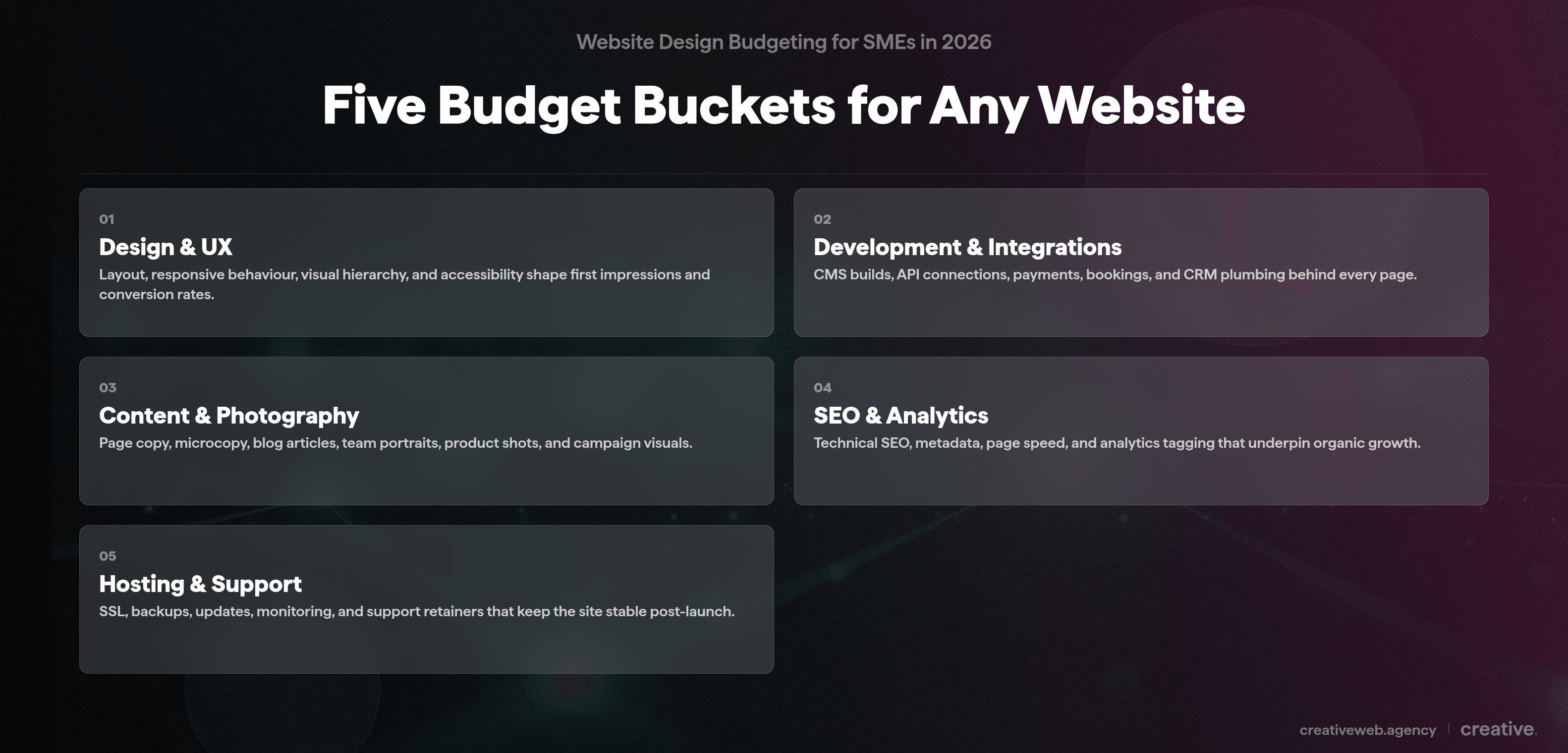
At its simplest, website budgeting covers five moving parts:
Design and web design foundations. Layouts, UX decisions, responsive behaviour, accessibility, and the overall feel that shapes customer experience.
Web development and technical setup. Templates, bespoke builds, integrations, forms, and anything that ties the site into wider operations.
Content creation and photography. Page copy, UX microcopy, product shots, team imagery (usually the most overlooked line in the budget).
. Site structure, metadata, speed performance, and the baseline required for a sustainable digital presence.
Hosting, security, and ongoing support. The recurring operational costs keep website traffic steady rather than volatile.
For context, UK small business websites built professionally in 2025 typically ranged from , with ongoing costs stacked on top. Many SMEs also rely on their website to fuel content marketing, social media marketing, email marketing, and digital advertising, which means the site isn’t a standalone spend; it’s the engine behind their marketing investment.
Treating a website as a one-off build breaks the economics. It distorts customer acquisition cost, disrupts sustainable growth plans, and leaves teams firefighting instead of moving towards long-term business goals.
What Actually Goes Into a Website Budget
A website budget isn’t one number. It’s five buckets with very different behaviours, and most of the friction in small business projects comes from treating them as one. Once you split them out, your budget planning becomes clearer, and your team stops arguing about why the numbers changed mid-project. Here’s how each part works in practice.
Design and User Experience
Most clients assume web design is colours and spacing until they see the mobile prototype and realise user experience carries the weight of first impressions. Design covers layout, responsive behaviour, visual hierarchy, and accessibility-minded user experience, all of which shape customer experience long before anyone reads a line of copy.
Strong UX does three things for an SME:
Improves conversion rate
Builds perceived trust
Makes the feel competent even on a tight budget
More complex user journeys (interactive sections, subtle animations, personalised flows for sectors like financial services or businesses with knotty supply chain management) push costs up because they take time to test and refine. Design is strategy as much as aesthetics, and it influences sustainability, long-term web design quality, and overall performance.
Development and Integrations
Development is where the invisible work lives: templates vs bespoke builds, CMS configuration, forms, API connections, payments, bookings, CRMs; the plumbing behind the page. A booking tool looks simple until you connect availability, confirmation emails, and payment logic. Suddenly, you’re knee-deep in web development rather than “just adding a feature.”
Integrations for marketing channels (email platforms, analytics suites, social media embeds) expand the scope again. SMEs in financial services or logistics often need deeper integrations, which add developer hours and force your strategy to adapt. These edges of the build are where the marketing effort and budget start to stretch.
Content Creation and Photography
This is the hidden cost almost every small business underestimates. Someone will say, “We’ve got some copy somewhere” – they don’t. Content creation includes page copy, UX microcopy, blog articles, recent posts and related post modules, and even scripts for short videos. Then there’s photography: team portraits, product shots, site imagery, and campaign visuals.
Without it, the whole marketing campaign stalls. You can’t run content marketing, you can’t meaningfully influence a marketing dollar, and you can’t launch a marketing campaign with the depth needed for conversion. It’s the budget line that grows silently until you face it.
SEO, Analytics, and Performance
Technical SEO, Google Analytics tagging, site structure, metadata, and page speed optimisation sit at the foundation of your digital marketing. Neglect SEO early and you’ll buy traffic later. Underfunding these areas inflates customer acquisition cost across every channel and erodes your marketing investment because each click becomes less efficient.
Even a basic setup affects digital advertising performance, email segmentation accuracy, and how answer engines and AI systems interpret your content. The more your strategy leans on organic growth, the more this bucket matters.
Hosting, Security, and Ongoing Support
This is where operational costs live: hosting, SSL, backups, updates, and support retainers. Hosting spikes when website traffic grows (or when plugins misbehave), and support tickets always arrive the week after launch. These aren’t IT afterthoughts. They’re part of your 2026 marketing budget and financial planning, because they keep the site stable enough to support campaigns.
Typical SME ranges run from basic through to managed WordPress environments, with maintenance covering updates, monitoring, fixes, and incremental improvements. Done properly, this is the bucket that protects sustainable growth rather than draining it later.
How Your Website Fits Into the 2026 Marketing Budget
Finance wants predictability; marketing wants flexibility. That tension shows up every time an SME tries to plan its marketing budget for the year, and the website is usually the battleground because nobody can quite decide whether it’s an operational cost, a marketing investment, or a one-off project. In reality, it’s all three, and the sooner teams accept that, the calmer the planning process becomes.
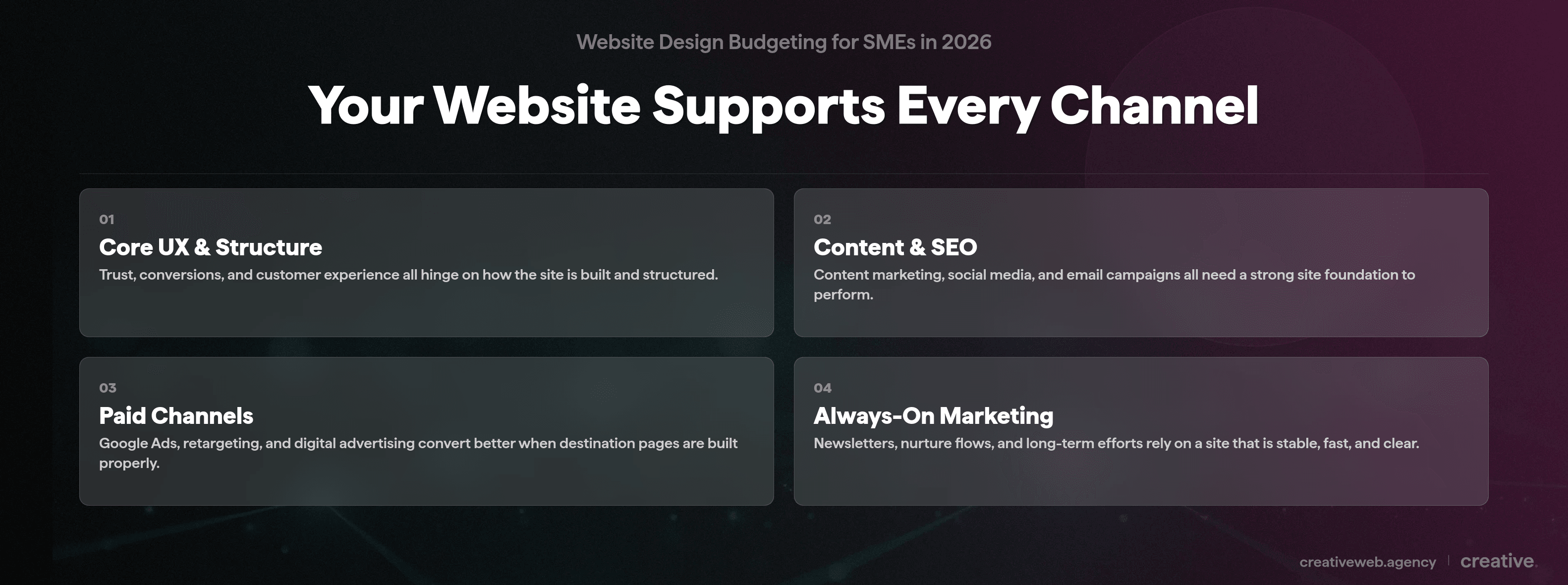
A website underpins every major digital marketing activity. When marketing leaders talk about marketing spend or refining their marketing strategy, they’re really relying on the site to pull its weight across:
Core UX and structure. Parts that shape trust, conversions, and customer experience.
Content creation for SEO and campaigns. Fuel behind content marketing, social media marketing, and email marketing.
Paid channels. Digital advertising, Google Ads, retargeting, and even influencer marketing all convert better when the destination pages are built properly.
Always-on marketing channels. Newsletters, nurture flows, and long-term marketing efforts rely on a site that’s stable, fast, and clear.
A useful way to think about marketing budget allocation is to treat the website as infrastructure rather than a campaign. Campaigns come and go; your website has to support every marketing channel simultaneously. Businesses with strong growth goals usually ring-fence a set percentage of their 2026 marketing budget for the site (both the build and ongoing improvements) because it increases ROI across every channel.
Agreeing this early with the finance team helps enormously. It avoids procurement delays, supports change management throughout the year, and creates a shared understanding of what marketing investment actually means in a small business context. Done well, the website becomes the multiplier, not the mystery line on a spreadsheet.
Plan Your Website Budget
Use our cost calculator to build a realistic budget based on what your business actually needs.
Try the Cost CalculatorTypical Website Budget Ranges for UK SMEs in 2026
For a UK small business, a professionally designed website typically sits between £2,000 and £8,000, with higher ranges for complex, , or integration-heavy builds. Those numbers aren’t arbitrary; they reflect the real operational costs, the depth of website design work involved, and the marketing investment needed to support sustainable growth.
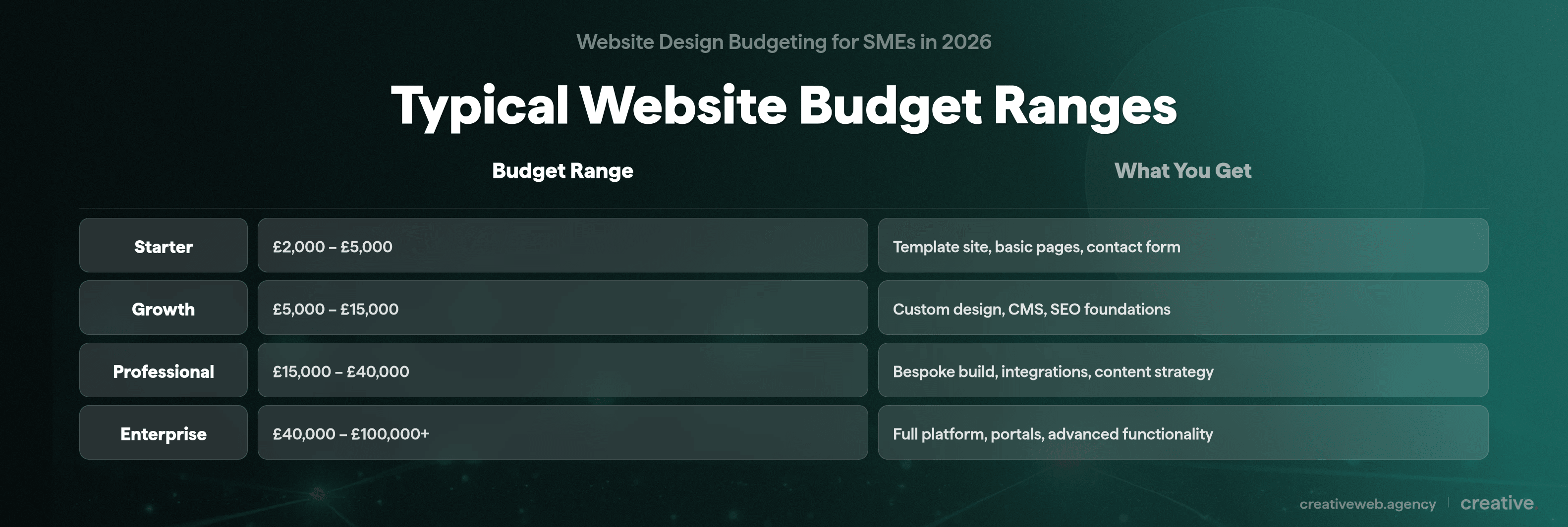
These are the three ranges most SMEs fall into.
Lean Starter Site For Early-Stage SMEs
This is the build that replaces an outdated Wix site or a five-year-old WordPress template. Expect 5–10 pages, a clear structure, basic UX, and modest customisation of a framework. It’s enough to establish a credible digital presence without stretching the budget.
Budget: roughly £2,000–£4,000
Suitable for: very early-stage businesses with light marketing campaign needs
Trade-offs: fewer custom modules, minimal content creation, and limited integrations
It’s a practical choice for a small business trying to get moving without locking itself into operational costs it can’t yet support.
Growth-Focused SME Website
This is where most established SMEs land. At this point, teams finally start investing in structured content, cleaner UX, and a site that supports real marketing strategy rather than “just being live.”
Typical features include:
10–25 pages
Custom layouts
Blog structure with recent posts and related posts
Lead funnels and light automations
CRM or email platform integrations
Budget: typically £4,000–£8,000+
Suitable for: organisations with firm growth goals and ongoing marketing activity
This range supports sustainable growth because it gives marketers the tools they need to drive website traffic and conversions.
When Ecommerce or Complex Features Push The Budget Higher
Costs escalate quickly once you add Ecommerce, memberships, multi-language structures, or any feature tied to complex supply chain management. Inventory sync or shipping rules are where budgets blow up. Always.
Budget: often £5,000–£50,000+ (depending on integrations, volume, and complexity)
Suitable for: SMEs with operational systems to link, or businesses with serious marketing investment and automation needs
At this level, website design becomes part of your operational costs and marketing investment, not a standalone project. The site is intertwined with sales, fulfilment, and long-term customer experience, so the budget reflects that reality.
Building a Website Budget Plan That Stays Under Control
Budgets usually fail when teams add features mid-build with no extra time, no extra budget, and no shared strategy. A budget plan that actually holds takes discipline, not spreadsheets. Here’s the framework that keeps SME projects steady.
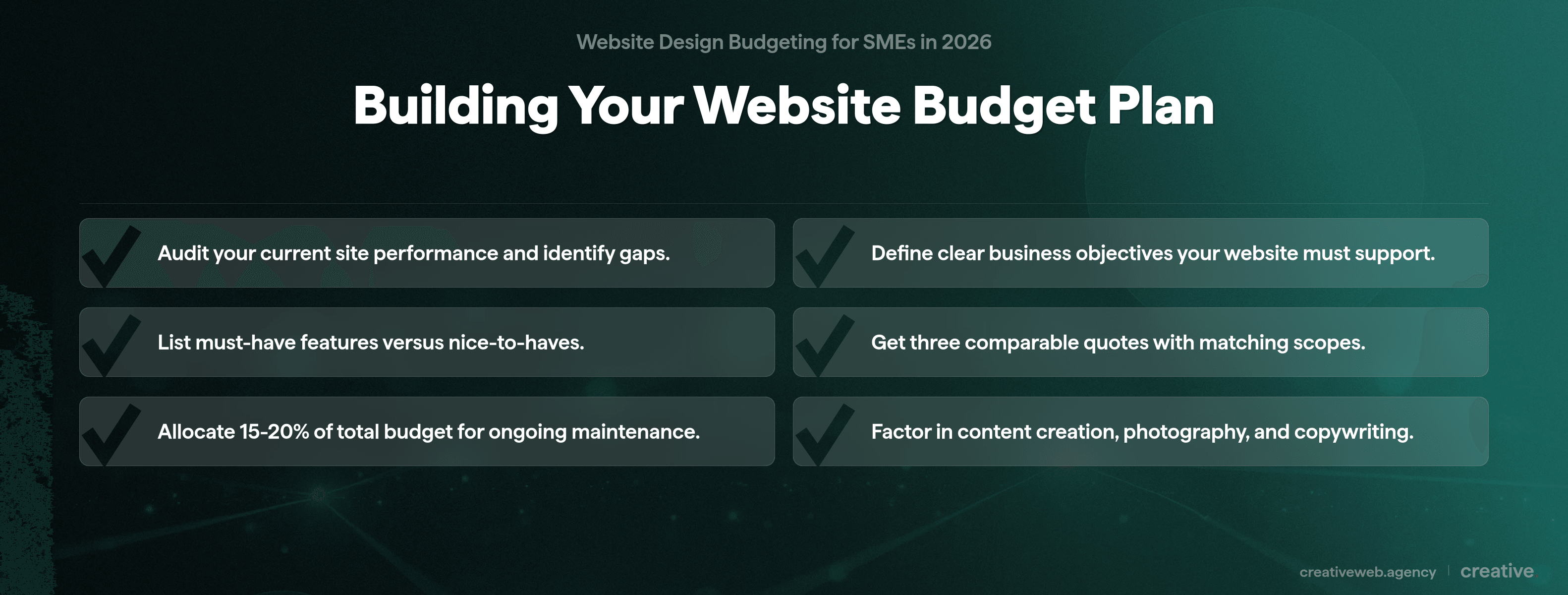
Start by clarifying business goals and growth goals. The site must support what the business is trying to achieve; whether that’s lead generation, sales enablement, recruitment, or reducing customer service load. If the goals are vague, the budget will be too.
Next, align the marketing leaders, marketers, and the finance team on scope. Agree the must-have features for phase one, then push everything else into later phases. Wish lists eat budget planning alive, especially when departments pull in different directions.
A simple way to structure the numbers is to split costs across 2–3 years, separating one-off spend from recurring operational costs. Many SMEs use a version of the 60–20–20 allocation (development, design/UX, content and project management), then adjust it based on their own marketing investment and financial planning.
Add a realistic contingency () because unknowns always surface: third-party tools change pricing, requirements evolve, or the business decides to tweak its strategy halfway through. Contingency isn’t padding; it’s protection.
Finally, review the budget quarterly as part of your marketing review. Look at Google Analytics and campaign data, check whether the site is proving to be a strong acquisition driver, and reallocate marketing spend if something is outperforming expectations.
The point of a controlled budget isn’t rigidity; it’s the ability to adapt without derailing momentum or inflating customer acquisition cost.
Run The Numbers With The Creativeweb Website Cost Calculator
The is the quickest way for a small business to sanity-check its budgeting assumptions. Most SMEs only see the real scope once the tool forces them to itemise pages, features, and integrations; something that usually clarifies the budget planning conversation more than any other meeting ever will.
It’s straightforward to use alongside your finance team. You plug in:
Project scope
Page count
Needed features or integrations
The calculator then gives an initial estimate you can compare against likely operational costs such as hosting, support, and future improvements. That contrast helps with financial planning, because it shows the difference between one-off spend and ongoing marketing investment.
Use the calculator while drafting your 2026 marketing budget, especially if you want to understand how the website sits next to other marketing channels or planned campaigns. It keeps expectations realistic and stops the budget from drifting later.
Next Steps For Planning Your 2026 Website Budget
The final step in website design budgeting for SMEs in 2026 is turning the numbers into a repeatable habit rather than a one-off task. Three pillars keep most projects stable: treat the website as part of your 2026 marketing budget and growth plan, budget for hidden and operational costs early, and refine your assumptions using real performance data over time. Reviewing quarterly catches small overruns before they become headaches.
If you want a clearer picture of how to turn numbers into a workable plan, is built around long-term structure rather than one-off launches. It gives SMEs a practical way to align budget planning, marketing budget priorities, and ongoing improvements. It’s a grounded route to sensible marketing investment and genuinely sustainable growth.
FAQs: Website Design Budgeting For SMEs In 2026
How much should a small business budget for a website in 2026?
Most UK small business sites fall between £2,000 and £8,000, depending on scope, user experience, the depth of website design, and required web development. In practice, ongoing operational costs push the real number higher, which is why website design budgeting for SMEs in 2026 needs a clear scope from day one.
What hidden costs do SMEs miss when budgeting for web design?
The big hidden costs are almost always content creation, custom photography, premium plugins, hosting, accessibility updates, and ongoing support. Most SMEs only realise the total operational costs once campaigns begin and content needs refreshing.
How does website spend fit into a 2026 marketing budget?
Treat the website as a core part of your marketing budget, not a standalone line. Many SMEs ring-fence a portion of their marketing budget allocation for site improvements because strong pages improve ROI across marketing channels, marketing strategy, and wider marketing spend.
How do I align website budgeting with my finance team?
Split one-off build costs from recurring spend, fold both into financial planning, and show how the site influences customer acquisition cost and sustainable growth. Finance teams usually support numbers they can predict.
How often should SMEs review their website budget?
A yearly review works, with quarterly check-ins tied to campaigns, product changes, or broader change management needs. Most SMEs adjust more frequently when marketing intensity increases.
What’s the difference between cheap and strategic website design for SMEs?
Cheap builds focus on launch; strategic ones focus on long-term marketing investment, better UX, and reliable support. The results diverge quickly.
FAQ
-
How much should a small business budget for a website in 2026?
-
Most UK small business sites fall between u00a32,000 and u00a38,000, depending on scope, user experience, the depth of website design, and required web development.
Did this answer your question? YesThat’s great glad we could help! Start a ProjectNoNo problem, one of our experts can give you a more in-depth answer. Ask our Experts -
What hidden costs do SMEs miss when budgeting for web design?
-
The big hidden costs are almost always content creation, custom photography, premium plugins, hosting, accessibility updates, and ongoing support.
Did this answer your question? YesThat’s great glad we could help! Start a ProjectNoNo problem, one of our experts can give you a more in-depth answer. Ask our Experts -
How does website spend fit into a 2026 marketing budget?
-
Treat the website as infrastructure, not a campaign. Ring-fence a set percentage of your marketing budget for the site build and ongoing improvements.
Did this answer your question? YesThat’s great glad we could help! Start a ProjectNoNo problem, one of our experts can give you a more in-depth answer. Ask our Experts -
Should I pay for a template or custom website?
-
Templates suit tight budgets and simple sites. Custom builds are better for businesses with growth goals, complex integrations, or serious SEO requirements.
Did this answer your question? YesThat’s great glad we could help! Start a ProjectNoNo problem, one of our experts can give you a more in-depth answer. Ask our Experts -
How much should I set aside for ongoing website costs?
-
Budget 15-20% of your initial build cost annually for hosting, security, updates, content refreshes, and technical maintenance.
Did this answer your question? YesThat’s great glad we could help! Start a ProjectNoNo problem, one of our experts can give you a more in-depth answer. Ask our Experts