Google Ads Campaign Management in 2026: How Copy, Targeting, and Performance Fit Together


There’s no shortage of articles about Google Ads. Most of them walk you through creating an account, picking some keywords, and writing a few headlines.
Then they stop.
The bit they skip is the bit that actually matters: how all those pieces connect. Your ad copy quality affects your Quality Score. Your Quality Score affects what you pay per click. What you pay per click determines how far your budget stretches.
And how far your budget stretches dictates whether your targeting can actually reach enough of the right people.
We run Google Ads campaigns for UK businesses (solicitors, tradespeople, e-commerce, B2B services). The accounts that perform well aren’t the ones with the biggest budgets. They’re the ones where copy, targeting, and bidding pull in the same direction.
The ones that waste money have a breakdown somewhere in that chain and usually don’t know where to look.
This guide to Google Ads campaign management covers how the whole system works, with UK data throughout. If you’re running campaigns yourself or figuring out whether to bring in help, this is the hands-on companion to our broader Google Ads strategy guide.
How Google Ads Campaigns Work in 2026
The fundamentals haven’t changed: you bid to show ads when someone searches for something relevant to your business. What’s changed is how much Google’s AI now handles.
The auction and why your ad copy affects your costs
Every search triggers an auction. Your Ad Rank (which determines whether and where your ad appears) is roughly: bid x Quality Score. Quality Score is Google’s 1-10 rating of your ad relevance, expected click-through rate, and landing page experience.
Here’s the bit most guides skip: a Quality Score of 4 means you pay a 25% premium on every click. Get it to 7 and you receive a 28.5% discount instead. On a £1,000/month budget, that difference alone can mean 40% more (or fewer) leads from the same spend.
This is why copy, targeting, and landing pages aren’t separate disciplines. They all feed into Quality Score, which feeds into cost per click, which feeds into how many enquiries your budget can generate.
What’s New in Google Ads for 2026
If you haven’t looked at the platform in a while, a few things are worth knowing. AI Max for Search is Google’s latest push toward full automation: it generates headlines, expands keyword matching, and optimises landing pages on your behalf. I’m genuinely not sure yet whether AI Max will become essential for smaller accounts or remain a tool for bigger advertisers with more data. Right now the evidence leans toward the latter.
Performance Max has better controls than a year ago but still offers less transparency than Search campaigns. Consent Mode v2 became mandatory for UK and EU advertisers in March 2024 (if your tracking is not compliant, you’re likely losing conversion data). And broad match works differently now: paired with Smart Bidding it can perform well, but without Smart Bidding it’s still basically an open tap on your budget.
Choosing the Right Campaign Type
So which campaign type should you actually use?
| Campaign Type | Best For | Minimum Budget | Control Level |
|---|---|---|---|
| Search | Services, lead gen, high-intent queries | £500/month | High |
| Performance Max | E-commerce, multi-channel reach | £1,500/month | Low |
| Display | Remarketing (not cold prospecting) | £300/month (as a layer) | Medium |
| Demand Gen | Visual products, discovery-based | £1,000/month | Low |
Search campaigns are where most businesses should start. They show text ads to people actively searching for what you offer. The intent is highest, the control is greatest, and the data is most transparent.
If you’re a service business (solicitor, accountant, plumber, agency), Search is probably the only campaign type you need. That’s what we’d recommend to most of the businesses we work with.
Performance Max runs ads across Search, Display, YouTube, Gmail, Maps, and Discover. It works well for e-commerce businesses with product feeds and strong creative assets. For service businesses on smaller budgets, it tends to spend heavily on Display and YouTube placements that generate impressions but few actual enquiries.
One thing we’ve noticed across accounts we manage: PMax can cannibalise your branded search terms, inflating the campaign’s reported performance without actually generating new business. Worth watching closely.
So what about Shopping campaigns? If you’re e-commerce with a product feed, Shopping sits alongside Search as part of your core strategy. For everyone else, stick with the table above.
Display and Demand Gen work best as supporting campaigns alongside a solid Search foundation. Display is useful for remarketing (showing ads to people who’ve already visited your site but didn’t convert). Demand Gen suits visual products in a scroll-based placement.
Neither works well on its own for small budgets. We’ve tried.
Writing Ad Copy That Earns Clicks
Right, so here’s where most businesses start (and where most guides end). Ad copy matters, but not in the way most people think: it’s less about creativity and more about relevance.
In 2026, Google’s Responsive Search Ads (RSAs) are the default format. You provide up to 15 headlines and 4 descriptions, and Google tests combinations to find what performs best.
I know it feels excessive to fill all 15 headline slots. Do it anyway. Google’s machine learning needs variety to optimise effectively.
Include your primary keyword in at least 3 headlines. Pin your most important message to position 1 so it always appears.
Top tip: write each headline as if it might be the only one the searcher sees. That forces clarity.
What actually moves the needle on click-through rate is specificity. “We Build Websites” gets outperformed by “WordPress Sites from £2,500 | 40+ UK Businesses Served” almost every time. Numbers, prices, and proof points beat vague benefits. We see this across every account we manage.
Specificity wins.
Ad assets
Sitelinks, callouts, structured snippets, call extensions: use them all. They increase your ad’s visual footprint on the page and directly improve your Ad Rank. A well-configured set of ad assets can can boost click-through rates by 15-20% (Google Ads Help Centre, 2025).
We test our clients’ ads every 6-8 weeks. Pause headlines that consistently underperform and write new ones based on what’s working. And honestly, sometimes the headline you thought would win bombs completely. We’ve all been there.
Getting Your Targeting Right
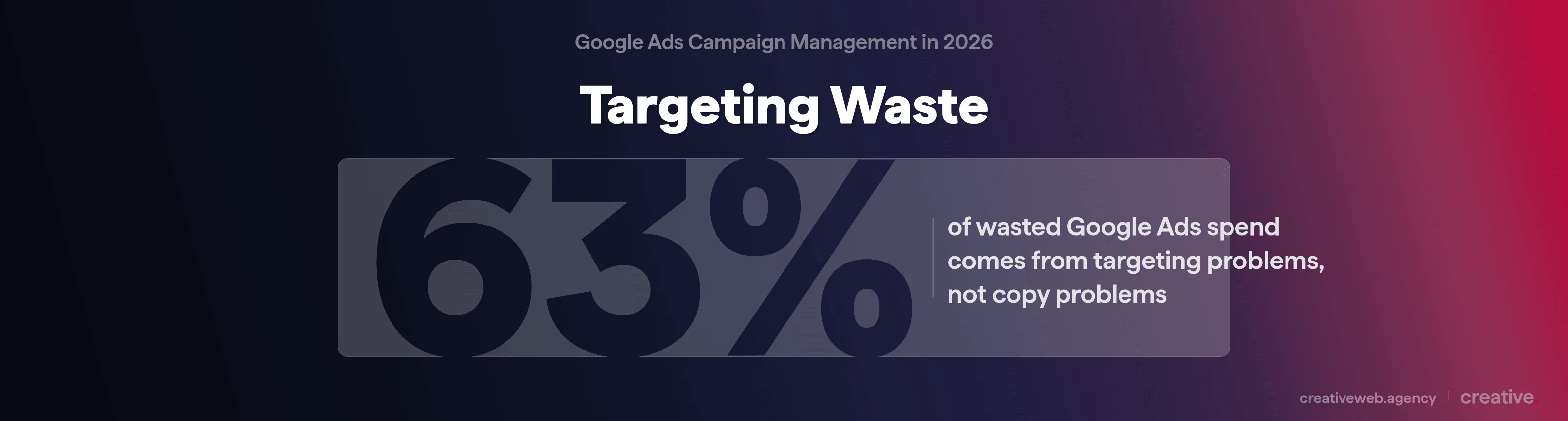
63% of wasted Google Ads spend comes from targeting problems, not copy problems (WordStream, 2025). That stat surprised me when I first saw it, but it matches what we see in audits.
Keyword match types in 2026
Broad match has changed. Paired with Smart Bidding, it now uses conversion data to narrow who sees your ad. Without Smart Bidding, broad match is still dangerous (especially in high-CPC industries).
Does that mean exact match only? Not quite. For most accounts spending under £2,000/month, we recommend starting with phrase and exact match, then introducing broad match once Smart Bidding has enough conversion data to steer it effectively.
Negative keywords
This is one of best ways to stop wasting money immediately. Check your search terms report weekly. You’ll find queries like “free,” “jobs,” “DIY,” and “how to do it myself” triggering your ads.
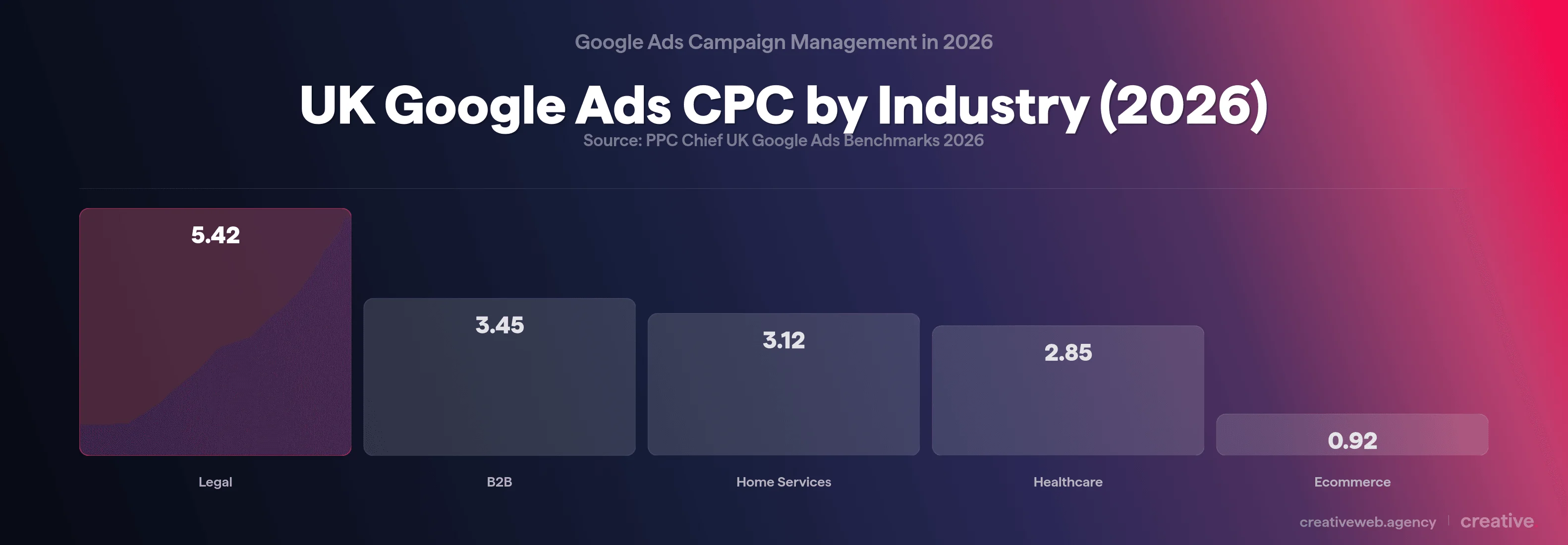
In legal, where the average UK CPC is £5.42 (PPC Chief, 2026), a single irrelevant click per day costs you £163/month. That is £1,956/year on people who were never going to hire you.
In e-commerce at £0.92/click, the same mistake costs £336/year. The cost varies wildly by industry, which is why most “common mistakes” guides are too generic to actually help.
Simple fix though.
Negative keywords are the single most cost-effective optimisation available to any Google Ads account, yet most of the campaigns we audit have none configured.
Audience targeting
Our advice: start with observation mode (not targeting mode). This lets you see how different segments perform without restricting your reach. Layer in-market audiences for commercial campaigns.
Use remarketing to re-engage visitors who didn’t convert first time. Custom segments work well for B2B if you want to target specific industries or job functions.
Location targeting for UK businesses
Set your location targeting to “presence” not “presence or interest.” The default setting (which Google quietly preselects) shows your ads to people “interested in” your area, even if they’re physically in another country. If you’re a plumber in Manchester, you don’t want clicks from someone in Canada researching Manchester plumbing regulations.
We check this on every account we take over. It is wrong more often than you would expect.
Bidding Strategies and Budget for UK Businesses
Ok, the money bit.
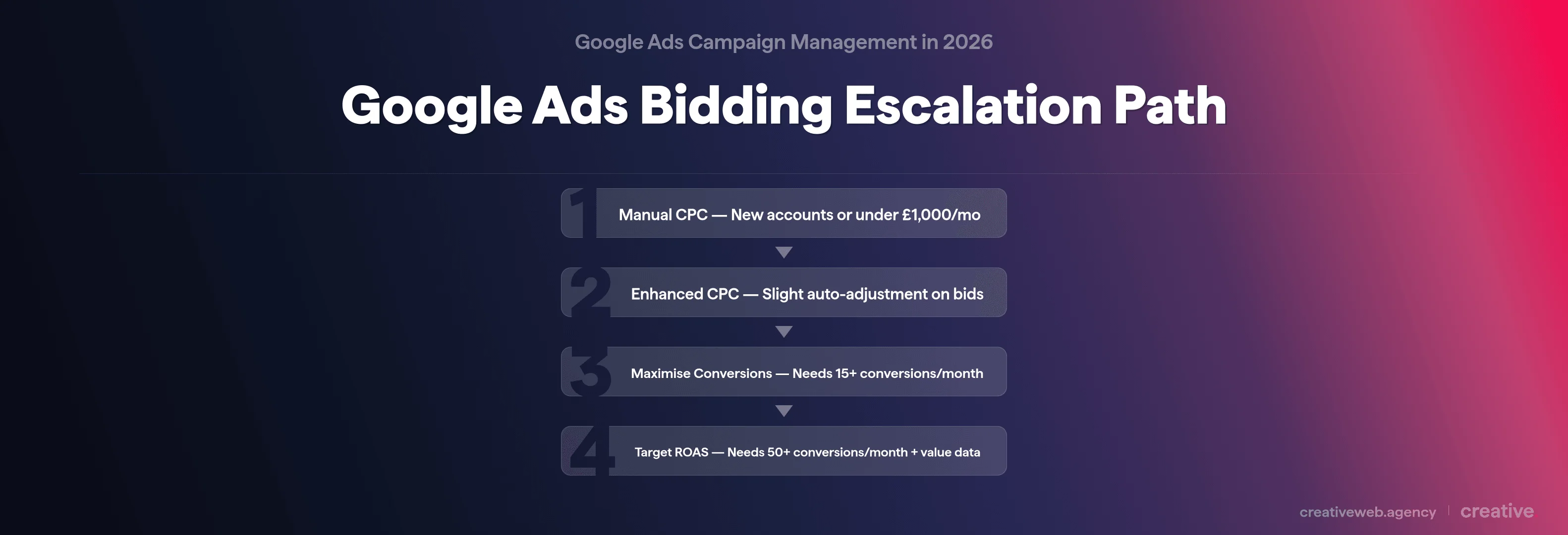
The bidding escalation path
- Manual CPC: Full control. Best for new accounts or budgets under £1,000/month.
- Enhanced CPC (ECPC): a sensible middle ground. Google adjusts your bids slightly based on how likely each click is to convert.
- Maximise Conversions: Fully automated. Needs at least 15 conversions per month to work properly.
- Target ROAS: You need 50+ conversions per month and reliable conversion value data for this one. When it works, it’s the most effective option available.
Jumping to automated bidding without enough data is like asking sat nav to find the fastest route when it doesn’t know where the roads are. We always tell our clients the same thing: start manual, gather data, then graduate.
UK CPC by industry
| Industry | Avg CPC (UK) | Avg CTR | Avg Conversion Rate |
|---|---|---|---|
| Legal | £5.42 | 4.2% | 4.8% |
| Home Services | £3.12 | 5.2% | 8.2% |
| B2B | £3.45 | 3.8% | 4.1% |
| Healthcare | £2.85 | 4.1% | 5.5% |
| Ecommerce | £0.92 | 4.5% | 3.2% |
Source: PPC Chief UK Google Ads Benchmarks 2026
The budget concentration principle matters here too: £1,500/month spread across five campaigns gives each roughly £10/day. That’s 1-3 clicks per campaign. Nowhere near enough data to optimise.
We almost always advise concentrating budget in one or two well-structured campaigns than spreading it thin.
Calculating your actual budget: three UK industry examples
The formula: target leads x (industry CPC / conversion rate) = monthly spend
Scenario 1: Legal firm (QS 5 baseline)
Target: 10 enquiries/month. CPC: £5.42. Conversion rate: 4.8%.
Clicks needed: 10 / 0.048 = 209. Budget: 209 x £5.42 = £1,133/month.
With QS 4 (25% CPC penalty): £6.78 per click = £1,417/month. That’s £284 extra for the same number of leads.
With QS 7 (28.5% discount): £3.88 per click = £811/month. Same leads, £322 less per month.
Scenario 2: Home services (QS 5 baseline)
Same formula. 15 leads, £3.12 per click, 8.2% conversion rate. That’s 183 clicks, so £571/month. Drop to QS 4 and you’re paying £714. Get to QS 7 and it falls to £409.
Scenario 3: Ecommerce (QS 5 baseline)
Higher volume, lower CPC. 50 sales at £0.92 per click with a 3.2% conversion rate means 1,563 clicks: £1,438/month. The QS swing is even bigger at this volume. QS 4: £1,797. QS 7: £1,028. That’s a £769 difference every single month.
Same story every time: improving Quality Score from 4 to 7 saves roughly 40% of your budget regardless of industry. That’s the connected system at work: better ad copy and landing pages reduce what you pay per click, which buys more clicks, which generates more leads from the same spend.
Plug your own numbers in. The formula works for any industry.
That is the exercise we walk every new client through.
Want campaigns that actually deliver results?
See Our PPC ServicesQuality Score: Where Copy, Targeting, and Performance Connect
We’ve talked about copy, targeting, and budget as separate topics up to this point. Quality Score is where they collide.
Google rates three things on a 1-10 scale:
Expected CTR: how likely people are to click your ad. Depends on your ad copy quality, keyword relevance, and historical click performance. This connects directly back to the RSA structure and headline specificity we covered earlier.
Ad relevance: how closely your ad matches what someone searched for. Tight ad groups with closely themed keywords score higher here. This is your targeting at work.
Landing page experience: page speed (under 3 seconds), mobile responsiveness, content relevance to the ad, and clear calls to action. This is the third piece that most people neglect until it’s dragging everything else down.
Fix that first.
See the connection? Improving your ad copy boosts expected CTR. Better keyword grouping improves relevance. A faster, more relevant landing page improves experience. Each improvement pushes Quality Score up, which reduces your CPC, which stretches your budget further. We see the results within weeks on the accounts we manage.
The thing I keep coming back to is how few businesses look at this as a connected system. They’ll rewrite ad copy and wonder why nothing changed. Usually it’s because the landing page loads in 6 seconds and has nothing to do with what the ad promised.
What we have seen across our accounts: ad relevance changes show within 2 weeks. Landing page improvements take longer (Google recrawls periodically). Budget 4-6 weeks before you see consistent QS improvement across a campaign.
Measuring and Improving Campaign Performance
Conversion tracking done properly
Set up tracking before you spend a single pound. Without it, you are optimising for clicks, and clicks on their own tell you nothing about actual business results.
Use Google Tag Manager for implementation. Define what a meaningful conversion actually is for your business: a form submission, a phone call, a purchase, a booking. Not a page view.
We do not launch a campaign until tracking is confirmed and tested. Link your Google Ads account to Google Analytics 4 (GA4) for cross-platform attribution: it shows you what happens after the click, not just that it happened.
NB: If you’re advertising to UK audiences, Consent Mode v2 has been mandatory since March 2024. Your cookie consent banner needs to integrate with Google’s consent framework. If it doesn’t, you lose conversion data from every user who doesn’t consent (which is a significant percentage).
Enhanced conversions (which send hashed first-party data back to Google) help plug this gap. Most guides still skip this entirely, but it directly affects the quality of data your bidding algorithms work with.
The metrics that actually matter
Compare your numbers against UK benchmarks: CTR 4.7% is the UK Search average (PPC Chief, 2026). Below 3% points to copy or keyword problems. CPC should sit somewhere near your industry average from the table above: significantly higher usually means Quality Score issues.
Conversion rate averages 4.4% for UK Search. Below 2% typically means your landing page needs work. CPA (cost per acquisition) needs to be calculated against customer lifetime value: a £50 CPA is expensive for a £30 product but cheap for a £5,000 service contract.
ROAS: aim for 3:1 minimum, with e-commerce usually targeting 4:1 or higher.
How Often to Check Your Campaigns
This sounds obvious written down, but you’d be amazed how often we see campaigns running for months with nobody checking them.
Here is the rhythm we follow with our own clients:
Daily (10-15 minutes): confirm spend is on track, pause anything clearly broken. Weekly (1-2 hours): review search terms report, add negative keywords, check Quality Scores, assess ad performance. Monthly (2-3 hours): strategic review covering bidding strategy, budget reallocation, landing page performance, and competitor activity.
If you are spending under £1,000/month, the weekly review is the minimum viable commitment. Below that frequency and you’re basically hoping for the best.
The Mistakes That Drain Your Budget
These are not listed equally. We have ranked them by how much money they typically waste based on what we see across our clients’ accounts, using UK CPC data.
- No negative keywords. Every irrelevant click at UK average CPC (£1.95) costs you directly. In legal at £5.42/click, we’ve audited accounts losing 30%+ of their total budget to irrelevant searches, making this almost always the single biggest fix available.
- Broad match without Smart Bidding. Broad match alone expands your keywords to queries you never intended to target. In high-CPC industries, this drains budgets at an alarming rate. Only use broad match once you’ve got enough conversion data for Smart Bidding to steer it.
- No conversion tracking. We’ve inherited accounts spending £2,000/month with zero conversion tracking set up. They had literally no idea what was working. You cannot improve what you are not measuring.
- Homepage as landing page. Your ad targets a specific search intent. Your homepage serves everyone. That mismatch kills conversion rates, and we see it constantly. Build landing pages that match what the ad actually promises.
- Accepting Google’s auto-recommendations blindly. Google’s “optimisation score” suggests changes that often increase your spend. Some are genuinely helpful (adding sitelinks, fixing disapproved ads). Others are not (broadening match types, raising daily budgets, enabling audience expansion).
I’m not saying Google is deliberately trying to waste your money, but their incentives and yours are not perfectly aligned.
Review every recommendation individually.
Beyond the big five: set-and-forget management (launch a campaign, check it once, never look again), wrong bidding strategy for your data level (running Target ROAS with 5 conversions/month is pointless), and budget spread too thin across too many campaigns (£1,500 split five ways gives each campaign 1-3 clicks per day, which isn’t enough data to optimise anything).
Managing Google Ads: When to DIY and When to Get Help
I’ll be upfront: we’re an agency that manages Google Ads campaigns. But we also turn clients away when it’s not the right fit. Genuinely. It’s better for everyone.
The DIY vs agency decision
Under £1,000/month: managing it yourself (or hiring a consultant for initial setup) usually makes more financial sense. Agency management fees don’t justify themselves at this spend level.
£1,000-2,000/month: a hybrid approach works well. Get professional setup and strategy, then handle the day-to-day with monthly expert check-ins.
Above £2,000/month: professional management usually pays for itself. UK agency fees generally run £500-2,000/month or 10-20% of ad spend (Search Engine Journal, 2025).
Red flags we tell our clients to watch for when choosing an agency: anyone guaranteeing specific results (nobody controls Google’s auction), refusing to give you access to your own account (you should always own it), and no transparent reporting on spend versus results.
When Google Ads isn’t the right answer
Not every business should be on Google Ads. If your product requires demand creation (people don’t know they need it yet), Google Ads captures existing demand: somebody has to be searching for it first. You might need content marketing or social advertising before PPC makes sense.
If your industry CPCs make the return impossible (some niches see £15+ per click with sub-2% conversion rates), the numbers just don’t work. Having managed PPC campaigns for well over a decade, we’ve found it’s better to say this upfront than watch someone burn through three months of budget proving it.
And if you don’t have landing pages, conversion tracking, or 5+ hours per week for management, that budget is usually better invested in SEO content that builds organic traffic over time.
Frequently Asked Questions
-
How much do Google Ads cost in the UK?
-
It depends entirely on your industry. UK CPCs range from £0.92 (e-commerce) to £5.42+ (legal) based on PPC Chiefu2019s 2026 UK benchmarks. We recommend budgeting at least £500-1,000/month for meaningful results, but the formula in the budget section above gives you a proper figure for your industry.
Did this answer your question? YesThat’s great glad we could help! Start a ProjectNoNo problem, one of our experts can give you a more in-depth answer. Ask our Experts -
Are Google Ads worth it for small businesses?
-
In our experience, yes, if youu2019re capturing existing demand (people are already searching for what you sell), youu2019ve got proper conversion tracking, and you can commit to weekly management. No, if youu2019re trying to create demand for something people donu2019t search for, or if you canu2019t afford to test for at least 3 months before judging results.
Did this answer your question? YesThat’s great glad we could help! Start a ProjectNoNo problem, one of our experts can give you a more in-depth answer. Ask our Experts -
What is a good click-through rate for Google Ads?
-
UK Search average is 4.7% (PPC Chief, 2026). Below 3% and your copy or targeting probably needs work. Above 6% is strong. But CTR on its own means nothing if those clicks arenu2019t converting.
Did this answer your question? YesThat’s great glad we could help! Start a ProjectNoNo problem, one of our experts can give you a more in-depth answer. Ask our Experts -
What is Quality Score and why does it matter?
-
Quality Score is Googleu2019s 1-10 rating of your ad relevance, expected click-through rate, and landing page experience. It directly affects your cost per click: QS 7 gives you a 28.5% CPC discount, while QS 4 adds a 25% premium. Improving Quality Score is the single most cost-effective way to reduce your Google Ads spend without cutting budget.
Did this answer your question? YesThat’s great glad we could help! Start a ProjectNoNo problem, one of our experts can give you a more in-depth answer. Ask our Experts -
Should I use Performance Max or Search campaigns?
-
Search for most service businesses and lead generation. Performance Max for e-commerce with product feeds and strong creative assets. If youu2019re spending under £1,500/month, stick with Search for the control and transparency it gives you. PMax works best with sufficient conversion data for Googleu2019s AI to optimise around.
Did this answer your question? YesThat’s great glad we could help! Start a ProjectNoNo problem, one of our experts can give you a more in-depth answer. Ask our Experts -
How do I set up conversion tracking properly?
-
Start with Google Tag Manager for your tracking code. Define what actually counts as a conversion for your business (form submissions, phone calls, purchases), and enable enhanced conversions for better data accuracy. Make sure your cookie consent setup is Consent Mode v2 compliant (mandatory in the UK since March 2024). Test everything with Googleu2019s Tag Assistant before you start spending.
Did this answer your question? YesThat’s great glad we could help! Start a ProjectNoNo problem, one of our experts can give you a more in-depth answer. Ask our Experts -
Whatu2019s a good CPC for Google Ads in the UK?
-
It varies massively by industry. UK averages for 2026: legal sits around £5.42 per click, home services £3.12, B2B £3.45, healthcare £2.85, e-commerce £0.92. The cross-industry average is about £1.95. But u201cgoodu201d depends on your conversion rate and what each lead is worth. If youu2019re paying £5 per click but converting at 8%, thatu2019s roughly £62 per lead, which is excellent value for a solicitor but terrible for a t-shirt shop.
Did this answer your question? YesThat’s great glad we could help! Start a ProjectNoNo problem, one of our experts can give you a more in-depth answer. Ask our Experts -
How do I fix an underperforming Google Ads campaign?
-
Our first recommendation: start with the search terms report. Youu2019ll almost certainly find irrelevant queries eating budget, so add negative keywords for anything thatu2019s clearly not a potential customer. Then check your Quality Scores: anything below 5 needs attention (usually ad relevance or landing page issues). After that, look at your conversion rate. If people are clicking but not converting, your landing page is the problem, not your ads. Make one change at a time so you can actually see whatu2019s helping.
Did this answer your question? YesThat’s great glad we could help! Start a ProjectNoNo problem, one of our experts can give you a more in-depth answer. Ask our Experts
Where to Start
The difference between Google Ads campaigns that waste money and campaigns that perform is understanding how copy, targeting, and measurement work as one system.
Plug your industry CPC, target leads, and Quality Score into the formula above. See what the numbers actually say. If you want the strategic context first, we’ve already written about that: Google Ads strategy for UK businesses.
And if you’d rather have someone handle campaign management end to end, get in touch about our PPC services.