How to Build a Keyword Research Strategy That Actually Brings in Customers (2026)


You’ve done keyword research before. Opened a tool, typed in what you sell, sorted by volume, picked the biggest numbers, built content around them.
And then nothing happened. Traffic trickled in (maybe).
Enquiries? Zero.
If you have a keyword spreadsheet that looks thorough but has never produced a single lead, you’re in good company. We see it constantly.
The data was real. The research looked solid. But the approach was the problem.
Over 53% of all website traffic starts with organic search (BrightEdge, 2025). So keyword research still drives the pipeline. But most guides on how to do keyword research for SEO teach you how to use a tool.
This one won’t. We’re covering how to build a keyword research strategy that starts with what your business needs and works backwards.
Intent first, tools second.
Why Most Keyword Research Falls Flat
There’s a pattern we notice with businesses that try keyword research themselves. The list looks solid: high volumes, relevant terms, everything organised in a spreadsheet. But the content built from those keywords attracts the wrong visitors (or nobody at all).
The volume trap
High-volume keywords rarely deliver for smaller businesses. “Keyword research” has 4,000 monthly UK searches (Ahrefs, 2026). Sounds brilliant.
But the keyword difficulty is 97, and every page-one result has a domain rating above 80. If your site sits at DR 25, you’re not getting on that page.
Not this year.
And even if you could rank: 58.5% of Google searches now result in zero clicks (SparkToro, 2024). The AI Overview answers the question before anyone scrolls down.

That 4,000 volume? Actual click opportunity is probably closer to half.
High-volume keywords with difficulty scores above 80 are effectively unreachable for most small business websites, regardless of how good the content is.
The missing link between keyword lists and results
The bigger issue is that most keyword research stops at “here are terms with decent numbers.” It never asks the important question: which of these will bring in people who actually want what I sell?
A keyword research strategy without business context is just a spreadsheet exercise.
Sound familiar?
Search Intent Matters More Than Search Volume
If there’s one concept that transforms keyword research, it’s search intent. Not as a buzzword you see in every SEO article, but as a practical filter for every keyword decision you make.
The four types of search intent (and why the real picture is messier)
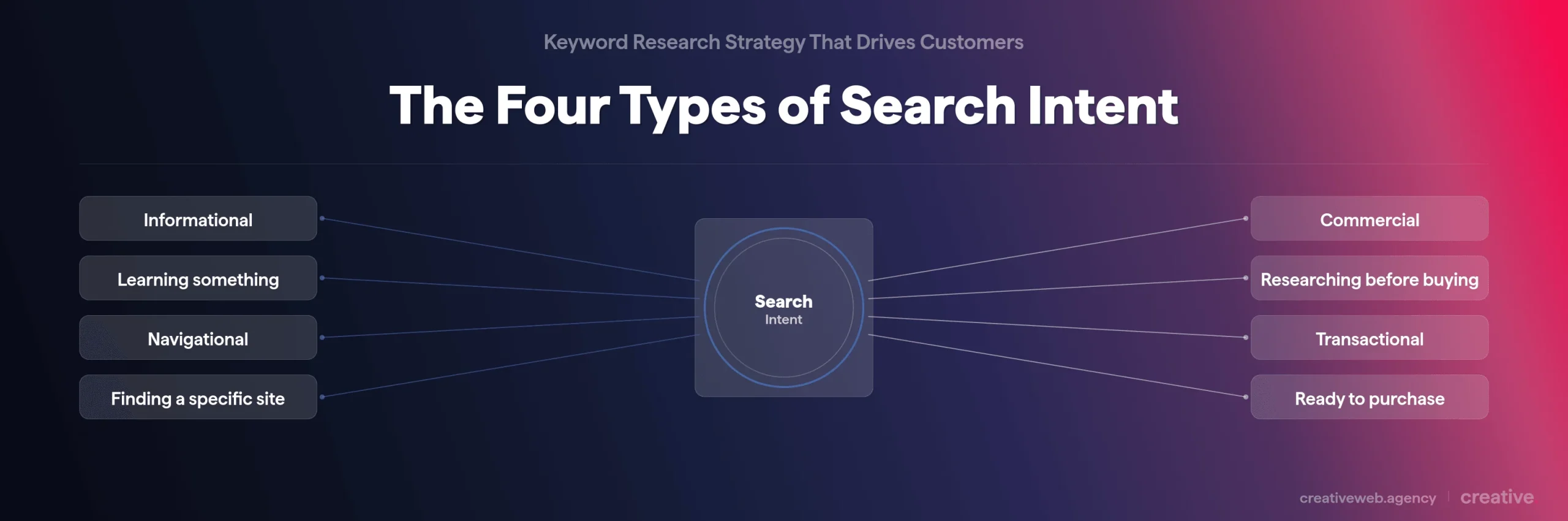
Most guides present four clean types: informational (learning something), navigational (finding a specific site), commercial (researching before buying), transactional (ready to purchase). Useful as a starting point. But the real picture is messier than four neat boxes.
Take “keyword research strategy.” Informational on the surface: someone wants to learn about the topic.
But dig deeper and you’ll find a significant chunk of those searchers are business owners evaluating whether to handle this themselves or hire an agency.
That’s commercial intent sitting underneath an informational keyword.
We call this layered intent. Roughly 70% of all search queries are informational (Semrush, 2025), but many carry commercial undertones that most keyword tools won’t flag. Your keyword research strategy needs to spot which terms sit on that boundary, because that’s where the real revenue hides.
How to read intent from the search results page itself
Google has already classified intent for you. Search your keyword and look at what actually ranks:
- All guides and how-to articles? Informational
- Comparison pages and “best of” lists? Commercial
- Product pages with pricing? Transactional
- Forums, Reddit threads, mixed results? Possibly layered intent
Takes two minutes per keyword.
Tells you more than any metric in a tool.
So should you do this for every keyword on your list? Yes. Every single one.
It’s tedious (nobody pretends otherwise) but it saves you writing content that Google will never show for that query.
Evaluating keywords beyond volume: a practical checklist
Before committing to any keyword, run it through these six signals:
| Signal | What to Check | Why It Matters |
|---|---|---|
| Intent alignment | Does this keyword match a service you actually offer? | Ranking for irrelevant terms wastes time and budget |
| SERP achievability | What DR do the top 5 results have? Can you compete? | If you can’t reach page one, the keyword has zero practical value |
| Click-through potential | Does an AI Overview answer this query fully? | Zero-click keywords deliver zero traffic regardless of volume |
| Conversion likelihood | Would the searcher realistically enquire or buy? | Traffic without conversions is a vanity metric |
| Cluster value | Does this keyword strengthen your topical authority? | Low-volume keywords can lift an entire topic cluster |
| Trend direction | Is search interest growing, stable, or declining? | A declining keyword is a depreciating asset |
Volume is one input out of six. Treating it as the only one is how keyword research goes wrong.
Search intent is the most reliable filter for deciding which keywords will waste your budget and which will bring in paying customers.
Connecting Keywords to What Your Business Actually Needs
This is where most guides go quiet. They tell you to “align keywords with business goals” then immediately go back to sorting by volume. So what does actually connecting keywords to business outcomes look like in practice?
Working backwards from business goals to keyword targets
Start with what you sell, not what a tool suggests. If you’re a web design agency in Leeds and your goal is 10 new website enquiries per month, work backwards from there.
What do people search before contacting a web designer? What questions come up while they’re comparing agencies? What problems do they try solving themselves first?
Each of those search behaviours maps to a different keyword type. Someone searching “how to write a website brief” is earlier in the buying journey than someone searching “web designer Leeds quotes.” Both are worth targeting, but the second converts at a higher rate per visit.
How this looks in practice (a UK service business example)
We worked with a regional accountancy firm wanting more enquiries for their tax planning service. They’d already done keyword research: “tax planning” (2,400 monthly searches, KD 78) was the primary target.
Three articles published around it.
Zero organic enquiries in six months.
When we took a different approach (starting from the actual service: tax planning for owner-managed businesses) and mapped backwards to what their ideal clients actually search, the picture changed completely:
| Keyword | Volume | KD | Intent | Enquiry Value |
|---|---|---|---|---|
| tax planning | 2,400 | 78 | Informational | Low (browsers, students) |
| tax planning for limited companies | 200 | 22 | Commercial | High (owners evaluating) |
| how to reduce corporation tax legally | 150 | 18 | Commercial | High (active problem) |
| accountant for tax planning near me | 90 | 12 | Transactional | Very high (ready to hire) |
| annual tax planning checklist | 70 | 15 | Informational | Medium (DIY, may convert) |
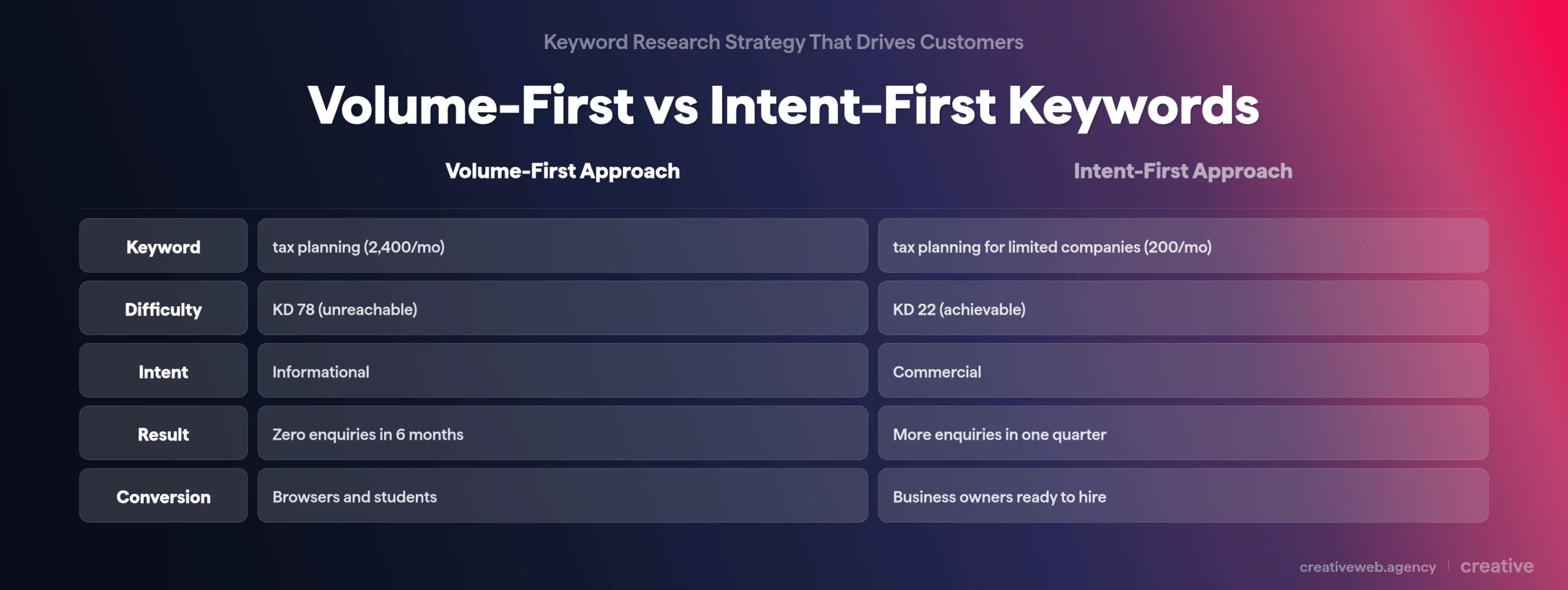
The high-volume keyword pulled in students and people with no intention of hiring an accountant. The lower-volume terms? Each visitor was significantly more likely to convert because the intent matched the service being sold.
That 90-search transactional keyword drove more enquiries in one quarter than the 2,400-volume term managed in six months. Long-tail keywords like these convert at roughly 2.5x the rate of head terms (Ahrefs, 2024).
That’s revenue-potential prioritisation in action.
Not the biggest numbers.
The right visitors.
(It sounds obvious written down, but almost nobody actually does this.)
A keyword research strategy built around business goals will consistently outperform one built around volume alone.
When a keyword isn’t worth pursuing (and what to do instead)
Sometimes your research reveals you genuinely can’t compete. If your domain rating is 20 and every page-one result is DR 70+, publishing content against that keyword is burning time.
Be honest about it.
Options when a keyword is out of reach:
- Target the long-tail version. “Tax planning for limited companies” (KD 22) instead of “tax planning” (KD 78)
- Use PPC as a bridge while organic authority builds. Sometimes paid search is the smarter short-term move
- Build topical authority on achievable terms first. As your DR grows, harder keywords open up
- Focus your content budget elsewhere. Some keywords genuinely aren’t worth the investment right now
NB: This honesty is rare in keyword research guides. Everyone sells the idea you can rank for anything with enough effort. In our experience, businesses make faster progress when they start with what’s achievable and work up from there.
Want Keyword Research That Drives Actual Enquiries?
Talk to Us About Your SEOFrom Keywords to Topic Clusters
Once you’ve identified your keywords and filtered by intent, the next step is organising them into something useful. This is where topic clusters come in: the point where keyword research becomes an SEO content strategy.
How topic clusters work (and why search engines reward them)
A topic cluster is straightforward: one comprehensive pillar page covering a broad topic, supported by cluster pages that go deep on specific subtopics. All pages link to each other.
Sites using topic cluster architecture see around 30% more organic traffic than those with isolated pages (HubSpot, 2025). Google treats your site as a genuine authority on the topic because you’ve covered it comprehensively, not just published one article and hoped for the best.
Topic clusters build topical authority because they signal comprehensive subject coverage to search engines, not just isolated keyword targeting.
One blog post about “keyword research” is a single voice in a crowded room. A pillar page on keyword research strategy, supported by cluster content on search intent, keyword mapping, and competitor analysis? That’s a coordinated argument.
(I’ve started explaining this to clients with a library analogy: one book on a shelf versus an entire dedicated section. Google notices which sites have the section.)
Building a cluster from your keyword research
Sort your keyword list by semantic similarity. Terms that would be satisfied by the same page go together. Then identify the broadest group (your pillar) and the specific subtopics (your clusters):
- Pillar: “keyword research strategy” (broad strategic overview)
- Cluster 1: “search intent seo” (intent classification deep dive)
- Cluster 2: “competitor keyword research” (market intelligence)
- Cluster 3: “keyword mapping” (connecting research to website pages)
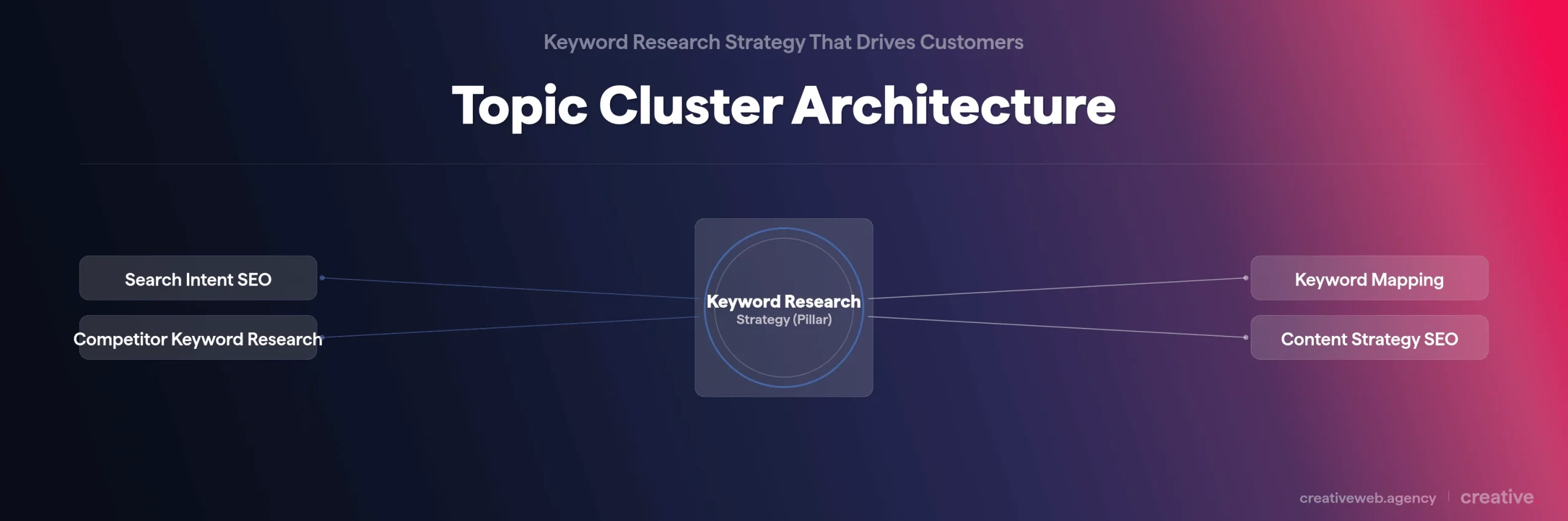
Each cluster links to the pillar. The pillar links to each cluster. Related clusters link to each other.
If you want to understand how we build content clusters for clients, we’ve written about our approach to SEO content and blogging.
What Your Competitors’ Keywords Actually Tell You
Competitor keyword research isn’t about copying what other businesses do. It’s about reading the market.
A competitor’s keyword profile shows their content strategy in reverse. Where they rank tells you what they’ve invested in. Where they don’t rank reveals the gaps.
It’s basically their business plan published on the internet for you (very generous of them).
The real value is in those gaps. If three competitors all rank for “keyword research tools” but nobody ranks for “keyword research for small businesses UK,” that’s unserved demand.
Market intelligence you can act on today.
The most valuable insight from competitor keyword analysis isn’t what they rank for. It’s the gaps: terms with real demand and no strong content serving them.
Check keyword difficulty relative to their domain rating too. If a competitor with similar authority to yours ranks for a term, you can can compete there. 91.8% of all search queries are long-tail (Ahrefs, 2024), and these are exactly where smaller businesses find the openings.
Top tip: Don’t just look at what competitors rank for. Look at what they rank for badly (positions 11-20).
Those are keywords where they’ve tried and haven’t broken through. If your content is genuinely better, those are quick wins.
Mapping Keywords to Your Website
Keyword mapping bridges the gap between research and doing something with it. Without a map, you have ideas in a spreadsheet and no plan for execution.
One page, one primary keyword
Every page should target one primary keyword and a handful of supporting terms from the same intent cluster. If two pages target the same keyword, they compete against each other (content cannibalisation). It happens more often than you’d think: we’ve spotted it on nearly every website audit we run.
When two pages compete for the same keyword, both lose rankings through content cannibalisation. One page, one primary keyword is the rule.
Your content roadmap: create, optimise, or leave
Go through your keyword map and assign one action per keyword:
- Create: No existing page matches this keyword. New content needed.
- Optimise: A page partially covers the topic but isn’t targeting the keyword properly. Update it.
- Leave: Difficulty is too high or the keyword doesn’t align with your business right now. Park it for later.
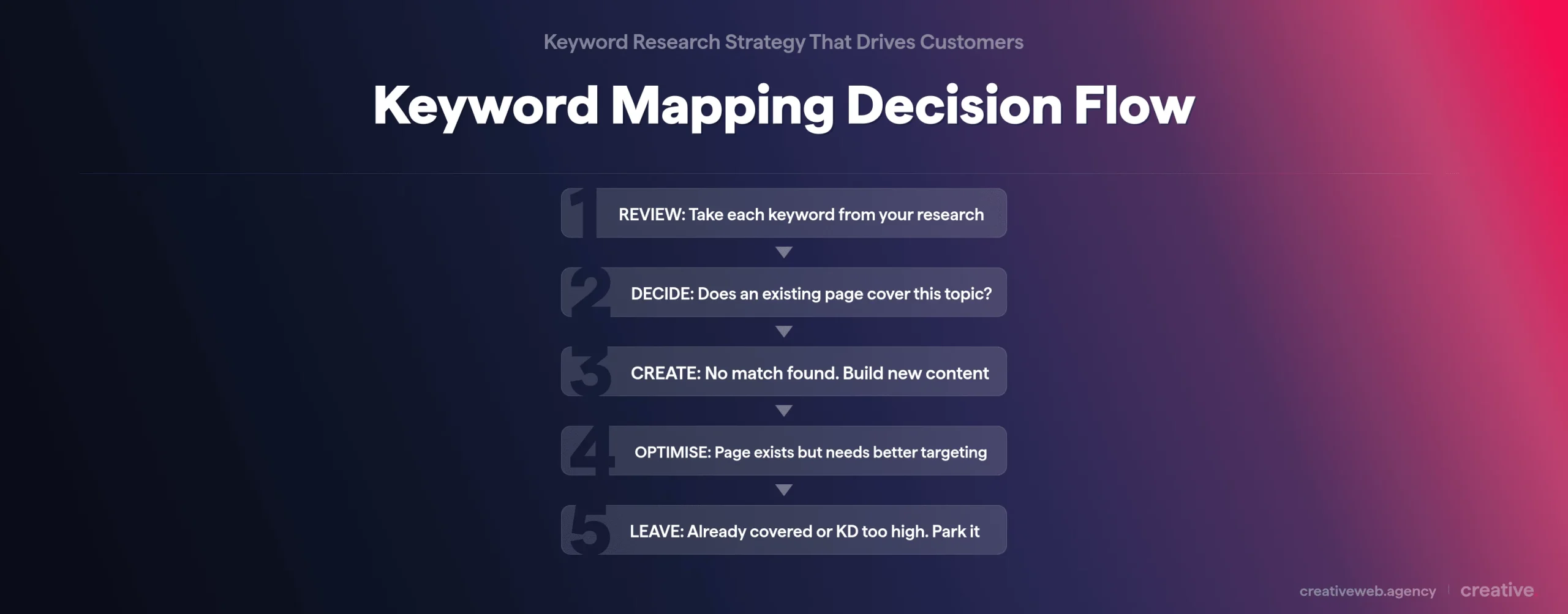
This gives you a content roadmap, not a wish list. Every keyword has a decision attached. We’ve found this is the exact moment keyword research stops being a research project and becomes a content plan.
If you’re not sure where to start with keyword mapping, our SEO services include building these as part of the strategy process.
Keyword Research in the Age of AI Search
Is keyword research still worth the effort when ChatGPT, Perplexity, and Google’s AI Overviews answer questions directly? Yes. But how you approach it has changed.
How AI Overviews change which keywords are worth targeting
AI Overviews handle straightforward factual questions well. “What is keyword research?” gets fully answered before anyone clicks through. But “how do I build a keyword research strategy connected to my business goals?” is too nuanced for a paragraph answer.
Complex, experience-based queries still drive clicks.
This means pure informational keywords with simple answers are worth less than before. Nuanced queries requiring genuine expertise? Worth more.
The intent-first approach we’ve discussed naturally steers you toward higher-value keywords. 88% of searchers still use Google as their primary search engine (HubSpot, 2025), so the platform isn’t disappearing, but the types of keywords worth targeting have shifted.
Making your content citable across search and AI platforms
It’s not just about ranking anymore.
It’s about being cited.
AI platforms pull from sources they consider trustworthy, and organic search still generates 44.6% of all B2B revenue (BrightEdge, 2025). AI citations are quickly becoming a second discovery channel.
To be citable, your content needs: clear definitions an AI can quote directly, original experience (not rehashed stats from other articles), structured headings that make extraction easy, and genuine expertise that adds something the AI can’t generate itself. Basically, everything that makes content good for humans also makes it good for AI citation.
Not a coincidence.
Content built on original experience and structured, clear definitions is what both search engines and AI platforms choose to cite.
Keeping Your Keyword Strategy Alive
Keyword research isn’t a project with an end date. Search behaviour shifts, competitors publish, your domain authority grows.
A keyword you couldn’t realistically target six months ago might be within reach now. One that was driving traffic might have been absorbed by an AI Overview.
B2B SEO campaigns deliver 702-1,389% ROI over three years (First Page Sage, 2025), but only if the keyword strategy behind them stays current.
What to check each quarter:
- Rankings movement: Which keywords shifted up or down? Why?
- Traffic quality: Are keyword-driven pages generating enquiries, or just visits?
- New opportunities: As your DR grows, revisit the keywords you parked earlier
- Decay signals: Pages losing rankings might need updating or a stronger competitor appeared
- SERP changes: Has a new AI Overview appeared for one of your key terms? That changes the value calculation
Quarterly keyword reviews prevent strategy decay and catch ranking shifts before competitors capitalise on them.
We’ve built quarterly keyword reviews into our client work because we saw too many strategies go stale after six months.
Set a calendar reminder.
Keyword research that gets reviewed stays strategic. Research that gathers dust in a spreadsheet becomes irrelevant.
Keyword research doesn’t finish when you close the spreadsheet. The businesses that get consistent results from SEO treat it as part of how they operate, not a box ticked once.
Start with what your customers need and connect your keywords to actual business outcomes. Come back to it quarterly. If you want to see how your current strategy holds up, get in touch and we’ll take a look.
Frequently Asked Questions
-
Can I use ChatGPT for keyword research?
-
For brainstorming, yes. ChatGPT is decent at generating keyword ideas and spotting topics you might not have considered. But it can’t give you accurate search volumes, keyword difficulty scores, or real SERP data.
Use it for ideation, then validate everything with a proper keyword tool (even the free Google Keyword Planner works). Don’t skip the validation step.
Did this answer your question? YesThat’s great glad we could help! Start a ProjectNoNo problem, one of our experts can give you a more in-depth answer. Ask our Experts -
How do I do keyword research for free?
-
Google Keyword Planner is free (you need a Google Ads account but don’t have to spend anything). Google Search Console shows what your site already ranks for. Google Trends shows search interest over time.
Between these three you can do meaningful research without paying for a premium tool. You’ll miss some detail (particularly keyword difficulty) but it’s enough to get started.
Did this answer your question? YesThat’s great glad we could help! Start a ProjectNoNo problem, one of our experts can give you a more in-depth answer. Ask our Experts -
How do I do local keyword research?
-
Add location modifiers to your core terms. If you’re a plumber in Bristol, your keywords include ‘plumber Bristol,‘ ‘emergency plumber near me,‘ and ‘boiler repair Bristol.‘
Google Keyword Planner lets you filter by specific locations. Also check your Google Business Profile insights: they show what people actually search to find businesses like yours locally.
Did this answer your question? YesThat’s great glad we could help! Start a ProjectNoNo problem, one of our experts can give you a more in-depth answer. Ask our Experts -
What is the best tool for keyword research?
-
Depends on budget. Ahrefs and Semrush are the industry standard for professional SEO work (from around £80-100/month). For smaller budgets, Ubersuggest or Mangools offer solid data at lower cost.
Google Keyword Planner is free and perfectly adequate for most small businesses getting started. The tool matters far less than the strategy you apply with it.
Did this answer your question? YesThat’s great glad we could help! Start a ProjectNoNo problem, one of our experts can give you a more in-depth answer. Ask our Experts -
What is the 80/20 rule in SEO?
-
The Pareto principle applied to search: roughly 80% of your organic traffic comes from about 20% of your keywords. This is one of best reasons to focus your keyword research strategy on the terms that genuinely drive business outcomes. Find your top performers, double down on them, and stop spreading effort across keywords that aren’t converting.
Did this answer your question? YesThat’s great glad we could help! Start a ProjectNoNo problem, one of our experts can give you a more in-depth answer. Ask our Experts -
What is search intent in SEO?
-
It’s the reason behind someone’s search query. When a person types something into Google, they’re trying to accomplish something specific: learn a fact, find a particular website, compare products, or make a purchase. Those map to the four intent types (informational, navigational, commercial, transactional).
Understanding intent tells you whether a keyword will attract visitors who might actually convert, or just people browsing with no intention of buying.
Did this answer your question? YesThat’s great glad we could help! Start a ProjectNoNo problem, one of our experts can give you a more in-depth answer. Ask our Experts -
How do I do keyword research for a blog?
-
Start with the topics your customers actually ask about, not what a tool suggests. Use a keyword tool to find the specific phrases people search, check the intent behind each one, and group related keywords into topic clusters. Each blog post should target one primary keyword and a handful of related terms.
The biggest mistake we see is writing blog posts around high-volume keywords without checking whether the content Google already ranks for that query matches what you’re planning to write.
Did this answer your question? YesThat’s great glad we could help! Start a ProjectNoNo problem, one of our experts can give you a more in-depth answer. Ask our Experts -
Why is keyword research important for SEO?
-
Without it, you’re guessing. Keyword research tells you what your potential customers actually search for, how competitive those terms are, and whether you have a realistic shot at ranking.
It’s the difference between writing content that attracts the right visitors and writing content nobody ever finds. Done properly, it connects your content directly to business outcomes rather than vanity metrics like page views.
Did this answer your question? YesThat’s great glad we could help! Start a ProjectNoNo problem, one of our experts can give you a more in-depth answer. Ask our Experts