Influencer Outreach in 2026: From Link Building to Digital PR


If you Google “influencer outreach” right now, you’ll get a wall of guides telling you to find influencers, send a template email, and wait for the links to roll in. Most of them were written by software companies trying to sell you a tool.
The problem? That approach stopped working years ago.
We’ve spent over a decade running outreach campaigns for UK businesses at CreativeWeb, and what we do now looks almost nothing like what we did five years ago. The shift is fundamental: outreach has moved from a link-building tactic into something much closer to digital PR. And if you’re still thinking about it as “email 100 bloggers for backlinks,” you’re working from an old playbook.
What Influencer Outreach Actually Means in 2026
Influencer outreach is the process of building relationships with people who already have trust and visibility in your industry: content creators, publishers, journalists, bloggers, and industry experts. The goal is to earn mentions, links, and visibility naturally through genuine partnerships rather than chasing them through cold requests.
That definition probably sounds different from what most outreach marketing guides tell you.
And honestly, it should.
What used to be a straightforward SEO tactic (find blogs, send emails, ask for links) has turned into something between content marketing and digital PR. The practice has changed even if the terminology hasn’t caught up.
From “send emails, get links” to building a visibility network
Five years ago, an influencer outreach campaign was basically a numbers game. Send 200 emails, get 5 links, move on. The whole thing ran off a spreadsheet of targets and a template email with a [FIRST NAME] merge tag.
That model worked when creators got a handful of partnership requests per month. Now micro and nano creators receive 50+ pitches per week (Modash, 2025), and most of those pitches look identical. The maths stopped adding up.
So the practitioners who get results have shifted. Instead of treating outreach as a task you tick off a list, it’s become part of how you build visibility: earned media, partnerships, content collaboration, relationship building.
Who counts as an “influencer” now (and why the term is misleading)
Here’s something we keep coming back to: the word “influencer” in “influencer outreach” is actually quite misleading.
Most people hear it and picture Instagram creators with ring lights. But the most valuable outreach targets for UK businesses are often niche bloggers, local journalists, trade publication editors, LinkedIn thought leaders, podcast hosts, and industry experts who happen to have a following.
If you’re a B2B company, your best target might be someone writing a newsletter to 2,000 finance directors. Not someone with 100,000 TikTok followers who’s never heard of your sector.
The point is: expand your definition. The people worth building relationships with are the people your audience already trusts.
Why the Old Outreach Playbook Stopped Working
Right, so here’s what actually happened.
The old approach (what most people still call “blogger outreach” or “link building outreach”) was simple enough. Find relevant blogs. Send a pitch. Offer a guest post or suggest a link swap. Repeat at scale.
The numbers behind template fatigue
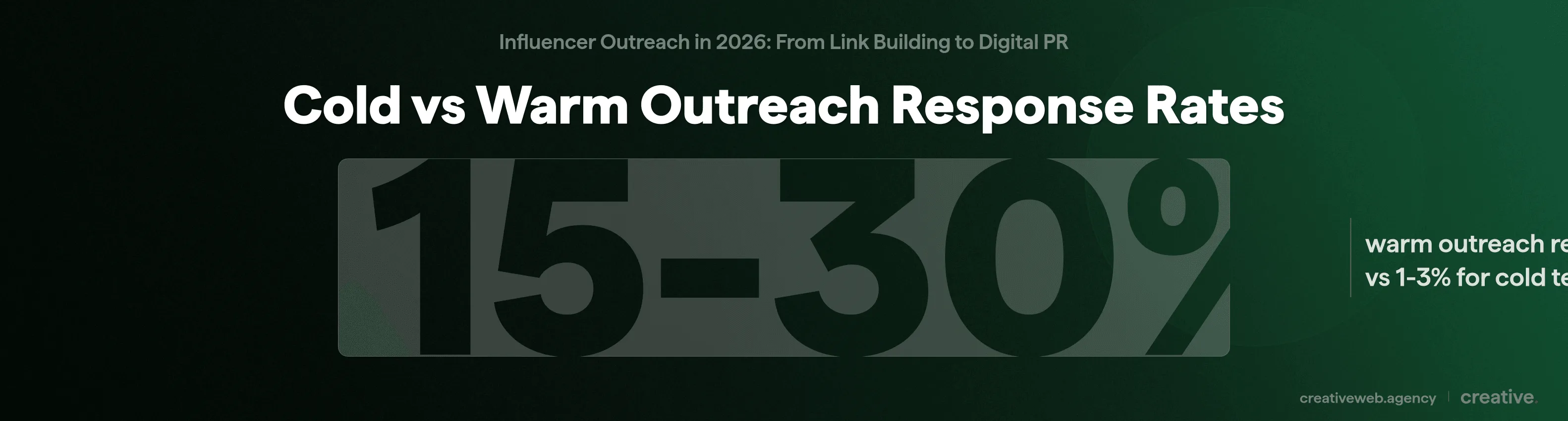
The data tells the story. Cold outreach emails now get a 1-3% response rate (Ranking Raccoon, 2026). Compare that with warm outreach, where you’ve built some kind of prior connection: 15-30% response rates.
That’s not a marginal improvement.
It’s a completely different way of working.
And it gets worse. 94% of all published content never earns a single backlink (Ranking Raccoon). So even when cold outreach does land, the content being pitched often isn’t worth linking to in the first place.
TLDR: cold templates to strangers about mediocre content. It’s a wonder the old model worked at all.
What blogger outreach used to look like (and why it worked then)
This sounds obvious written down, but you’d be amazed how often we see it. Businesses still running the 2015 playbook and wondering why nobody replies.
Blogger outreach and guest posting used to work because things were different. Bloggers got fewer pitches. Guest contributions were genuinely novel. Google’s algorithm was simpler: more links generally meant higher rankings, regardless of how you got them.
But Google got smarter, creators got busier, and the old approach started producing less and less. It didn’t break overnight. It just gradually stopped being worth the effort.
The Shift From Link Building to Digital PR
This is the bit that matters most, and it’s something we rarely see explained properly.
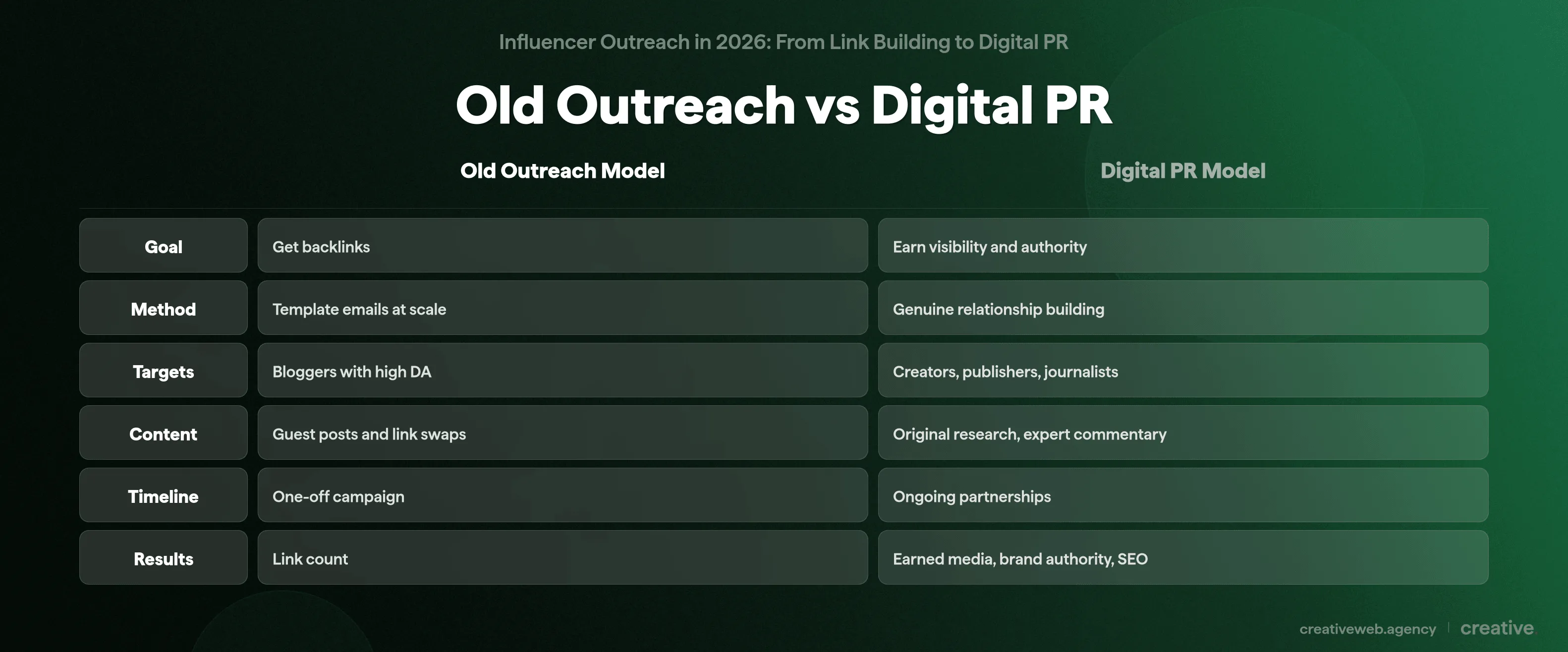
Outreach has evolved from a link-building tactic into a form of digital PR. That’s not just a rebrand. The way the whole thing works has changed.
Links as a byproduct, not the goal
In the old model, links were the goal. Everything (the email, the content, the relationship) existed to get a link placed.
In the new model, earned media is the goal. You build relationships with trusted voices, create content worth referencing, and collaborate on projects that serve both audiences.
Links happen naturally as part of that process.
We’ve found this shift in mindset changes everything. When you stop chasing links and start building genuine visibility, the links come anyway. Usually better quality ones than you’d have ever got through cold requests.
What digital PR actually looks like for a UK business
For a UK SME, digital PR outreach might look like: building a relationship with a local trade journalist who covers your sector. Contributing expert commentary to an industry publication.
Collaborating with a complementary business on a piece of joint research. Getting mentioned in a roundup because you’re known as a reliable source in your niche.
None of that starts with a template email.
It starts with being visible, useful, and part of the conversation.
Influencer outreach and digital PR have basically merged. Both run on relationships and trust, not transactions.
How Modern Outreach Actually Works
So where do you actually start?
The practical framework is simpler than most guides make it sound.
Effective outreach in 2026 comes down to three things: having content worth referencing, building genuine relationships with the right people, and keeping those relationships going long enough that the returns start compounding.
Start with something worth sharing
Before you contact anyone, you need something worth outreaching with. Content outreach starts with (obviously) content. Not a sales pitch. Not a product page. Something genuinely useful that someone else’s audience would benefit from.
This could be original research, a detailed guide, a free tool, or a case study with real numbers. If there’s nothing worth linking to no amount of outreach technique will generate links.
We’ve seen this play out dozens of times with clients. The ones who invest in one genuinely excellent piece of content get more outreach results than clients who produce 10 mediocre blog posts and try to promote all of them. If you’re not sure where to start with that, our approach to SEO content covers how we think about it.
Finding the right people (without paying for a tool)
You don’t need an expensive platform to find outreach targets. Start with:
- Check who links to your competitors’ best content (Ahrefs’ free backlink checker works for this)
- Industry event speakers and panellists are usually open to content collaboration
- Find LinkedIn content creators in your niche, particularly those getting genuine engagement
- Search for local journalists and trade press editors on LinkedIn using your industry + “journalist” or “editor”
The 4x rule helps: identify roughly four times as many targets as you need, because not everyone will respond.
What 12 Weeks of Real Outreach Looks Like
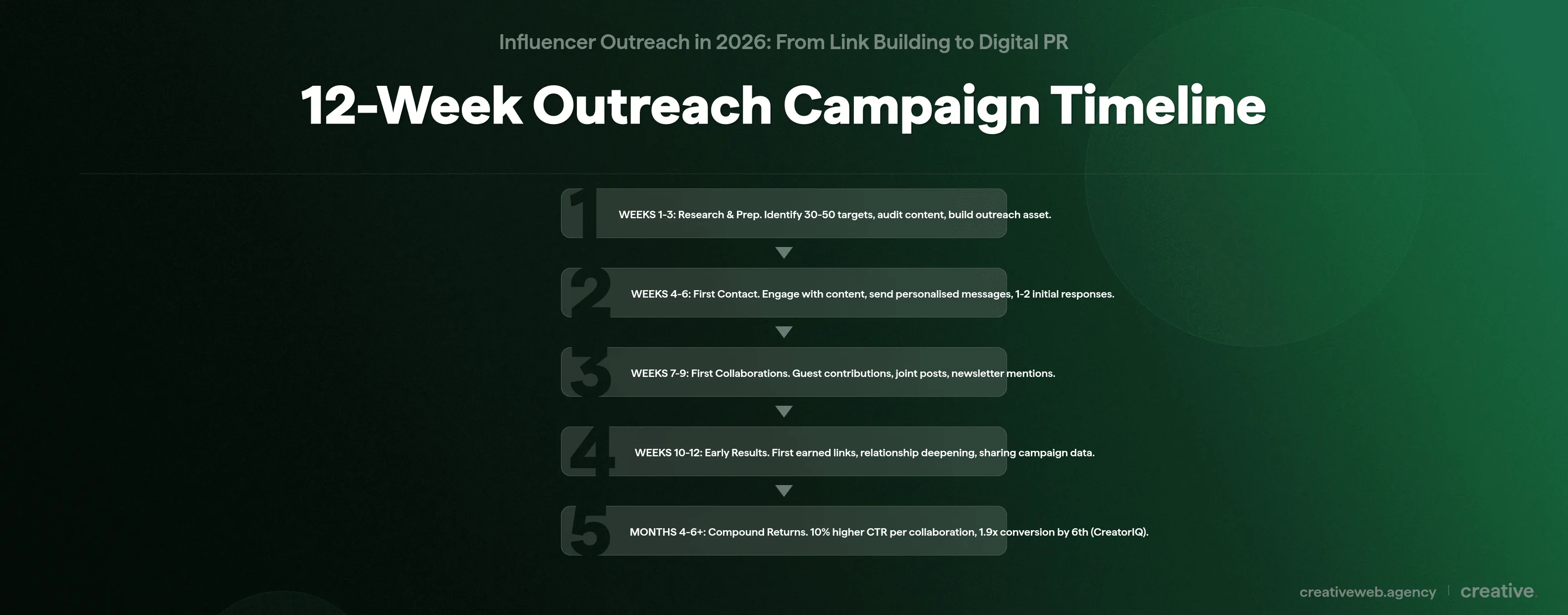
This is where most guides fall short. They give you steps but no timeline. Here’s what an actual outreach campaign looks like week by week, based on what we run for clients at CreativeWeb.
Weeks 1-3: Research and preparation
You’re not sending any emails yet. This phase is all research: identifying 30-50 potential targets, auditing your existing content, and creating (or improving) the asset you’ll build relationships around.
You’ll be tempted to skip this and start emailing straight away. Don’t.
Weeks 4-6: First contact and relationship building
Start engaging with your targets’ content genuinely. Comment on their posts. Share their articles.
Then begin first direct contacts: short, personalised, value-first messages. You might get one or two responses at this stage. That’s completely normal.
Weeks 7-9: First collaborations
By now you should have a few conversations going. Some will fizzle. That’s fine.
This is where the first creator partnerships or content collaborations start to form: a guest contribution, a joint social post, a mention of your research in their newsletter. Nothing huge yet, but momentum is building.
Weeks 10-12: Early results and relationship deepening
First earned links and mentions start appearing. The relationships you invested in begin producing tangible results. You’re also maintaining your network: sharing campaign data, helping with their content, building the ongoing relationships that keep delivering.
Months 4-6 and beyond: This is where it starts paying off properly. Research from CreatorIQ shows that click-through rates increase approximately 10% per additional integration with same creator, reaching a 1.9x conversion rate lift by the sixth collaboration. The relationships you built in weeks 1-12 generate returns that cold outreach never could.
Tools and AI-powered discovery
AI-powered tools can speed up the discovery phase (finding targets, analysing engagement rates, pulling contact details). But they don’t replace the human relationship part. Tools are accelerators, not substitutes for genuine media outreach.
Building Relationships That Earn Visibility
OK, so the process makes sense on paper. But how do you actually build these relationships rather than just sending cold emails into the void?
Warm outreach vs cold outreach: what the data says
The numbers are stark. Warm outreach (where someone recognises your name) produces 15-30% response rates. Cold emails sit at 1-3%.
“Warm” doesn’t mean you need to be mates. It means they’ve seen your name before. You’ve commented on their work, shared their content, or interacted in a community or at an event.
Basically, when your outreach email lands they have some idea who you are.
What a good outreach message actually looks like
I’m not going to give you a template here. The SERP is already drowning in outreach email templates (one guide has 14 of them), and honestly that’s part of the problem. When everyone uses the same format, nobody stands out.
Is that more effort than blasting 200 templates? Obviously. But the results aren’t even comparable.
Instead, here are the principles that actually get responses:
- Reference something specific they created, not “I love your content”
- Keep first contact under 100 words
- Explain what you can offer them, not what you want
- Be clear about why them specifically, not why 200 other people
Should you email or DM? Generally, email for established publishers and journalists. DMs (LinkedIn or Instagram) for smaller creators who might not check a business inbox regularly.
Following up and maintaining relationships long-term
This is the bit nobody talks about. What happens after the first collaboration?
Most guides stop at “follow up after 5 days.” But the real value comes from what happens once you’ve actually worked together:
- Share the campaign results with them (traffic, engagement, reach)
- Check in occasionally without asking for anything
- Recommend them to others in your network
- Keep looking for the next opportunity to collaborate
One good relationship maintained over 12 months is worth more than 50 one-off cold emails. We see this every single week.
Who to Target (Beyond Social Media Influencers)
Micro and nano creators: why smaller audiences deliver better results
There are generally four tiers: mega (1M+ followers), macro (100K-1M), micro (10K-100K), and nano (1K-10K). For most UK businesses, micro and nano creators deliver better results.
Are smaller creators harder to find? Sometimes. But they’re usually more responsive and more genuine in how they promote a brand.
The reasons are straightforward: higher engagement rates (typically 3-5% compared with under 1% for mega creators), more authentic recommendations, lower cost, and audiences that actually trust what they say. 73% of brands now prioritise micro-influencers (Influencer Marketing Hub, 2025), and that number keeps growing.
Worth knowing too: 35% of creators now engage their audiences through private communities such as newsletters, Discord servers, and membership sites (LBB Online, 2025). That changes how outreach works entirely.
You’re not just asking for a post. You’re asking to be introduced to a trusted community.
Publishers, experts, and industry voices
If you’re not targeting niche bloggers, journalists, trade press editors, and LinkedIn thought leaders alongside (or instead of) Instagram influencer outreach, you’re missing the most valuable part of this whole approach.
These are the people who make you credible. A mention in a trade publication does more for your SEO than a sponsored Instagram story. And a quote from an industry expert backs up your claims in a way a creator shoutout just can’t.
For B2B influencer outreach especially, this is where the real results sit. A LinkedIn thought leader with 5,000 engaged followers in your exact niche is worth more than an account with 50,000 followers who couldn’t care less about your industry.
What Outreach Actually Delivers for Your Business
So what’s the actual return? Most guides cite the “$6.50 per $1 spent” figure (from Influencer Marketing Hub’s 2019 benchmark report, focussed on US markets). Here’s what UK businesses should actually expect.
The SEO and AI Overview connection
Here’s something we’ve started noticing that barely anyone talks about yet.
Quality backlinks from trusted sources now influence both traditional search rankings AND AI-generated search results: Google’s AI Overviews, ChatGPT responses, Perplexity citations. That means SEO outreach in 2026 has a double payoff.
A link from a respected industry publication helps your rankings. It also makes your content more likely to be cited when someone asks an AI engine a question about your topic.
I genuinely don’t know if most businesses understand this connection yet. But it means the ROI of quality outreach has actually increased, even as cold link building has declined. If you’re already investing in organic SEO, outreach is the multiplier that ties it all together.
Results take time: the compound returns argument
This is where honesty matters.
If you expect results in week 2 you’ll be disappointed and you’ll quit. A realistic timeline: 3-6 months for measurable SEO impact from a properly run outreach campaign. The first 12 weeks are mostly relationship building. Tangible results (improved rankings, referral traffic, earned media mentions) start compounding from month 4 onwards.
And they compound properly.
Repeat collaborations produce 10% higher click-through rates per additional integration, reaching 1.9x conversion by the sixth (CreatorIQ, 2025). The businesses that stick with this see returns cold outreach emails could never match.
The ones that give up after 6 weeks? They just wasted 6 weeks.
Should You Handle Outreach Yourself or Work With an Agency?
This is a question we get constantly, and there isn’t a one-size-fits-all answer.
When DIY outreach makes sense
If your total marketing budget is under £1,000 per month handle outreach yourself (at least to start). You’ll learn the fundamentals, understand what resonates in your niche, and build relationships that an agency can’t manufacture on your behalf.
DIY also makes sense when you have strong niche knowledge. Nobody knows your industry better than you do. That expertise makes your outreach more authentic than anything an outsider could produce.
When to bring in help (and what to look for)
Bring in an agency when you’ve hit the ceiling of what you can manage yourself, or when your budget supports proper investment: £1,500 per month minimum. Below that, you’re usually paying for someone to send template emails at scale, which is exactly what we’ve been saying doesn’t work.
Red flags for outreach agencies:
- They promise a specific number of links per month
- They rely on bulk email campaigns
- They can’t show you examples of real relationships they’ve built (not just links they’ve placed)
- Their pricing is under £1,000/month
A good agency focusses on strategy, relationships, and content quality. Not just a link count.
If you want to work with an agency that actually does this properly, head over to our digital marketing services page and get in touch.
Need a Digital PR Strategy That Actually Builds Authority?
Talk to Our TeamGetting Started: A Practical Framework for UK Businesses
Budget, compliance, and UK-specific considerations
For UK businesses specifically, there are a few things to sort before you start any influencer outreach strategy:
| Factor | What to Know |
|---|---|
| Nano creator budget | £10-100 per collaboration (product exchange often works at this level) |
| Micro creator budget | £50-200+ per collaboration |
| ASA/CAP disclosure | All paid partnerships must be clearly labelled. The ASA’s guidance on social media advertising covers the rules |
| GDPR | No mass unsolicited emails. Build your contact list through legitimate, opt-in methods |
| Platform priorities | Instagram and TikTok for B2C; LinkedIn for B2B; newsletters for niche audiences |
Your first 30 days of outreach
If you want to put this into practice, here’s your starting framework for month one:
Days 1-10: Audit your existing content. Identify your best asset (or create one). Research 15-20 potential outreach targets using the methods above.
Days 11-20: Start engaging with your targets’ content. Follow, comment, share. Build name recognition before you send a single message.
Days 21-30: Send your first personalised messages to 5-10 targets. Not 50. Not 100.
Five to ten, and make each one genuinely count.
If you want the full roadmap after that, scroll back up to the 12-week timeline.
NB: if you’re not sure whether your content is good enough to outreach with, ask yourself one question: would you share it if someone else wrote it? If the answer is no, fix the content before you worry about outreach.
The businesses that get this right aren’t the ones sending the most emails. They’re the ones building the best relationships. And that starts with being genuinely useful to the people you want to to work with.
Not a complicated formula. Just a hard one to stick with.
Frequently Asked Questions
-
What is influencer outreach?
-
Influencer outreach is the process of building relationships with people who already have trust and visibility in your industry. That includes content creators, journalists, niche bloggers, podcast hosts, and industry experts. The goal isn’t to buy mentions or beg for links. It’s to earn visibility by being genuinely useful to people whose audiences overlap with yours.
Did this answer your question? YesThat’s great glad we could help! Start a ProjectNoNo problem, one of our experts can give you a more in-depth answer. Ask our Experts -
What’s the difference between influencer outreach and digital PR?
-
Honestly, the line between them has almost disappeared. Traditional influencer outreach focused on getting links from bloggers. Digital PR is broader: it’s about earning media coverage, mentions, and visibility through relationships and newsworthy content. In practice, modern outreach is digital PR. You’re building relationships with trusted voices to earn visibility naturally, not running a link-building campaign with a different name.
Did this answer your question? YesThat’s great glad we could help! Start a ProjectNoNo problem, one of our experts can give you a more in-depth answer. Ask our Experts -
Does blogger outreach still work for SEO in 2026?
-
The old version (sending template emails asking for guest posts or link swaps) barely works anymore. Response rates on cold outreach sit at 1-3% at best. But the principle behind it still holds: getting your content mentioned and linked from relevant, trusted sites genuinely helps rankings. The method has changed. You need to build relationships first, create content worth referencing, and earn those mentions rather than chasing them.
Did this answer your question? YesThat’s great glad we could help! Start a ProjectNoNo problem, one of our experts can give you a more in-depth answer. Ask our Experts -
How do you personalise outreach so it doesn’t get ignored?
-
Start by actually knowing who you’re contacting. Reference something specific they’ve created. Keep your first message under 100 words. Lead with what you can offer them, not what you want. And ideally, make sure they’ve seen your name before you send anything: engage with their content, share their work, comment on their posts. That warm-up phase is what turns a 1-3% response rate into 15-30%.
Did this answer your question? YesThat’s great glad we could help! Start a ProjectNoNo problem, one of our experts can give you a more in-depth answer. Ask our Experts -
What are the four types of influencers?
-
They’re grouped by audience size: mega (1M+ followers), macro (100K-1M), micro (10K-100K), and nano (1K-10K). For most UK businesses, micro and nano creators deliver the best results. They tend to have higher engagement rates (3-5% compared with under 1% for mega accounts), more authentic relationships with their audiences, and they’re significantly more affordable to work with.
Did this answer your question? YesThat’s great glad we could help! Start a ProjectNoNo problem, one of our experts can give you a more in-depth answer. Ask our Experts -
Should you approach influencers by email or DM?
-
It depends on who you’re contacting. For established publishers, journalists, and trade press editors, email is usually the right call. For smaller creators who might not check a business inbox regularly, a LinkedIn or Instagram DM often works better. The channel matters less than the quality of your message. A thoughtful, specific DM will outperform a template email every time.
Did this answer your question? YesThat’s great glad we could help! Start a ProjectNoNo problem, one of our experts can give you a more in-depth answer. Ask our Experts -
How much do micro-influencers charge for brand partnerships?
-
In the UK, nano creators (1K-10K followers) typically charge £10-100 per collaboration, and product exchanges often work at this level. Micro-influencers (10K-100K) usually sit around £50-200+ per collaboration. These costs are significantly lower than macro or mega influencers, and the engagement rates are usually much higher. Worth noting: ASA rules mean all paid partnerships must be clearly disclosed.
Did this answer your question? YesThat’s great glad we could help! Start a ProjectNoNo problem, one of our experts can give you a more in-depth answer. Ask our Experts -
Is outreach marketing the same as paid advertising?
-
No, they’re fundamentally different. Paid advertising is transactional: you pay for placement and it stops when the budget runs out. Outreach marketing is relationship-based: you earn mentions, links, and visibility by building genuine connections with trusted voices in your space. The results compound over time rather than disappearing when you stop spending. That said, any paid partnerships with influencers still need to be disclosed under ASA/CAP rules.
Did this answer your question? YesThat’s great glad we could help! Start a ProjectNoNo problem, one of our experts can give you a more in-depth answer. Ask our Experts