What Is SEO? What’s Changed and What Actually Works in 2026

A few months ago a client said something that stuck with us: “I Googled my own business and I’m nowhere. Then I asked ChatGPT to recommend someone like me and I wasn’t mentioned there either.”
That’s the visibility problem in 2026.
It’s not just about Google any more.
If you’ve been told “you need SEO” by an agency or by that one friend who “knows about websites,” this is for you. As a team that designs, builds, and optimises websites for UK businesses, we’re going to explain what SEO actually means now, whether it’s worth your money, and what’s genuinely changed.
By the end you’ll know what SEO is, how it works, and whether it makes sense for your business.
What SEO Actually Means in 2026
SEO stands for Search Engine Optimisation (that’s the British spelling, and we’re sticking with it). It’s the process of making your website more visible to people searching for what you offer.
Where the Term Comes From
The term dates back to the mid-1990s. Back then, it meant exactly what it sounds like: optimising your website for search engines.
Get your keywords right, get some links pointing at your site, rank higher. Simple.
But that definition is about a decade out of date.
Why the Definition Has Changed
In 2026, SEO means being visible across search engines, AI assistants, and recommendation systems. Google still handles over 8.5 billion searches per day according to Internet Live Stats, but it’s not the only place your customers look.
They’re asking ChatGPT. They’re using Perplexity. They’re getting answers from Google’s own AI Overviews without clicking on anything.
The core principles haven’t changed: quality content and genuine authority still matter. But the playing field has expanded. If you want to be found, you need to show up in traditional search results AND in AI-generated answers.
That’s what SEO actually means now.
Not just ranking: being referenced.
How Search Engines Find and Rank Your Website
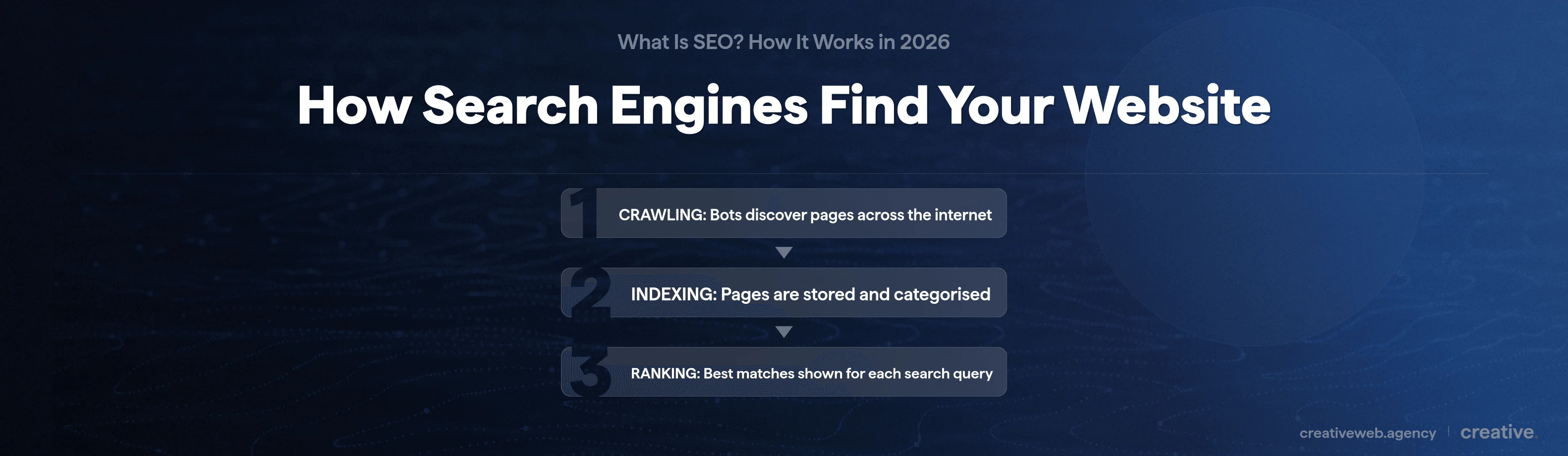
So how does SEO actually work? It comes down to three steps.
Crawling, Indexing, and Ranking
Think of it like a library system. Google sends out bots (called crawlers) to discover web pages across the internet. That’s crawling.
It then stores and categorises what it finds in a massive index. That’s indexing.
And when someone types a search query, it decides which pages to show and in what order. That’s ranking. The list of results you see is called a SERP: a search engine results page.
AI systems work similarly: they crawl content, evaluate its quality, and decide what to reference in their answers. So the technical requirements for being found by Google and being cited by ChatGPT are increasingly the same thing.
What Search Engines Are Looking For
Google uses over 200 ranking signals according to their own Search Central documentation, but the important ones boil down to something called E-E-A-T: Experience, Expertise, Authority, and Trust.
- Experience: Has the author actually done the thing they’re writing about?
- Expertise: Do they know the subject properly?
- Authority: Do other credible sources link to or reference them?
- Trust: Is the website secure, accurate, and transparent?
Great, what does that mean in practice though? It means search engines want content from people who genuinely know their subject.
Keyword stuffing is dead.
What matters now is search intent: matching what the person actually wants, not just the words they typed.
If someone searches “best accountant near me,” they want recommendations and contact details. Not a Wikipedia entry on accountancy. Your content needs to understand that difference.
The Four Types of SEO (and an Emerging Fifth)
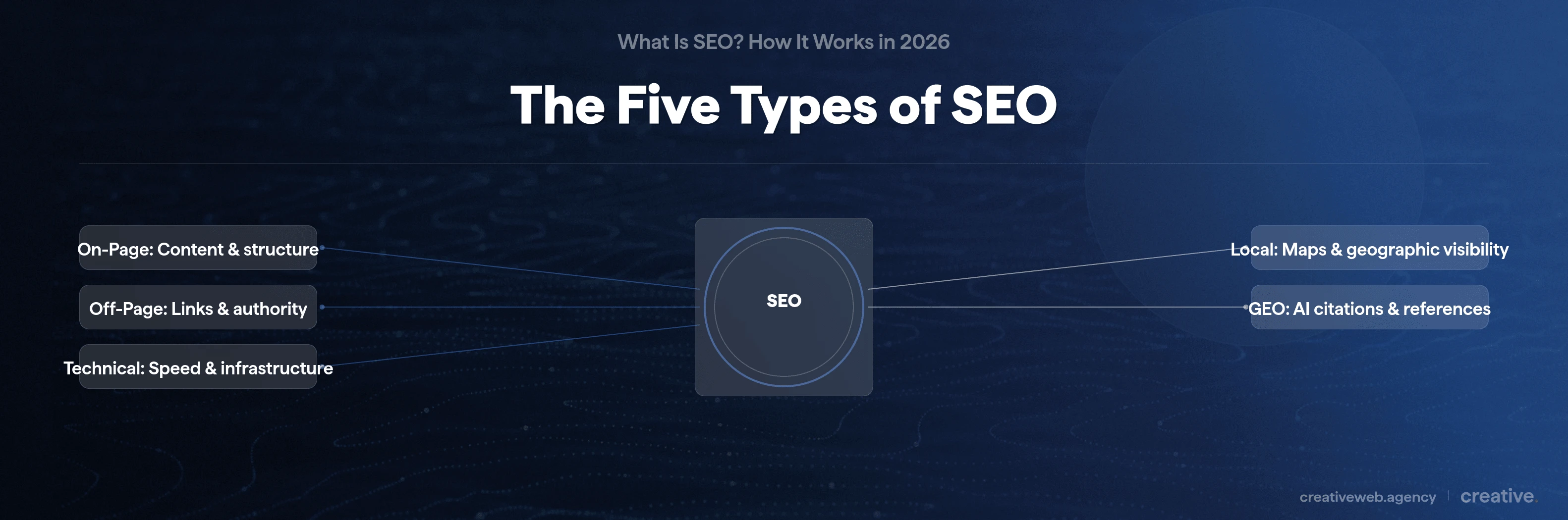
SEO isn’t one thing. It breaks down into four established types (on-page, off-page, technical, and local), with a fifth gaining ground in 2026: GEO.
On-Page SEO
This covers everything on your actual web pages: title tags, headings, content quality, internal linking, meta descriptions, and image alt text. Basically, making your content relevant and well-structured so both search engines and readers understand what you’re offering.
A Yorkshire accountancy firm, for example, shouldn’t just have a generic “Services” page. They need pages built around what their clients actually search for: “small business tax returns Leeds” or “VAT registration help Yorkshire.”
Off-Page SEO
Off-page SEO is everything happening outside your website. The biggest factor here is backlinks: other websites linking to yours. Think of each link as a vote of confidence.
Quality matters far more than quantity. One link from a relevant, respected publication beats fifty from random directories nobody visits. And from what we’ve seen, AI systems increasingly track citations and brand mentions too, when deciding what to reference in their answers.
Technical SEO
This is the backend infrastructure: site speed, mobile responsiveness, structured data (schema markup), security (HTTPS), and whether search engines can actually crawl your pages without running into problems.
Core Web Vitals (Google’s user experience metrics) measure loading speed, interactivity, and visual stability. 62.5% of all web traffic now comes from mobile devices according to Statista, so if your site takes five seconds to load on a phone you’re losing both rankings and visitors (yes, we still see this happening in 2026).
Top tip: fix technical issues before anything else.
Everything else builds on this foundation.
Local SEO
For UK service businesses, local SEO is often the most accessible starting point. It centres on your Google Business Profile, consistent local citations (your name, address, phone number listed correctly across directories), and location-specific content.
The good news: the map pack at the top of Google has stayed resilient against AI Overviews. When someone searches “plumber near me,” Google still shows that local map with phone numbers and reviews.
BrightLocal’s 2025 survey found 98% of consumers used the internet to find information about local businesses. If you have a service business with a geographic area, local SEO can deliver results in weeks.
GEO: The Emerging Fifth Type
GEO stands for Generative Engine Optimisation.
It’s about structuring your content so AI systems can reference and cite it in their answers.
This isn’t a separate discipline from SEO. It’s an evolution of the same principles: clear, fact-rich, well-structured content with demonstrable expertise.
If your content answers a question comprehensively and credibly, both Google and ChatGPT are more likely to use it. We cover this properly in the next section, and our GEO services page breaks down how we approach it.
Why SEO Still Matters for UK Businesses
Is SEO dead? No. But the “stuff keywords in and build dodgy links” version of it definitely is.
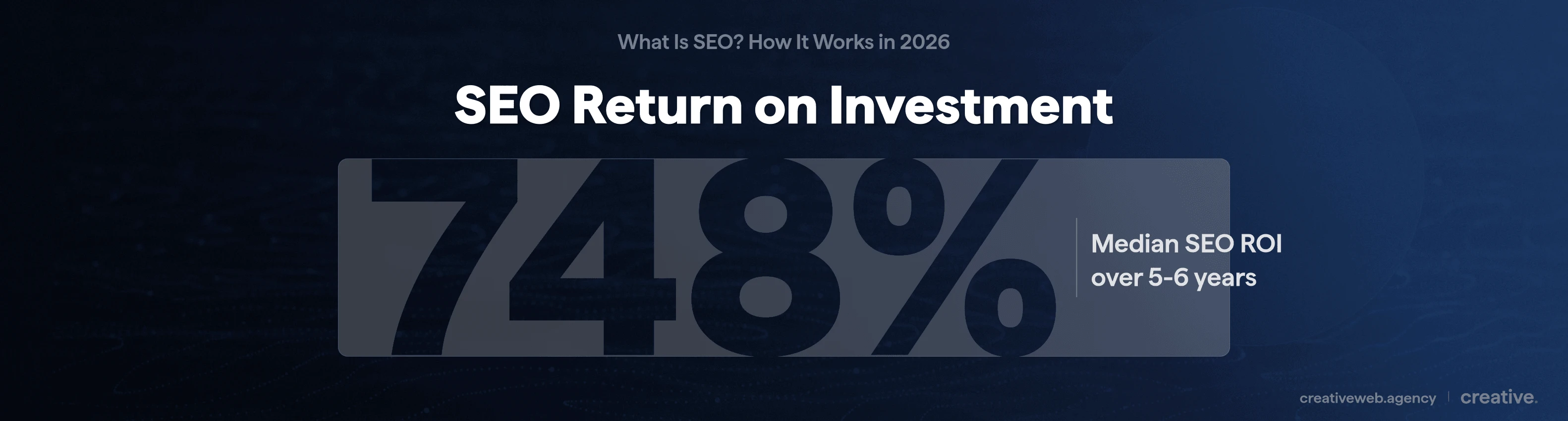
Organic search leads close at 14.6%, compared to just 1.7% for outbound marketing according to HubSpot’s research. The median return on SEO investment over five to six years is 748% according to FirstPageSage. For UK small businesses, it’s still one of highest-return channels in digital marketing.
But here’s what most guides won’t tell you.
The Foundation-First Argument
We build websites and run SEO campaigns for UK businesses, so we’ve seen what happens when people skip the foundations.
If your website has unclear messaging, dated design, or loads slowly on mobile, SEO won’t fix that. SEO amplifies what’s already there. If what’s already there isn’t converting visitors, you’re just amplifying a problem.
We had a client come to us after spending eight months paying another agency for SEO.
Traffic hadn’t moved.
The issue wasn’t the SEO work: their website was confusing, contact forms didn’t work properly on mobile, and the homepage didn’t clearly explain what they actually did. They needed a better website first, not better rankings.
Where Should You Start? A Self-Assessment
These are the questions we work through with every new client:
- Is your website fast, mobile-friendly, and clearly positioned? If not, fix foundations first. This is priority one, not SEO.
- Do your customers actually search for your services online? If not, SEO might not be your priority right now. Some businesses run entirely on referrals.
- Can people find you when they Google your business name? If not, start with local SEO basics: Google Business Profile and consistent business listings.
- Are competitors ranking above you for terms your customers use? If yes, you need a full SEO strategy covering technical, content, and authority.
- Do you want AI assistants to recommend your business? If yes, structured, experience-backed content is your competitive edge.
Four possible outcomes: fix your foundations, start with local SEO, invest in a full strategy, or accept that SEO isn’t your priority right now.
All of them are valid.
When SEO Might Not Be Your Priority
If you’re running a two-person consultancy with a full client book and no spare capacity, SEO probably isn’t urgent. But if you’re not visible when someone Googles you after getting a personal recommendation, that’s still a gap worth closing.
How AI Is Changing SEO
Ok, so this is the bit that’s genuinely new since the last time someone explained SEO to you.
What AI Overviews Mean for Your Website
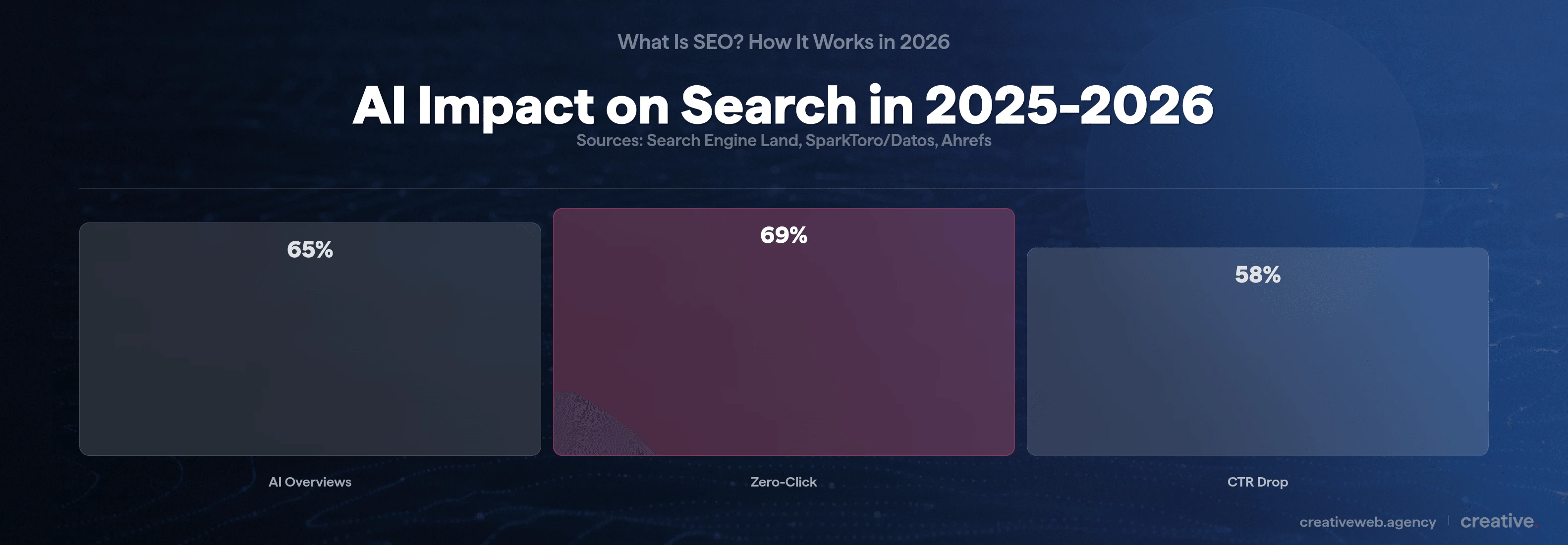
Google’s AI Overviews now appear in roughly 65% of search results according to Search Engine Land. Zero-click searches (where people get their answer without visiting any website) have reached 69% based on SparkToro and Datos research. And when AI Overviews do appear, they cut click-through rates by about 58% according to Ahrefs.
So is that bad news?
Depends on your business.
If you’re a local service business (plumber, accountant, solicitor), the impact is smaller than you’d think. The map pack still shows prominently, and local queries need human follow-up: you can’t hire a plumber through an AI Overview.
But if you’re competing on informational content, the bar has risen. Your content needs to be good enough to be cited in AI answers, not just ranked on page one.
From SEO to GEO
Here’s where our experience comes in.
In our work, we’re already seeing the shift: it’s less about how many people click through and more about how often content gets referenced in in AI-generated answers.
SEO optimises for rankings (clicks). GEO optimises for AI citations (references). But the line between them is disappearing.
The same things that make content rank well are exactly what AI systems look for when choosing sources to cite: clear structure, genuine expertise, factual accuracy, proper attribution. It’s content marketing at its most fundamental.
We’re already building strategies that cover both traditional search visibility and AI citation.
SEO isn’t being replaced by GEO. It’s evolving into it. The principles haven’t changed: the playing field has expanded.
For business owners, the practical takeaway is straightforward: invest in being a genuinely useful, trustworthy source of information. If you do that, both channels benefit. And if you want to see how we build organic visibility strategies that work across search and AI, that’s what we do.
Want SEO That Works Across Search and AI?
See Our SEO ServicesSEO vs Paid Advertising
Should you invest in SEO or just run Google Ads? The honest answer: it depends on your timeline and your budget.
The Compound Value of SEO
In our experience, SEO builds an asset that appreciates over time. A well-optimised page can generate leads for years without additional spend. PPC (pay-per-click) traffic stops the moment your budget runs out.
Organic leads cost roughly 61% less than paid leads according to Search Engine Journal, and they convert at significantly higher rates.
| Factor | SEO (Organic) | PPC (Paid Ads) |
|---|---|---|
| Time to results | 3-6 months | Immediate |
| Cost model | Ongoing investment | Pay per click |
| Traffic when you stop | Continues | Stops |
| Lead close rate | 14.6% | 1.7% (outbound) |
| Long-term ROI | Compounds over time | Flat |
When to Use Both
It’s not either/or. PPC gives you immediate visibility while SEO builds in the background. Many of the businesses we work with start with paid ads for quick wins and gradually shift budget toward organic as their SEO matures.
And there’s now a third channel worth watching: GEO (AI citation visibility). It behaves more like SEO than PPC, building gradually as your content earns trust from AI systems.
What SEO Investment Looks Like in the UK
Most guides conveniently skip this part. So how much does SEO actually cost in the UK?
UK Pricing Guide
Based on current market rates (which have gone up 15-30% since 2024 because AI-related work has expanded the scope of what agencies need to cover):
- Local SEO: £500-£1,200/month
- Regional SEO: £1,500-£3,000/month
- National SEO: £2,500-£6,000/month
- Enterprise: £5,000-£15,000+/month
The realistic minimum for meaningful strategic work is around £1,000-£2,000 per month. Below £500/month, you’re probably getting automated template-based work that won’t shift the needle.
NB: these are general market figures, not specific agency quotes. Pricing varies based on competition level, scope, and industry.
Red Flags When Hiring
- Guaranteed #1 rankings: Nobody can promise this. Google considers hundreds of factors no single agency controls.
- Sub-£500/month pricing: The work required for genuine results simply can’t be delivered at this price point.
- No transparent reporting: If you can’t see what they’re doing and what’s changing, that’s a problem.
- No strategy document before work begins: A good agency researches and audits before touching your website.
- No mention of AI search or GEO: Any agency in 2026 still only talking about Google rankings is behind the curve.
What Good SEO Actually Involves
Right, so what actually happens when you invest in SEO? Here’s the month-by-month reality.
The First Six Months
Months 1-2: Technical audit, keyword research, competitor analysis, and a strategy document. No changes to your website yet, but the groundwork for everything that follows.
Months 3-4: Technical fixes (site speed, mobile issues, crawl errors), content creation based on research findings, on-page optimisation across key pages (titles, headings, internal linking).
Months 5-6: Authority building through digital PR and quality backlinks. Content expansion into supporting topics. Initial results starting to appear in your search data.
Local SEO often delivers visible results faster than this. If you have a Google Business Profile, you can see movement in weeks rather than months.

How to Know It’s Working
Don’t just track rankings.
The metrics that actually matter:
- Organic traffic trends (month-over-month direction, not daily noise)
- Lead quality and conversion rate (are the visitors actually becoming customers?)
- Indexed page count (is Google finding and storing your content?)
- AI citation appearances (is your content being referenced in AI-generated answers?)
That last one is relatively new. Increasingly, we track how often content gets cited in AI answers alongside traditional traffic metrics. It’s an early signal that your content is building real authority.
3-6 months is typical for initial SEO results. Competitive terms can take 6-12 months. Anyone promising results in a fortnight is selling something other than SEO.
Your Next Step
Remember that business owner who couldn’t find their company in Google or in ChatGPT? The fix wasn’t complicated: make their content worth finding and citing.
SEO in 2026 means having a technically sound website, backed by content that genuinely helps your target audience and demonstrates real expertise. The playing field has expanded into AI, but the fundamentals are the same ones that have always worked.
Run through that self-assessment above. If you want to know where your site currently stands, head over to our website audit page: it’s a good starting point.
Frequently Asked Questions
-
What is SEO in marketing?
-
SEO is one channel within digital marketing, focussed specifically on earning organic (unpaid) visibility in search engines and AI-generated answers. It differs from PPC, social media, and email marketing because it builds a long-term asset rather than paying for temporary visibility.
Did this answer your question? YesThat’s great glad we could help! Start a ProjectNoNo problem, one of our experts can give you a more in-depth answer. Ask our Experts -
What are the 4 types of SEO?
-
On-page (content and structure), off-page (backlinks and authority), technical (site infrastructure), and local (geographic visibility). A fifth type is emerging: GEO (Generative Engine Optimisation), which focuses on getting your content cited in AI-generated answers.
Did this answer your question? YesThat’s great glad we could help! Start a ProjectNoNo problem, one of our experts can give you a more in-depth answer. Ask our Experts -
How does SEO work?
-
Short version: search engines crawl your site, index what they find, and rank pages based on relevance and quality. When someone searches, Google matches their query against its index and serves the best results. In 2026, AI systems like ChatGPT do something similar when deciding what content to reference in their answers.
Did this answer your question? YesThat’s great glad we could help! Start a ProjectNoNo problem, one of our experts can give you a more in-depth answer. Ask our Experts -
What is a backlink in SEO?
-
A backlink is a link from another website to yours. Search engines treat them as votes of confidence: the more relevant, reputable sites linking to you, the more authority your site builds. Quality matters far more than quantity though. One link from a respected industry publication is worth more than fifty from random directories nobody visits.
Did this answer your question? YesThat’s great glad we could help! Start a ProjectNoNo problem, one of our experts can give you a more in-depth answer. Ask our Experts -
Is SEO dead in 2026?
-
No. It’s evolving, not dying. AI Overviews have changed how some searches work, but organic visibility is still valuable. The businesses that invested in strong SEO are the ones now getting cited in AI answers too.
Did this answer your question? YesThat’s great glad we could help! Start a ProjectNoNo problem, one of our experts can give you a more in-depth answer. Ask our Experts -
How long does SEO take to work?
-
Typically 3-6 months for initial improvements. Competitive keywords can take 6-12 months. Local SEO often shows results within weeks. And AI citations can appear before traditional page 1 rankings, because AI systems evaluate content quality differently.
Did this answer your question? YesThat’s great glad we could help! Start a ProjectNoNo problem, one of our experts can give you a more in-depth answer. Ask our Experts -
How much does SEO cost in the UK?
-
It depends on scope. Local SEO typically runs u00a3500-u00a31,200 per month, regional SEO u00a31,500-u00a33,000, and national campaigns u00a32,500-u00a36,000. The realistic minimum for meaningful work is around u00a31,000-u00a32,000 per month. Below u00a3500, you’re likely getting template-based work that won’t move the needle.
Did this answer your question? YesThat’s great glad we could help! Start a ProjectNoNo problem, one of our experts can give you a more in-depth answer. Ask our Experts -
Can you do SEO by yourself?
-
The basics, yes: set up a Google Business Profile, write genuinely useful content, make sure your site loads quickly. But strategic SEO (keyword research, technical auditing, authority building, content planning) usually needs professional help. It’s a bit like accounting: you can do your own books, but a complex tax return probably needs an accountant.
Did this answer your question? YesThat’s great glad we could help! Start a ProjectNoNo problem, one of our experts can give you a more in-depth answer. Ask our Experts -
What is the difference between SEO and SEM?
-
SEM (Search Engine Marketing) is the umbrella term covering both SEO and PPC. SEO earns organic visibility; PPC buys it through ads. Most people use ‘SEM’ to mean paid search specifically, even though it technically includes organic too.
Did this answer your question? YesThat’s great glad we could help! Start a ProjectNoNo problem, one of our experts can give you a more in-depth answer. Ask our Experts -
Does social media help with SEO?
-
Not directly. Social media links don’t count as ranking signals for Google. But social activity helps indirectly: it drives traffic to your content, builds brand awareness, and can lead to natural backlinks when people discover and share your work.
Did this answer your question? YesThat’s great glad we could help! Start a ProjectNoNo problem, one of our experts can give you a more in-depth answer. Ask our Experts