Choosing Between Custom and Template Website Builds in 2026


A few years ago, choosing between a template and a custom website was straightforward. If your budget was limited, you went with templates. If you wanted something more unique, you went custom. Easy.
In 2026, the stakes are higher. Search isn’t just about matching keywords anymore. AI search engines like Google’s Search Generative Experience (SGE), ChatGPT Search, and Perplexity now interpret sites based on clean structure and clarity, trust signals, accessibility, user experience, and how they meet user intent.
If your site is built on a bloated, plugin-packed template, you could end up at a disadvantage. But that doesn’t mean every business needs to jump straight into a full custom build. The best choice depends on your business goals, scalability plans, and how important your site is for revenue and lead generation. This guide covers the real differences between the two options, from performance and to scalability and long-term value.
How AI Is Changing Search and the Way Websites Are Built
Here’s the thing: is reshaping what counts as a “good” website. Search engines aren’t just returning 10 blue links anymore. Instead, they’re summarising, synthesising, and sometimes answering queries directly using generative AI.
called these features “AI Overviews” and rolled them out widely in 2024, saying they expect the feature to reach “over a billion people” as it expands. Per Google’s Search Labs experiments, they found that people have used this feature billions of times. In particular, people used Google Lens to monthly.
So what does all of this mean for websites?
Speed and clarity matter more than ever
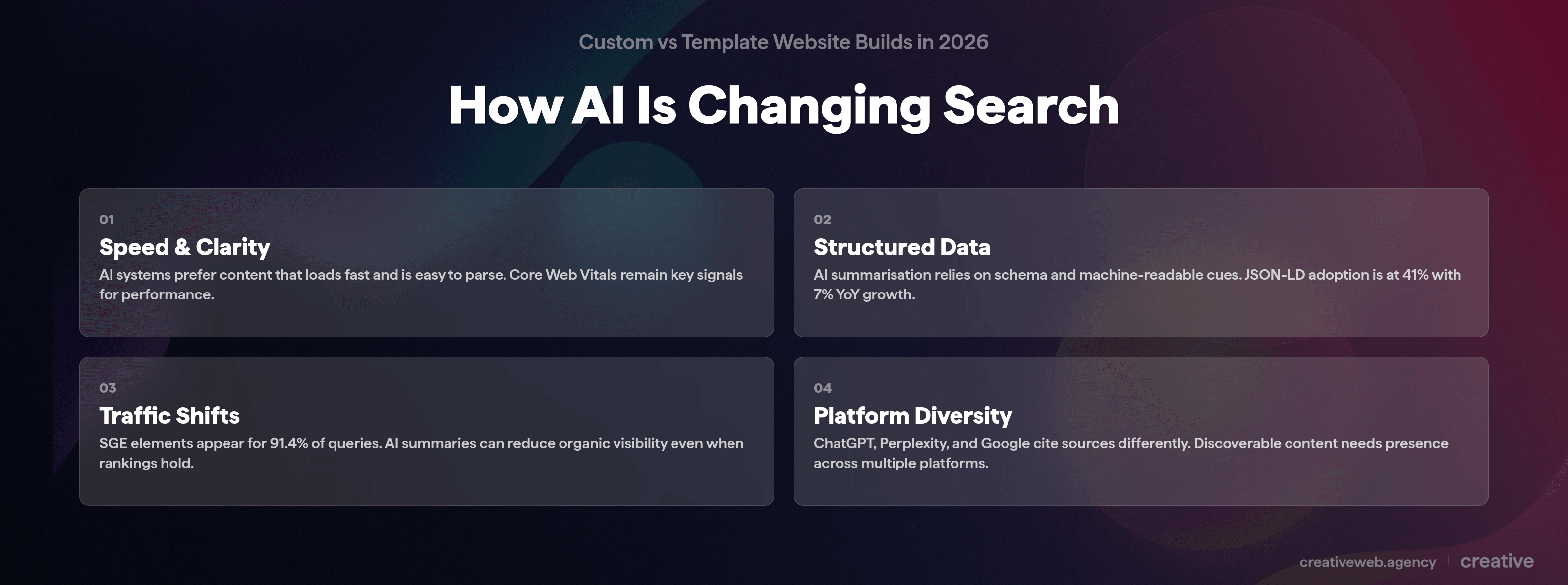
AI systems prefer content that loads fast and is easy to parse. Google’s remain a key signal for real-world performance (loading, interactivity, visual stability), and Google explicitly recommends optimising these metrics to improve how pages appear in Search.
In short: slow, messy pages are less likely to get highlighted or summarised, while websites with good CWVs will likely appear higher in SERPs.
Structured data is suddenly strategic
AI-powered summarisation relies on machine-readable cues (schema, structured data) to understand what your content is about.
Per a , adoption is growing across different structured data formats, which means more sites are optimising for AI-driven discovery:
- JSON-LD – 41% adoption, indicating a 7% YoY growth
- Open Graph – 64% growth in implementation (+5% YoY)
- RDFa – 66%, showing a 3% YoY growth
If your content isn’t semantically clear, AI may skip or misinterpret it.
Search results are shifting, and that can affect traffic
Early studies of Google’s SGE show noticeable changes in search result layouts and suggested that some sites saw drops in their usual organic visibility when AI summaries appear.
found that Google displays an SGE element for 91.4% of all search queries. These SGE results can affect traffic for sites in all verticals, with slightly less impact in Your Money Your Life categories.
That doesn’t mean SEO is dead. The rules for being picked as a trusted source are just changing. Clear structure, authority, and performance now carry more weight.
Different AI platforms cite differently, so diversify
ChatGPT, Perplexity, and Google all handle sourcing and citations in different ways.
shows Perplexity often leans on community-driven information (think Reddit and YouTube). Meanwhile, ChatGPT tends to prefer more authoritative sources (Wikipedia, Reddit, Forbes). Google AI Overviews blends both authoritative and social sources (Reddit, YouTube, Quora).
This matters because being discoverable in AI answers often depends on how you structure facts and show authority. So if you’re building a website, it helps to distribute high-quality content across the platforms these AI systems pull information from.
And while schema helps, it isn’t the be-all and end-all. According to , ChatGPT, for example, picks websites to cite based on four principles:
- Relevance, or which source has the clearest, most direct answer
- Authority, or the E-E-A-T framework, meaning ChatGPT values your site’s authoritativeness and credibility
- Consensus, meaning the information you publish can be found on other reputable sites
- Credibility (brand reputation, domain history), which signals to AI platforms that your site is a source that can be trusted
What Template Builds Actually Cost in 2026
A “template website” uses a pre-built layout adapted to your brand. Instead of building from scratch, designers use:
- WordPress themes/marketplaces
- Shopify themes for online stores
- Squarespace pre-designed layouts
They’re relatively affordable, quick to launch, and visually polished. Small teams can maintain them easily without coding.
That said, here are some cost considerations to think about when using template builds.
Upfront investment
In the UK, template-based websites for e-commerce sites.
A basic five-page site using builders like GoDaddy Website Builder can cost £155.88 annually. DIY options like Wix or Squarespace range from £10 to £40 a month. E-commerce options like Shopify or BigCommerce might cost you £25 to £500 monthly, while AI-powered builders like Hostinger can cost anywhere between £20 and £200 per month.
Hidden and recurring costs
The initial price rarely tells the full story. Some templates may require paid plugins to add functionality, and e-commerce features can start at , according to Forbes.
And once you start customising a template with premium fonts or A/B testing tools? That’s where development costs start to creep in.
What Custom Builds Actually Cost in 2026
A is just what it sounds like – it’s built from scratch for your business. It involves creating a website that fits your audience’s expectations and your brand’s long-term goals.
You get cleaner code, tailored UX, stronger SEO, better performance, and scalability. In 2026, that’s a huge deal because search engines and AI platforms reward fast, accessible, and well-structured sites.
Simply put, a well-built custom website is engineered for clarity and strategy.
Here’s what to consider when having a custom website built.
Upfront investment
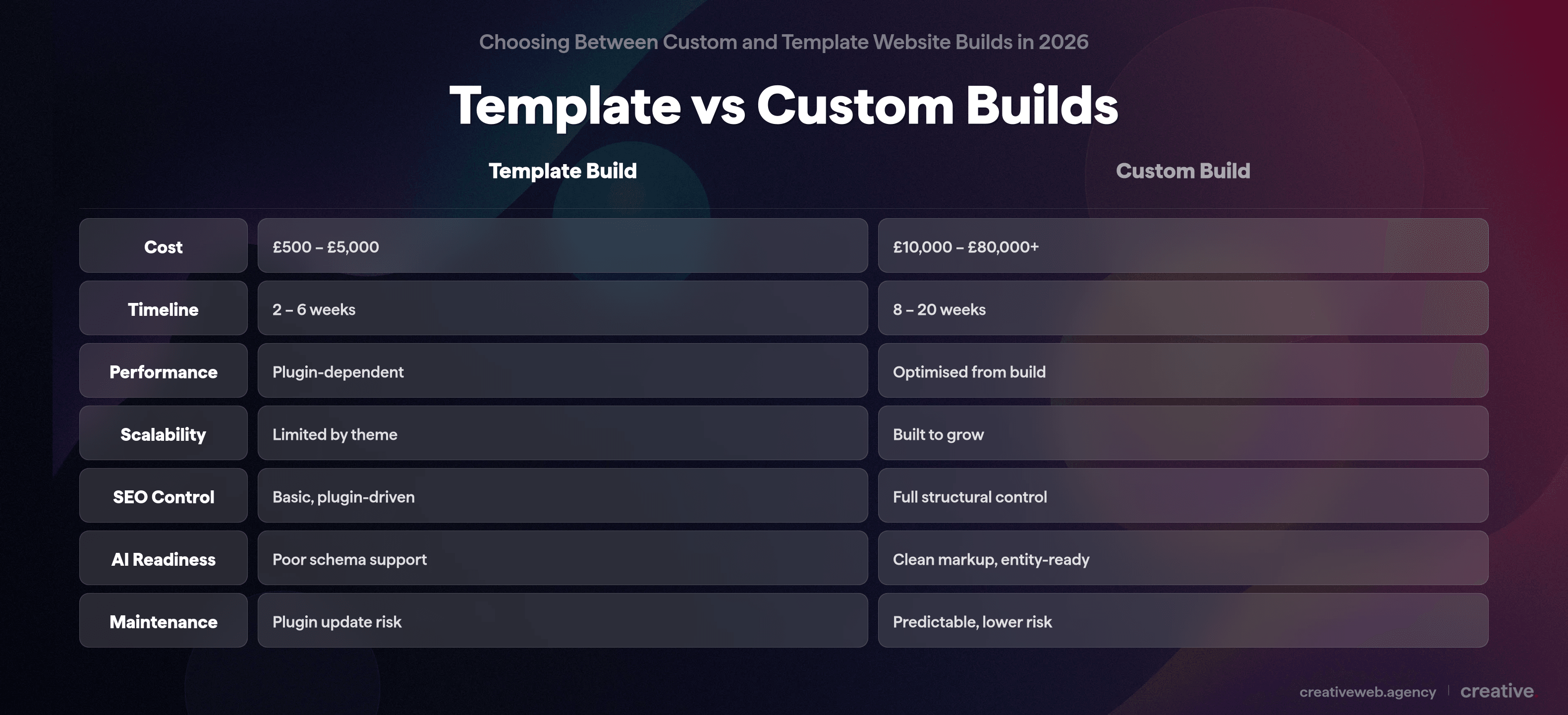
In the UK, custom website development typically starts at £8,000 for small business sites and ranges up to £30,000 for more complex builds.
E-commerce custom builds start around £7,000 to £8,000 and can reach £40,000 to £50,000, depending on requirements. Enterprise websites with advanced functionality, API integrations, and multi-language support typically begin at £20,000 to £25,000.
We covered rates in more detail in our guide, which you can also use to compare unique cost scenarios based on your business needs.
The price reflects the time and expertise involved. A custom build requires discovery sessions, UX research, design iterations, tech stack, development, testing, and deployment. Agencies typically take 4–8 weeks (up to 12) for smaller projects and several months, or even up to a year, for complex platforms.
What drives the cost higher
Custom builds get pricier when you add features like payment gateways, booking systems, CRM integrations, custom coding and APIs, and user dashboards. Third-party integrations and custom features require specialised development work, with costs varying based on complexity and how many systems need to connect.
Price Comparison
Here’s a realistic snapshot of the UK market in 2026:
Performance: Why Templates Struggle (and Custom Often Shines)
Performance should never be an afterthought because it directly impacts:
- Conversions (slow sites cause users to bounce)
- SEO ranking signals, including Core Web Vitals
- Trust and brand perception
- AI search results
The difference that speed makes
According to Google and independent UX studies:
- Faster pages can improve conversions by 2%–7% for each 1-second improvement.
- 53% of users will likely abandon a site or mobile page if it takes more than 3 seconds to load.
Why templates tend to lag behind
Templates are built to impress in demos, not for lean, task-focused user journeys. They often rely on page builders like Elementor, Divi, or WPBakery, which add extra HTML and CSS, resulting in:
- Larger Document Object Model sizes (slower rendering, less interactivity)
- Higher layout shift (worse user experience)
- More scripts loading upfront
Add to this a stack of plugins for features you don’t even use, and you get a site that looks nice but performs poorly.
Why custom builds usually perform better
Custom sites are built intentionally. Developers can reduce unnecessary third-party scripts, optimise CSS and images, or cache intelligently and optimise server responses.
Compare Your Options
Use our web design cost calculator to see what a custom or template build would cost for your business.
Try the Cost CalculatorUser Experience: Why Custom Often Converts Better
Templates offer a “set-and-forget” layout but don’t account for strategy or your customer’s mindset.
Where templates fall short
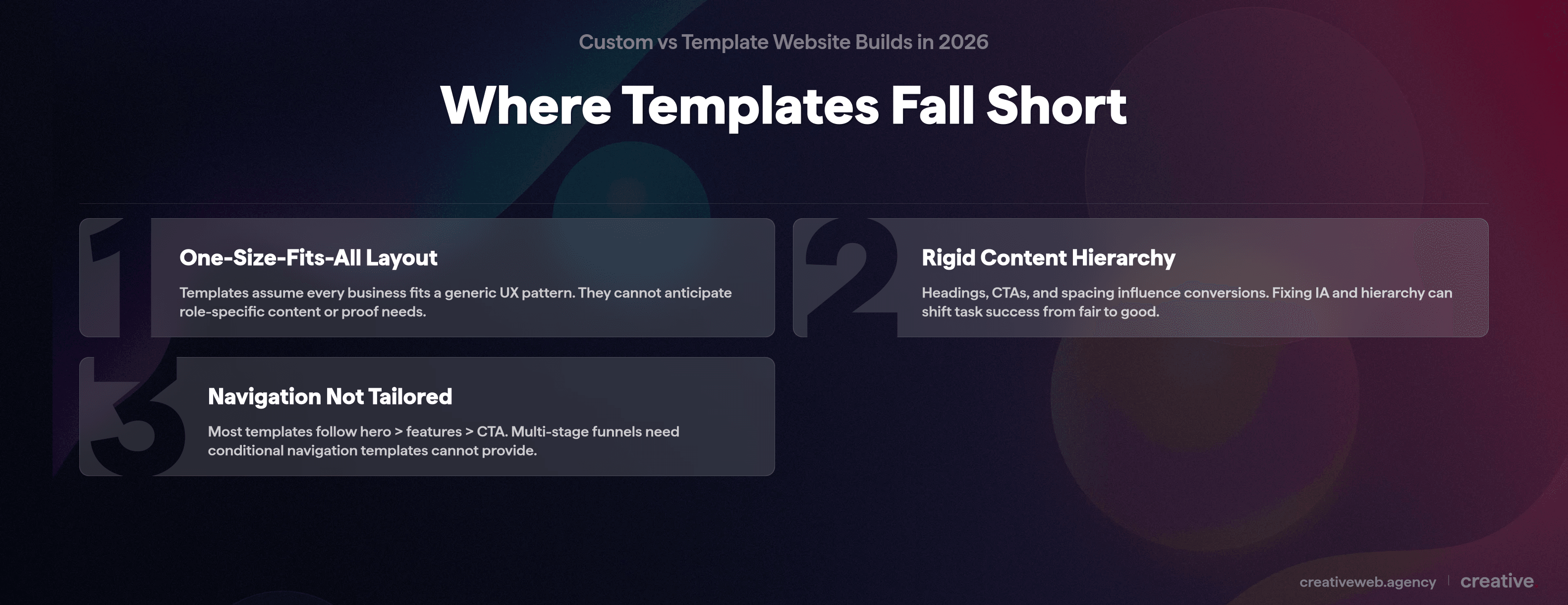
One-size-fits-all layout
Templates assume every business fits a generic UX pattern. But your customers may need more proof early in the journey, role-specific content (e.g., CFO vs IT manager), or simpler or shorter messaging. Templates can’t really anticipate those nuances.
Rigid content hierarchy
Headings, CTAs, and spacing influence conversions more than most people realise.
Improving information architecture (IA) and visual hierarchy using methods like card sorting or tree testing can lead to big gains in task success, the Nielsen Norman Group. In practice, teams can see pages shift from ‘fair’ to ‘good’ success rates (for example, from 41%–60% towards 60%–80%) after implementing IA and hierarchy fixes.
Navigation not tailored for intent
Most templates follow the same “hero features CTA” flow. Businesses with multi-stage funnels like software enquiries or segmented user roles need conditional navigation that a template usually can’t provide.
Why custom UX performs better
Custom sites are built around your customers’ actual behaviours. That means designing pathways for different buyer types, adjusting messaging based on intent, segmenting different journeys, and encouraging conversions at the right moments.
This results in higher conversions, stronger trust, and a more tailored experience.
Scalability: The Cost You Don’t See Until It’s Too Late
Templates handle initial launches well, but the thing is, most businesses don’t stay static for long.
Why templates struggle to scale
- New features require hacks. Duplicating styles, adding extra plugins, limited integration, or manually patching the theme.
- More content = slower editing. Page builders struggle with bigger sites.
- The problem with JavaScript. Some site builders rely heavily on JavaScript, which can affect mobile experiences and cause slow load times or layouts to shift.
Why custom sites scale more smoothly
Custom builds use flexible architecture and reusable components, letting you add pages, content, or features without breaking the existing design or performance.
Good custom-built websites can last 4–6 years or more without a rebuild, making them far more cost-effective over time.
Security and Maintenance
Security is a factor many businesses overlook, but it’s a part of long-term value.
Templates and plugins: A bigger attack surface
WordPress vulnerabilities show where risk lies. A reported that in 2024, 7,966 new security issues were found (roughly 22 per day), and 96% of these were in plugins. Only a tiny percentage affected WordPress core.
Some vulnerabilities require no login at all to exploit. About in 2024 were exploitable without authentication.
Combine this with the fact that many plugins are abandoned or poorly maintained. haven’t been updated in 2+ years, raising security risks dramatically.
With templates, you often take on many plugins to compensate for missing features. That’s more shared codebases, more risk, and more things that can break or be exploited.
Custom builds reduce unnecessary dependencies
A custom build has fewer moving parts and little to no reliance on shared codebases, so security oversight becomes simpler. Maintenance is more predictable because you’re not managing 20+ separate plugin codebases.
How to Make the Right Decision for Your Business
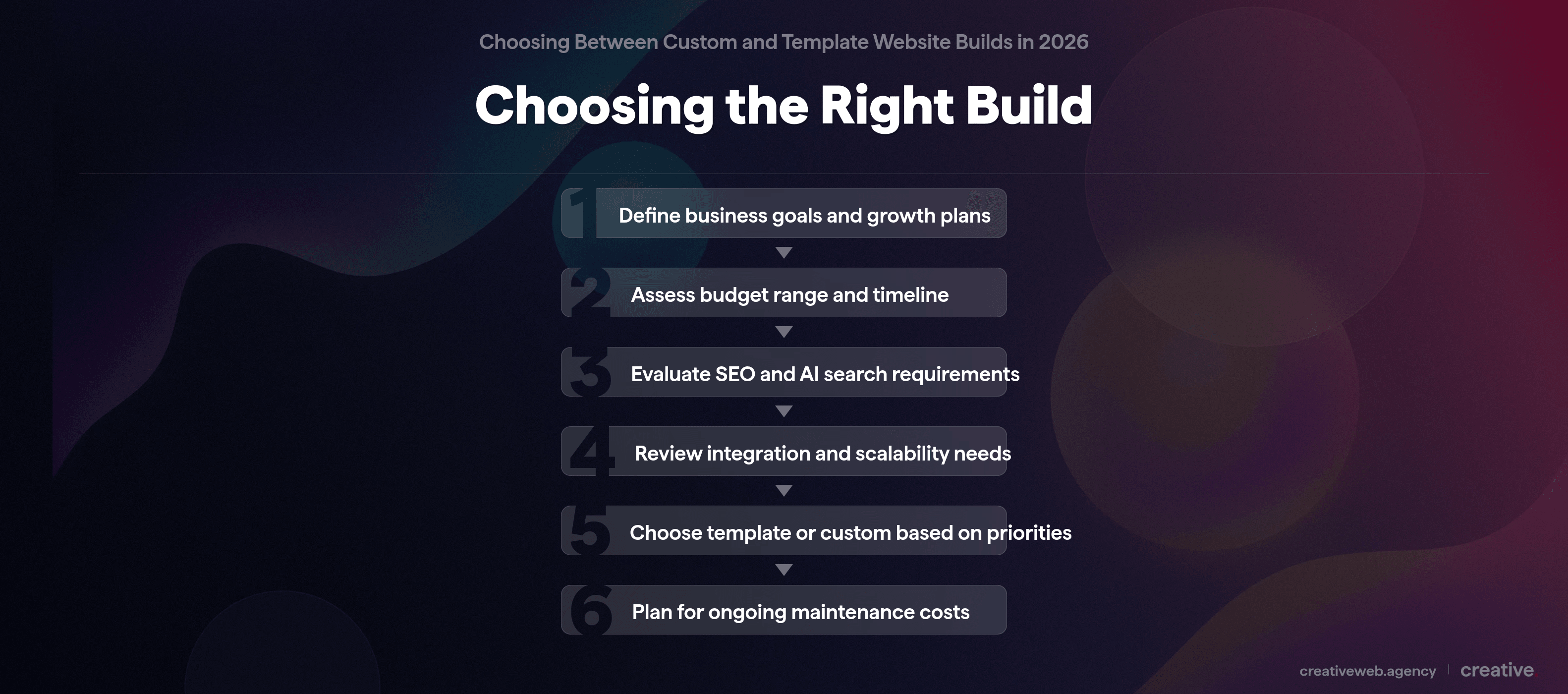
Follow this decision framework to determine which approach suits your situation:
Assess your timeline
Choose templates if you need to launch in under 4 weeks, you’re testing business ideas, or you have a time-sensitive campaign.
Choose custom if you can wait 4–12 weeks for launch, want a long-term strategic asset, or want to avoid rebuilding in 1–2 years.
Evaluate your budget
Choose templates if your total budget is under £5,000, or you need to preserve capital for other business needs. Now, if you can invest £8,000–£50,000 upfront, you view the website as a strategic investment, or you want to avoid accumulated costs over time, then consider choosing custom-built websites.
Consider your functionality needs
If you only need basic pages, forms, or content, standard functionality serves your needs, or you don’t require complex integrations, opt for templates. Choose custom if you need custom dashboards, APIs, or unique workflows. Custom sites also work if your business requires specific functionality not available in templates, or you’re building a platform or complex app.
Final Considerations
The template versus custom website build decision is about matching your choice to your specific situation, goals, and resources.
Templates work for businesses that need functional sites quickly or operate with tight budgets.
Custom builds deliver long-term value when your website is a core revenue driver, you need custom integrations or workflows, you require complex functionality, or your competitive edge depends on offering unique digital experiences.
Whether you start with templates and migrate later, or invest in custom from day one, the key is making an informed decision based on your current reality and future trajectory.
Use our to compare both paths and choose what fits your business goals and budget.
FAQ
-
Is a custom website always better than a template?
-
Not always – templates work perfectly for low-complexity needs. Custom becomes better when performance, conversions, or scalability matter.
Did this answer your question? YesThat’s great glad we could help! Start a ProjectNoNo problem, one of our experts can give you a more in-depth answer. Ask our Experts -
How long does each type take to build?
-
Template builds can take anywhere between a few hours and several weeks – quicker if you’re using no-code platforms. Meanwhile, custom sites can take between 4 and 12+ weeks, or even up to a full year, depending on complexity.
Did this answer your question? YesThat’s great glad we could help! Start a ProjectNoNo problem, one of our experts can give you a more in-depth answer. Ask our Experts -
Are templates bad for SEO?
-
Not automatically, but bloated code and plugin dependencies make them harder to optimise.
Did this answer your question? YesThat’s great glad we could help! Start a ProjectNoNo problem, one of our experts can give you a more in-depth answer. Ask our Experts -
Why are custom websites more expensive?
-
You’re paying for strategy, unique UX, original design, clean code, and long-term scalability, as well as the designer’s or developer’s years of experience and skills.
Did this answer your question? YesThat’s great glad we could help! Start a ProjectNoNo problem, one of our experts can give you a more in-depth answer. Ask our Experts -
Can I scale a template site later?
-
Yes, but businesses might eventually outgrow it and require a partial rebuild.
Did this answer your question? YesThat’s great glad we could help! Start a ProjectNoNo problem, one of our experts can give you a more in-depth answer. Ask our Experts