Web Design Best Practices for Tech Companies: Five Simple Strategies for Complex Products

Connectivity is one of the top trends that drives the tech industry. But how can tech companies effectively connect with management teams and investors?
Considering that website design is the main hub where digital products can introduce their brand identity and product capabilities, web development is as important for tech companies as the development of their own products. From page layout to sentence structure, here’s how tech companies can use web design to simplify complex technologies without underselling their capabilities.
Key Takeaway
The best tech websites are visually polished and built upon clarity and trust. By focusing on benefits and value instead of purely features and using social proof like customer testimonials to back up these claims, tech companies can create a faster path to conversion.
5 Web Design Best Practices for Tech Companies
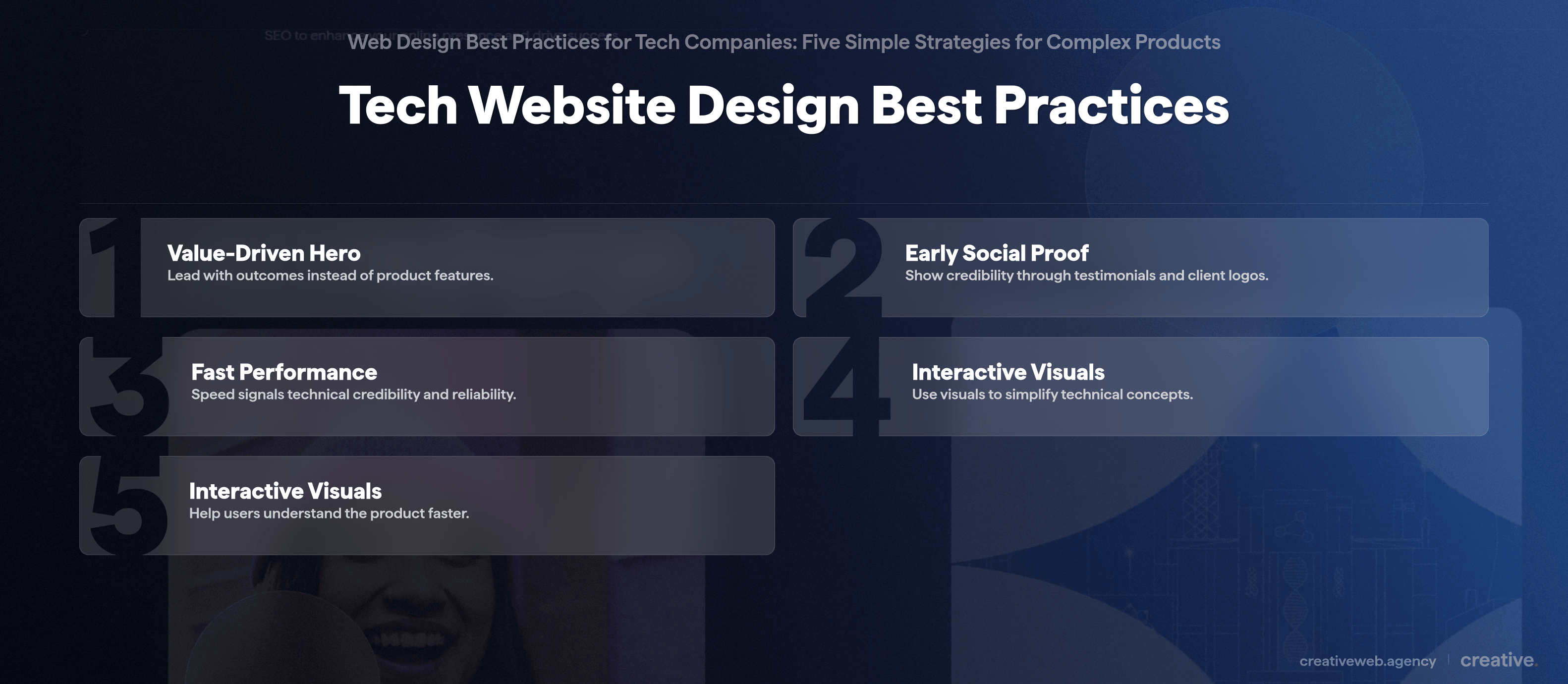
1. Lead with a value-driven hero section
A value-driven hero section effectively frames your tech product and positions your company as user-centric, helping you to connect with your target audience on an emotional level. It shows that you understand their specific pain points and illustrates how your product is meaningfully different from your competitors.
To do this, you’ll focus less on features and product descriptions and more on outcomes. For example, big tech companies like Adobe and Samsung use phrases like “work smarter and faster”, “decluttering on demand”, “create the unexpected”, and “stay connected effortlessly”. These headings focus on the results users can achieve such as faster output and more unique photos.
In fact, outcome-orientated messaging can explain what your product does better than copy that focuses on features. This is especially true for tech websites with product features that sound almost identical making product differentiation hard to pinpoint. Plus, leading with value and benefits is less intimidating to non-technical buyers who might not understand the use of “next-generation API infrastructure” or “advanced driver-assistance systems”, for example.
You’ll also likely find that this formula makes it easier to write the rest of your website copy. With your value proposition defined from the outset, you can find features, case studies, client testimonials, and a call to action that support your storytelling.
2. Showcase social proof early
Tech buyers tend to be more naturally cautious as their decisions often involve a fair degree of risk, such as cybersecurity threats, data migration, and new system integration. For AI companies, it’s even a bigger challenge, and McKinsey reports that trust in AI companies has declined from 61% to 53%.
This means that your target audience starts to evaluate whether your product looks credible and safe early on. And your website design becomes one of the first credibility tests.
Social proof, like customer testimonials, client logos, review scores, case studies, and press mentions, reduces initial scepticism as it shows that your product is indeed legitimate. This is key because in moments of uncertainty, such as switching to a new system, we tend to gravitate toward tools that appear established and widely trusted.
For example, when we designed China Telecom Europe’s website, we listed links to the latest press releases, and testimonials on the home page. Plus, using WordPress as the content management system, gives them the flexibility to add new events easily, ensuring that recent achievements are included.
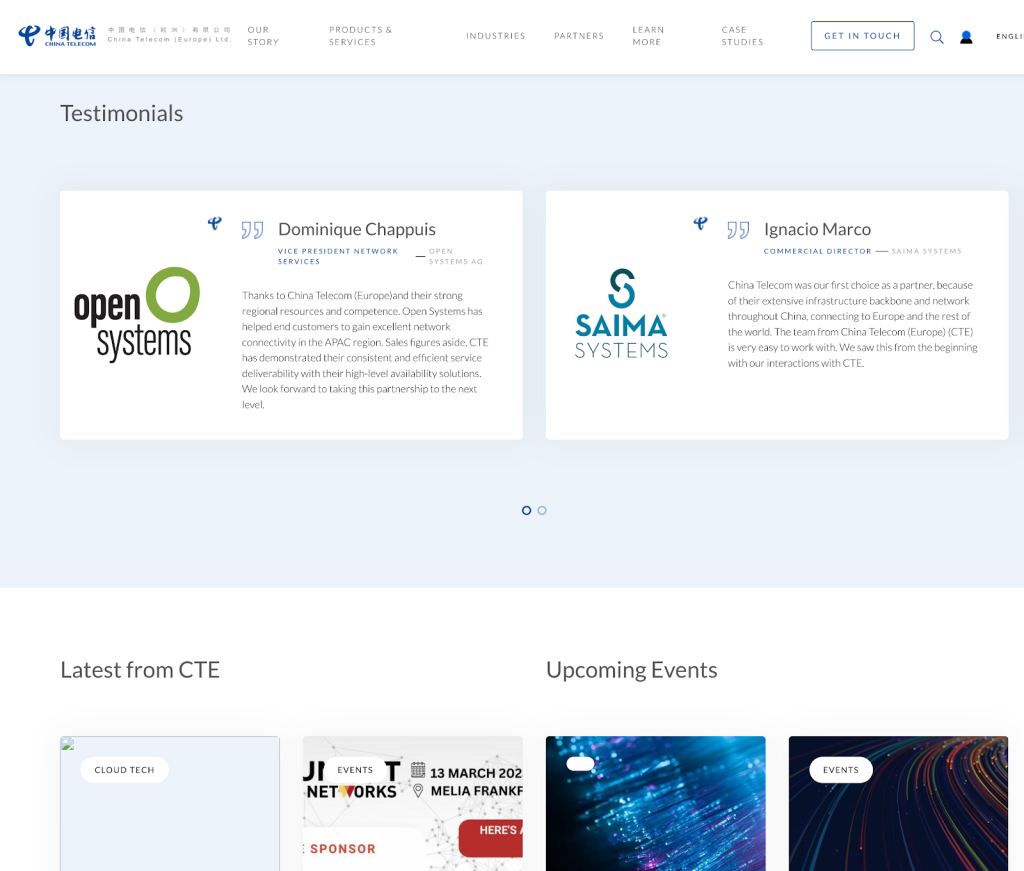
Source: China Telecom Europe
3. Prioritise performance and speed
While loading times are foundational for all industries, it’s even more so for tech sites. For e-commerce businesses, a website is a digital storefront, but for tech companies, website performance serves as a demonstration of your expertise.
If your website is sluggish, it will undermine your credibility as a tech leader (even when you showcase your social proof above the fold as recommended earlier). As a result, visitors will start to question the rest of your capabilities.
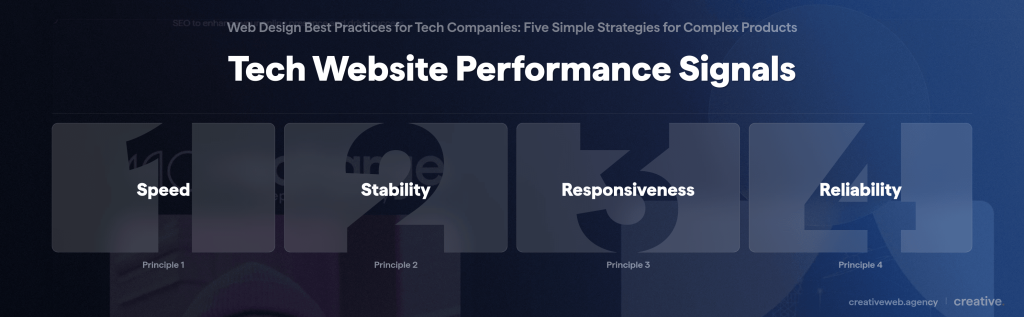
Slow site speed also adds friction to critical touch points like demo sign-ups. Developers and CTOs who want to see your solution in action, in particular, are uniquely sensitive to speed, latency, and overall performance. They know what a great performance is supposed to look and feel like.
And, of course, website speed also impacts your search ranking. Loading times are included In Core Web Vitals which means that Google will use it as a key ranking factor.
4. Incorporate interactive or visual elements
Digital products are inherently complex. It often involves abstract concepts like APIs, machine learning models, and security frameworks which are difficult to explain using traditional copywriting alone. For other industries interactive and visual elements are mere web design trends to follow, but for tech websites they become more functional.
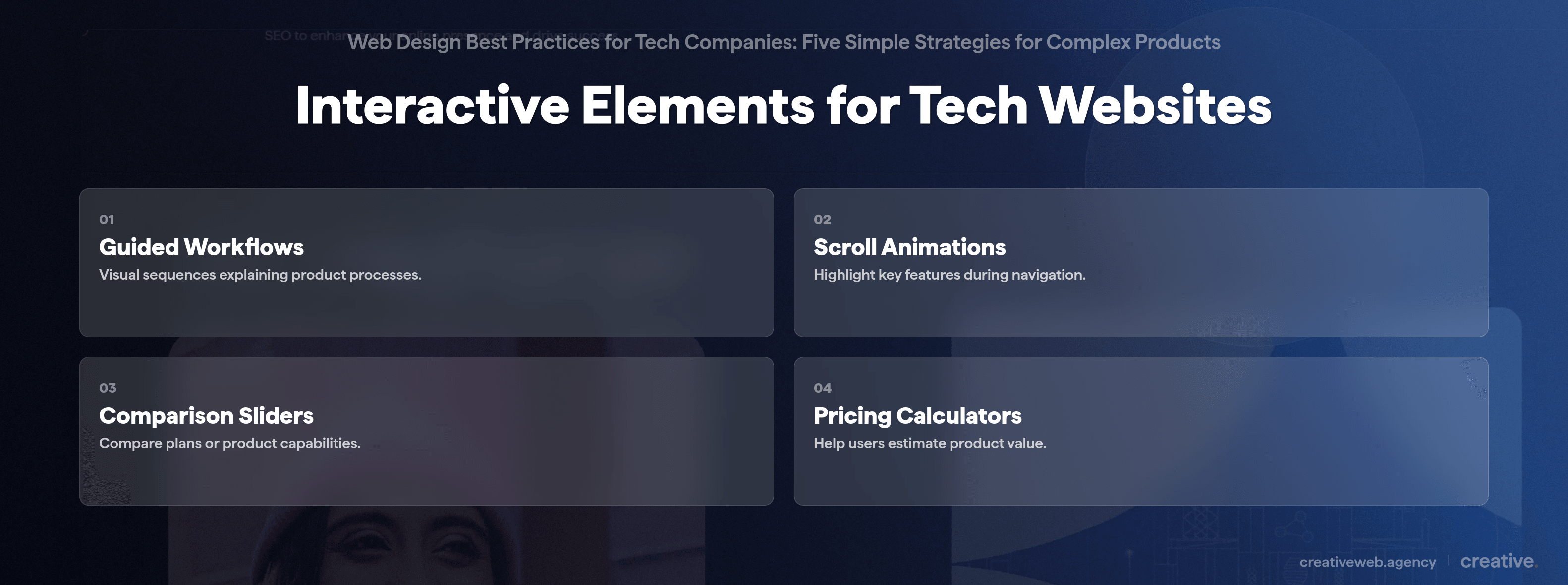
Guided sequences that walk users through workflows visually, scroll-triggered animations, comparison sliders, and pricing calculators are examples of how tech companies can help visitors understand their product’s value faster. It breaks down the complexity, reduces information overload, and improves understanding as well as information retention.
Plus, if your product is targeting technical as well as business decision-makers, visuals can make your offer more accessible across roles and expertise levels. Developers and non-technical stakeholders process information differently. For example, product walkthroughs can gently guide interested CTOs by using visual storytelling, while comparison sliders can organise information and highlight features and technical benefits that matter most to founders. This way, you can keep the user experience clear and focused. And, after all, people remember experiences better than text alone.
An element of interactivity also leads to better engagement. Instead of passively browsing different pages, interactive elements encourage visitors to explore your product deeper. It makes your product stick and lets potential users stick around on your website longer.
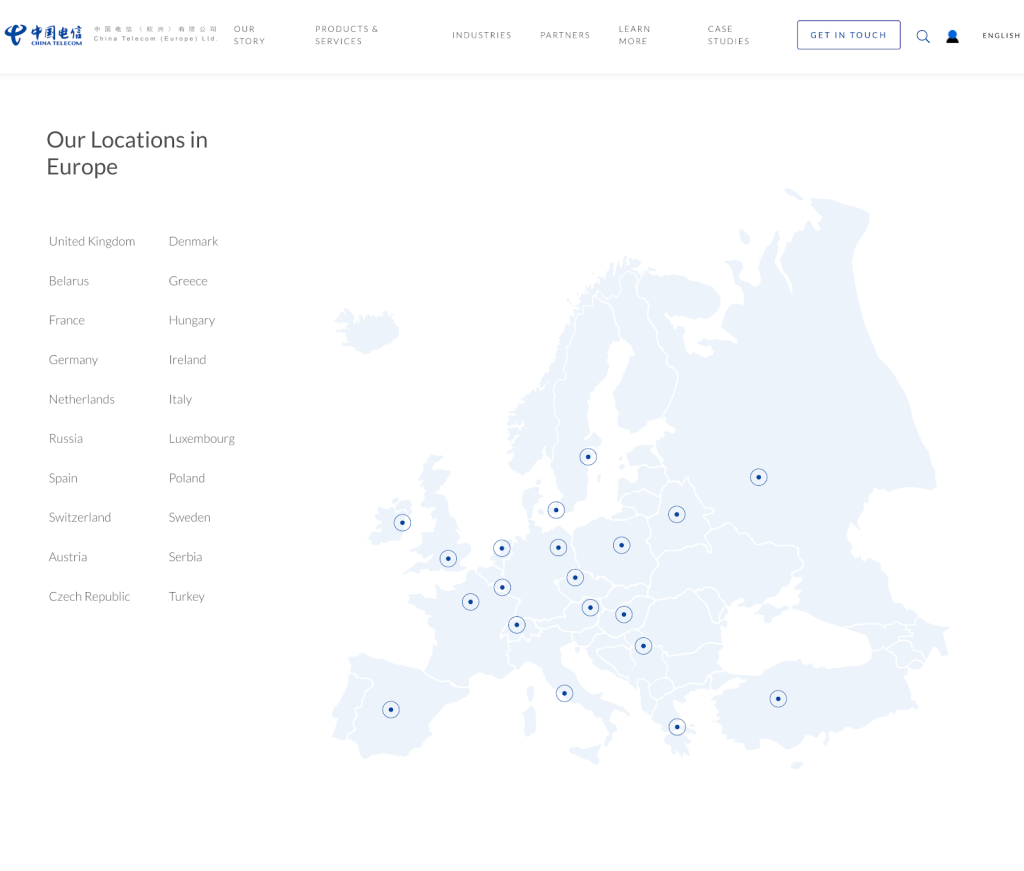
For example, for the website we designed for China Telecom Europe, we added an interactive map and used hover effects to explain key features like its extensive global coverage. The result is a helpful user experience that’s also satisfying.
A broader approach to tech website design
A structured approach to designing tech websites that prioritise clarity, performance, and usability for complex digital products.
Explore tech website design5. Create dedicated pages for key audiences
While interactive elements can help explain your tech product to different stakeholders, dedicated pages take it one step further. It lets you meet the audience where they’re at in the sales funnel giving you a platform where you can use language and examples that speak to their priorities directly. For example, CTOs want to understand data security when evaluating a tech solution, while C-level execs care more about return on investment.
Creating audience-specific pages can also help with your SEO strategy. This way, you can target more targeted queries like “cloud security solution for healthcare” instead of wasting your efforts on broad, competitive keywords. What’s more, long-tail phrases like these also typically generate traffic with higher intent that’s easier to convert.
Dedicated pages also make it easier to expand your website’s content as your tech company grows. When your product evolves, new audiences will emerge and you might want to target a new industry vertical like healthcare or different team roles like marketers.
FAQs
-
Why is website design so important for a tech company?
-
A tech company’s website is often the first place where target audiences and investors can evaluate a product’s technical competence and credibility. Plus, as many tech companies typically solve abstract, complex problems and work within a market where overlapping features make product differentiation subtle, good website design can help explain complicated ideas in a way that’s easier to understand. It can clarify what your product actually does and show how it can shape business success.
Did this answer your question? YesThat’s great glad we could help! Start a ProjectNoNo problem, one of our experts can give you a more in-depth answer. Ask our Experts -
What are the key web design trends for tech companies?
-
Examples of current web design trends that tech and software companies frequently use include: rnrn- Writing benefit-led headlines to shape their content hierarchy rn- Incorporating short product tours rn- Adding subtle motion and animation like buttons with gentle hover statesrn- Creating dark mode sites to reduce eye strain and cater to user preferencern- Using fluid grid layouts to ensure a responsive website
Did this answer your question? YesThat’s great glad we could help! Start a ProjectNoNo problem, one of our experts can give you a more in-depth answer. Ask our Experts -
What pages are essential for a tech company website?
-
The best tech websites typically include the following pages:rnrnA home page that immediately clarifies what the product does and who’ll benefitrnProduct or solutions pagesrnA features overviewrnPricingrnDocumentation/knowledge basernAbout and team pagesrnA blog or resource centrernContact page with a form to request a demo
Did this answer your question? YesThat’s great glad we could help! Start a ProjectNoNo problem, one of our experts can give you a more in-depth answer. Ask our Experts -
How can you improve tech websites’ conversion rates?
-
Tech audiences respond well to websites that are transparent. As such, it’s crucial that you include a value proposition, clear CTA buttons, and trust signals like customer testimonials and an SSL certificate. Then, to help improve conversion rate optimisation further, you should also focus on the user experience. This means including an intuitive navigation menu and user interface and ensuring loading times remain fast.
Did this answer your question? YesThat’s great glad we could help! Start a ProjectNoNo problem, one of our experts can give you a more in-depth answer. Ask our Experts -
Should tech companies include pricing on their website?
-
If possible, tech websites should include pricing information. Transparent pricing builds trust and can speed up the evaluation process. If you offer an enterprise solution or a highly customisable product, you can include a price range, starting price, or an interactive calculator to give interested buyers an indication of how much it will cost.
Did this answer your question? YesThat’s great glad we could help! Start a ProjectNoNo problem, one of our experts can give you a more in-depth answer. Ask our Experts