10 Things to Look for in an SEO Company (2026 UK Guide)

Go to any SEO company’s website right now. You’ll find the same three claims on every single one: “data-driven results,” “transparent reporting,” “bespoke strategies.” They’ve all read the same playbook.
So when every agency sounds identical, how do you tell which ones are actually worth your money?
We’re an SEO agency writing about how to evaluate SEO agencies (yes, we see the irony). But that means we know exactly what separates the companies doing genuine work from the ones running a sales operation. We’ve picked up enough clients who wasted months and thousands with the wrong agency to know what the warning signs look like.
This guide gives you 10 specific things to check before you sign anything. It’s written for UK businesses, with UK pricing, and updated for 2026: because AI search has changed what good SEO looks like.
If you’re still weighing up whether to hire an SEO company (a specialist that handles getting your site ranked on search engines) or go the DIY route: it works if you have 10-20 hours a week and about £200 a month for tools. If you don’t have that kind of time, finding the right SEO agency makes more sense than trial-and-error.
There’s a printable scorecard at the end. Bring it to your next agency meeting.
1. A Transparent Approach to Strategy and Methods
This is where everything starts. A good SEO company will explain what they’re doing, why they’re doing it, and how it follows Google’s Search Essentials (the official guidelines for ethical search engine optimisation).
We regularly talk to businesses who’ve spent months with an agency and can’t get a straight answer about what work was actually done. That’s always the first red flag.
How to verify white-hat practices
Ask directly: “Can you walk me through your link building process?”
A credible answer sounds like this: “We earn links through digital PR, guest contributions on relevant industry sites, and creating resources other sites want to reference. Here are three examples from the last quarter.”
A red flag answer sounds like: “We use proprietary outreach methods” or “we have relationships with a network of sites.” That vagueness usually means they’re buying backlinks (which violates Google’s spam policies and can get your site penalised).
Google’s own hiring guide states that no one can guarantee a #1 ranking (developers.google.com/search/docs/fundamentals/do-i-need-seo). Any agency claiming otherwise is either lying or doesn’t understand how search engines work.
Red flags that should end the conversation
Guaranteed rankings. “Secret sauce” excuses. Refusal to explain methods. Cold emails promising page 1 in 30 days. If you spot keyword stuffing on their own website, walk away.
Top tip: Check the agency’s own backlink profile using a free tool like Ahrefs’ backlink checker. If their own links look spammy, imagine what they’ll build for you.
2. Verifiable Case Studies and a Proven Track Record
Every SEO agency claims great results. The question is whether you can actually verify them.
A credible case study includes specific metrics with baselines: “organic traffic increased from 1,200 to 4,800 monthly sessions over 9 months” is useful. “We significantly increased traffic” is not. It should name the industry (if not the client), show a realistic timeline, and describe what the agency actually did.
We’ve been delivering SEO for UK businesses for over a decade. This article was first published in 2012, and we’re still here (which is more than you can say for most agencies from that era). In that time we’ve seen agencies fabricate case studies, use results from a single client across all their marketing, and claim credit for traffic that came from paid ads.
How to verify claims
Cross-reference reviews on Clutch, Trustpilot, and Google Reviews. Request a client reference call. And here’s one nobody tells you: ask to speak to a client who left. A confident agency won’t flinch at that question.
Clutch’s own research found that 84.5% of ChatGPT’s agency recommendations reference Clutch profiles, so a strong review presence on these platforms matters for AI visibility too.
Check whether the agency ranks for its own terms. Our site ranks #1 for “organic seo london” against much larger competitors. The best seo company in any market should be able to demonstrate this. If they can’t rank their own website, question whether they can rank yours.
Red flag: No case studies. Vague metrics. Refuses references. Uses one result across all their marketing.
3. A Customised Strategy, Not a Template
Generic SEO packages are a warning sign. A quality SEO agency starts by understanding your business, your competitors, and your business goals before proposing anything.
Here’s what we call the first-meeting test: does the agency ask more questions than they answer? Do they mention your specific industry, your competitors, your target customers? Do they request analytics access before writing an seo strategy?
A local plumber needs a completely different approach from an e-commerce retailer selling nationally. Any agency pitching the same seo campaign to both isn’t doing the work. A genuine content strategy might involve building hundreds of targeted pages over time (our own site has over 200 pages of optimised content). That’s not something you get from a template.
Ask: “What would you need to know about my business before creating a strategy?” If they can walk you through specific phases with specific deliverables, that’s a green flag. If they can’t describe their process, they’re improvising.
Red flag: Pitches a fixed package without asking about your seo needs, goals, or current performance.
4. Technical SEO Expertise Beyond the Basics
Technical SEO is the infrastructure that makes everything else work. But most guides mention it without explaining what it actually means if you’re not technical yourself.
In plain terms: it covers site speed (how fast your pages load), mobile friendliness, crawlability (whether search engines can find and index your content), Core Web Vitals (Google’s page experience scores), and structured data (code that helps search engines understand what your pages are about). A proper seo audit should assess all of these before any content work begins.
68.7% of all clicks go to the top 3 organic results (Backlinko, 2024). Technical issues like slow loading or broken mobile layouts push you down those rankings before your content even gets a chance.
So do you have to understand all this yourself? No. But the seo experts working on your account should. Ask what tools they use: professional keyword research needs Ahrefs or Semrush, technical monitoring needs Google Search Console, and performance tracking needs proper analytics. We’ve written about what a thorough audit involves on our website audit page.
A free check you can run right now
Open Google PageSpeed Insights (pagespeed.web.dev) and run it on the agency’s own website. If they score badly on their own site, that tells you something (I ran this recently on an agency that pitched us and their site scored 34 out of 100 on mobile. We didn’t call back).
Red flag: Focuses only on content marketing and links. No mention of technical SEO, seo audits, or Core Web Vitals.
5. Clear Pricing with No Hidden Costs
How much does SEO cost in the UK? It depends (helpful, I know). But here are realistic benchmarks based on over a decade of quoting and delivering SEO work for UK businesses:
| Tier | Monthly Cost | What You Typically Get |
|---|---|---|
| Micro-business / local | £800-£1,500 | Google Business Profile optimisation, local citations, basic on-page SEO, monthly report |
| Established SME | £1,500-£3,000 | Technical audit, keyword research, content strategy, link building, monthly calls |
| Growth / national | £3,000-£7,000+ | Full technical SEO, GEO, content production, digital PR, competitor monitoring, dedicated account manager |
| Freelance seo consultant | £50-£150/hour | Variable scope, usually specialist in one area |
| One-off audit | £500-£3,000 | Site health check, competitor analysis, prioritised recommendations |
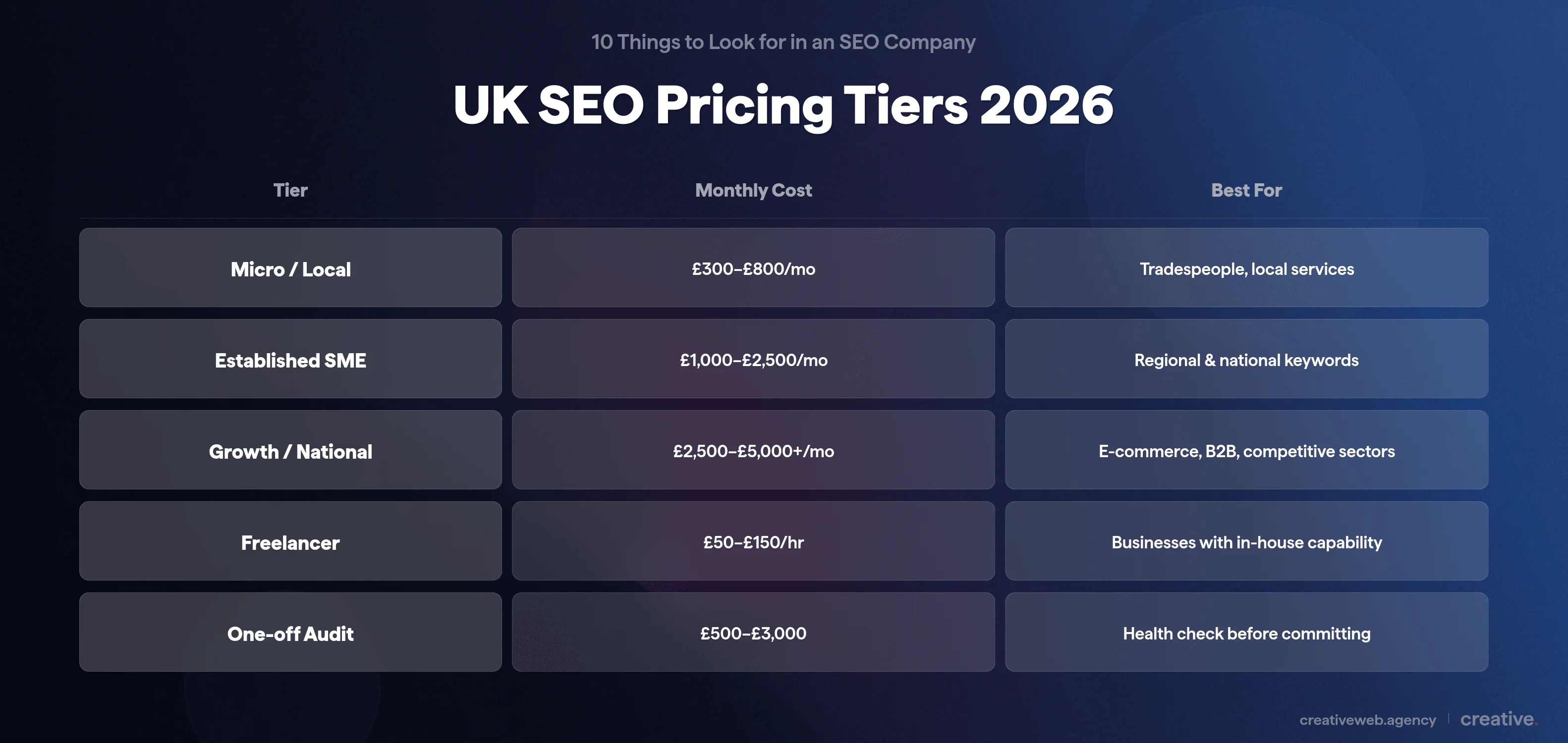
Below £1,000 a month, there isn’t enough budget to cover the cost of doing SEO properly. Decent SEO realistically sits around the £1,500 mark. Anything less and the work is either automated, outsourced to someone with no context on your business, or simply not happening.
So is SEO worth it for a small business? SEO leads convert at 14.6% compared to 1.7% for outbound marketing (HubSpot). The ROI is there, but only if the seo services you’re paying for are done properly.
NB: Some agencies now charge an AEO (answer engine optimisation) premium of 15-25% on top of standard fees in 2026. Ask whether AI search optimisation is included or billed separately.
Ask: “Can you break down exactly what’s included in your monthly fee?” and “What additional costs should I expect beyond the retainer?”
Red flag: Won’t discuss pricing until you’ve signed. Sub-£1,000 quotes for ongoing work. Hidden setup fees. Unusually long lock-in periods.
Want to See What Transparent SEO Pricing Looks Like?
See Our SEO Services6. Meaningful Reporting That Tracks Business Outcomes
From our experience, monthly reports should answer one question: is the SEO investment making money?
Too many agencies send reports packed with vanity metrics (impressions, “visibility scores,” keyword counts) that look impressive but don’t tell you whether you’re actually getting more customers.
Five things every monthly report should include
- Organic traffic trend with month-on-month and year-on-year context
- Keyword ranking movement for your target terms (not just the easy wins)
- Conversions and leads from organic search, tracked in Google Analytics
- Revenue impact or lead value where you can measure it
- Next month’s plan with specific deliverables
You should also have direct access to Google Analytics and Google Search Console. Your data, your accounts. Always.
We give our clients full GA and GSC access from day one. An SEO agency that controls your analytics access is a client retention strategy, not a service.
Ask: “Can you show me a sample monthly report?” and “How do you connect SEO metrics to business outcomes like leads and revenue?”
Red flag: No regular reporting. Reports only sent when you chase them. No link between digital marketing activity and business results.
7. Realistic Timelines and Honest Expectations
SEO is not instant. Google’s own documentation says results typically take “four months to a year” (developers.google.com). Anyone promising page-one rankings in 30 days is either using tactics that’ll get your site penalised, or lying.
What to expect in the first 12 months
- Month 1: Technical audit, site fixes, keyword research, strategy document
- Months 2-3: Content production begins, link building starts, on-page optimisation
- Months 4-6: Ranking movement for less competitive terms, organic traffic climbing
- Months 6-12: Compound growth, competitive terms start ranking, measurable ROI
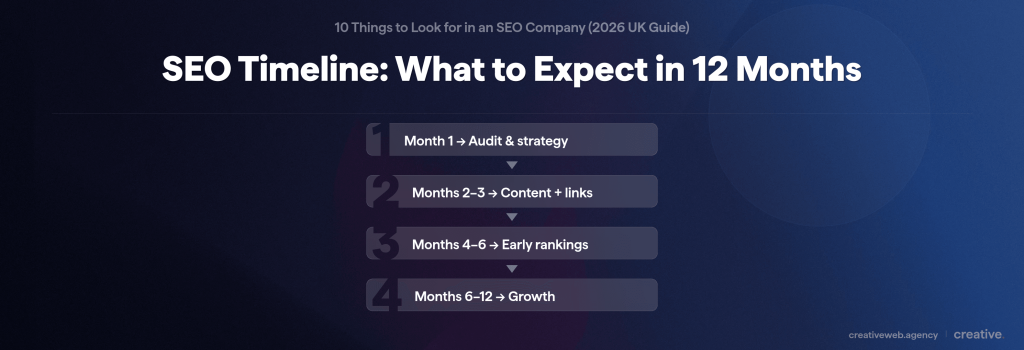
So should you just sit and wait for 12 months? Not exactly. If you’re seeing zero movement after 3 months, raise it with your seo partner. If there’s no meaningful progress after 6 months, seriously reconsider.
But don’t panic in month 2. Search engine optimisation compounds like interest: slow at first, then it accelerates. We review progress with our clients at 3 and 6 months to make sure we’re on track.
Ask: “What does your month-by-month roadmap look like for a business in my position?” and “What milestones should I expect at 3, 6, and 12 months?”
Red flag: Promises page 1 in 30 days. No phased roadmap. Can’t explain what success looks like at 3, 6, and 12 months.
8. Strong Communication and a Named Point of Contact
This is what separates a partnership from a transaction. After you sign, you want to know who’s doing the work, how often you’ll hear from them, and what happens if it isn’t working.
Here’s something nobody warns you about: the senior people in the pitch meeting are often not the people working on your account. Ask who will handle your day-to-day account.
Get a name and a role. Check their LinkedIn (high staff turnover at an agency means you’ll lose context every few months).
What your contract should include
- Exit clause: 30 days’ notice, ideally rolling monthly. No 12-month lock-ins.
- Data ownership: You keep your Google Analytics and Google Search Console access. Non-negotiable.
- IP rights: Content created for you belongs to you.
- Performance reviews at 3 and 6 months.
- GDPR compliance: Any agency handling your analytics data is a data processor under UK law.
A trustworthy SEO agency offers rolling monthly contracts, full data ownership, and a named account manager. Anything less should raise questions.
The best results happen when clients engage too: approving content marketing pieces promptly, providing analytics access, giving honest feedback. SEO isn’t something you outsource and forget about. As part of the working relationship, expect to spend a few hours a month reviewing work and providing input.
Ask: “Who specifically will work on my account?” / “What are your exit clauses?” / “Do I retain ownership of all content and data?”
Red flag: No named contact. Rotating junior staff. 12-month lock-in. Agency retains ownership of your data.
9. Specialist Knowledge for Your Sector and Location
We know from experience that not every seo company is the right fit for every business.
If you’re not sure which type of agency suits your needs, use this as a rough guide: if you need local SEO (tradesperson, restaurant, solicitor, estate agent), an agency with Google Business Profile expertise and knowledge of your area genuinely helps. 46% of all Google searches have local intent (Search Engine Roundtable). For these businesses, map pack rankings and local citations matter more than national keyword positions.
But if you’re selling nationally or running an e-commerce site, specialist depth matters more than geography. An agency that understands ecommerce seo or b2b seo and can show you relevant case studies will deliver more than one that happens to be nearby but has no experience in your sector. This is one of the best ways to narrow your shortlist quickly.
London-based agencies typically charge a 30-50% premium over regional firms, largely driven by higher salaries and overheads. Remote working means location matters less than it used to for non-local campaigns.
If your business also runs Google Ads alongside SEO, ask whether the agency understands how paid and organic channels work together. The best digital marketing results usually come from coordinating both, especially for lead generation.
Red flag: Claims expertise in everything. No sector experience. Can’t explain how local seo differs from national.
10. AI Search Readiness and GEO Capability
This is the 2026 differentiator. And honestly, most agencies are faking it.
Daily AI search usage doubled from 14% to 29.2% between February and August 2025 (eMarketer). Google AI Overviews now appear across a growing share of searches.
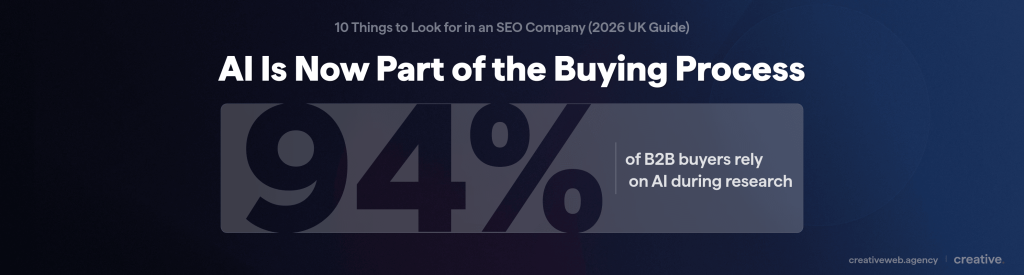
94% of B2B buyers use AI tools during their research process (Gartner, 2025). Any digital marketing agency that only optimises for traditional search results is already falling behind.
The shift is fundamental: being cited by AI now matters as much as ranking in traditional results. Answer engine optimisation (AEO) is a distinct discipline requiring structured data, E-E-A-T signals, and content formatted for AI extraction.
We track AI citations across ChatGPT, Gemini, and Perplexity as part of our standard workflow. If an agency claims AI readiness, ask them to show you the same.
Five questions to evaluate AI readiness
- Do you track whether our content appears in AI Overviews?
- Do you optimise for LLMs (ChatGPT, Perplexity, Gemini)?
- Do you understand structured data for AI extraction?
- Do you measure GEO alongside traditional SEO metrics?
- Can you show me AI search results for a current client?
A good answer references specific tools, shows actual data, and explains their methodology. A bad answer is: “Yes, we do AI SEO” with nothing behind it (basically the 2026 version of “we guarantee page 1”).
Red flag: No mention of AI search. Dismisses it as a fad. Can’t explain what answer engine optimisation means or how it differs from traditional SEO.
Your SEO Agency Scorecard: Score Before You Sign
Here’s where all 10 criteria come together. Print this (or save it on your phone) and score each agency you’re evaluating. For each criterion, mark Green, Amber, or Red.
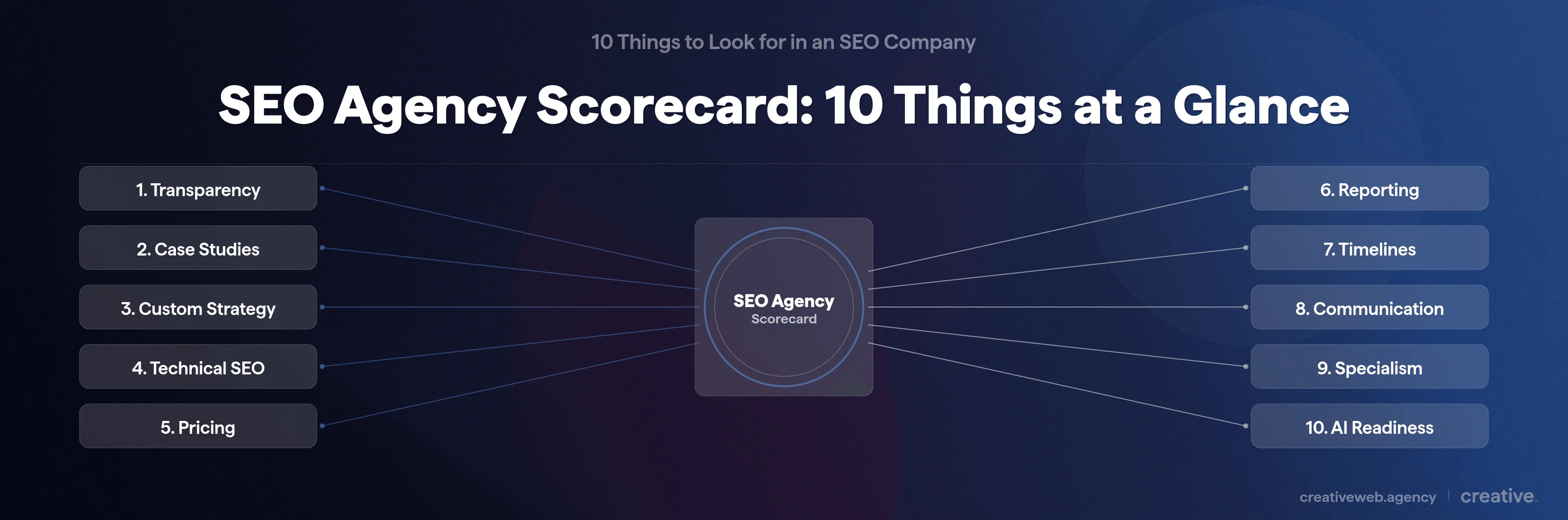
| Criterion | Green | Amber | Red |
|---|---|---|---|
| 1. Transparency | Explains methods clearly, references Google guidelines | Willing to explain but vague on specifics | Refuses to explain, guarantees rankings |
| 2. Case studies | Specific metrics, named industries, offers references | Case studies exist but generic | No case studies, refuses references |
| 3. Custom strategy | Asks about your business before proposing anything | Mentions customisation but leads with a package | Fixed package, no questions asked |
| 4. Technical SEO | Offers audit upfront, explains Core Web Vitals clearly | Mentions technical SEO but can’t explain simply | No mention of technical foundations |
| 5. Pricing | Clear pricing document, flexible terms, no hidden fees | Provides pricing but vague on scope | Won’t discuss pricing, sub-£1,000 quotes |
| 6. Reporting | Monthly reports with business KPIs, you keep GA/GSC | Reports exist but mostly vanity metrics | No regular reporting |
| 7. Timelines | Phased milestones at 1/3/6/12 months, realistic | Gives timeline but overpromises | Promises page 1 in 30 days |
| 8. Communication | Named account manager, 30-day exit, you own data | Good communication but inflexible contract | No named contact, 12-month lock-in |
| 9. Specialism | Relevant sector experience with supporting case studies | General experience but not in your sector | Claims expertise in everything |
| 10. AI readiness | Actively optimises for AI search, can show citation data | Aware of AI changes but hasn’t restructured | No mention of AI search |
Scoring guide: 8-10 Green is a strong candidate, move forward with confidence. 5-7 Green means proceed with caution and follow up on the amber areas. 4 or fewer Green means keep looking, too many gaps to ignore.
And three bonus questions that almost nobody thinks to ask when choosing an seo company:
- “What happens if results don’t materialise after 6 months? What’s your contingency plan?”
- “Who specifically (name and role) will work on my account day to day?”
- “What will you need from our internal team in terms of time and resources?”
If the agency welcomes these questions rather than deflecting them, that’s probably the right SEO agency for you.
Choosing an SEO company is a decision that shapes your marketing for years. Get it right and you build a marketing channel that compounds for years. Get it wrong and you waste months, potentially damage your site’s standing with search engines, and end up starting again.
Use the scorecard. Ask the hard questions. And if you want to see how we approach SEO for UK businesses, head over to our SEO services page and get in touch.