What SEO Actually Means in 2026 (And Why It Still Matters)


Every few months, someone publishes an article declaring SEO dead. And every few months, that article ranks on Google because of… SEO.
The contradiction says it all. SEO isn’t dead. But it has changed, quite significantly, and most of the advice online still describes what SEO looked like three or four years ago.
We run SEO campaigns for UK businesses every day. Not from a publication desk or a software company, but from an agency that builds the websites and does the work. So when we say things have shifted, it’s because we’re seeing it in real campaign data, not reading about it in trend reports.
This is a straight answer to the question: what does SEO actually mean now? No jargon and no 200-factor checklists. Just what’s changed, what hasn’t, and what your business should do about it.
What SEO Actually Means in 2026
The Simple Definition
SEO stands for search engine optimisation. It’s the practice of making your website more visible when people search for things related to your business.
That hasn’t changed.
What has changed is where that visibility matters. SEO used to mean one thing: rank higher on Google.
In 2026, it means being visible across search engines, AI assistants (ChatGPT, Gemini, Perplexity), voice search, and generative platforms. The goal is the same (get found by the right people) but the playing field is wider.
If someone asks Google “best web designer near me” you want to appear. If someone asks ChatGPT the same question you want to be referenced. SEO now covers both.
Why the Definition Has Changed
For years, SEO was the cornerstone of digital marketing: basically synonymous with Google rankings. You optimised your site, climbed the search engine results page (SERP), got clicks.
That model still works.
But it’s not the full picture anymore.
Google now shows AI Overviews at the top of many searches, answering the question before anyone clicks a link. AI tools like Perplexity and Gemini pull answers from web content and present them directly. Your content might be used as a source without ever generating a click to your site.
This is the shift from traffic to citations: the single most important change in search right now. We’ll come back to it.
How Search Engines Decide What to Show You
Crawling, Indexing, and Ranking (The Three-Step Process)
Think of Google like a library that never stops growing.
First, Google sends out crawlers (automated programs that follow links) to visit web pages. This is crawling: scanning the internet for new and updated content.
Second, what they find gets stored and organised in Google’s index. If your page isn’t indexed it basically doesn’t exist as far as Google is concerned.
Third, when someone searches, Google’s algorithm sorts through its index and decides what to show. This is ranking: weighing hundreds of signals to work out which pages are most relevant and useful for that specific query.
So when someone says “my site isn’t ranking” they usually mean Google’s algorithm isn’t prioritising their pages. Sometimes the issue is simpler: their pages haven’t been crawled or indexed at all.

What Google’s Algorithm Actually Prioritises
Google considers hundreds of ranking factors. But the ones that genuinely move the needle come down to four areas:
Relevance: does your content actually answer the search query? Not vaguely related. Directly useful.
Authority: do other reputable sites link to yours? Backlinks remain among the strongest signals Google uses to gauge trust.
Experience and expertise: Google’s E-E-A-T framework (that’s Experience, Expertise, Authoritativeness, Trustworthiness) increasingly determines which content gets shown. Content from someone who has clearly done the work ranks better than generic advice copied from elsewhere.
User satisfaction: does the searcher stay on your page or bounce straight back to the results? Site speed, mobile experience, and clear page structure all feed into this.
That last point matters more than most people realise.
A site that loads slowly or looks terrible on mobile will struggle regardless of how good the content is.
The Four Types of SEO (And Which One Most Businesses Miss)
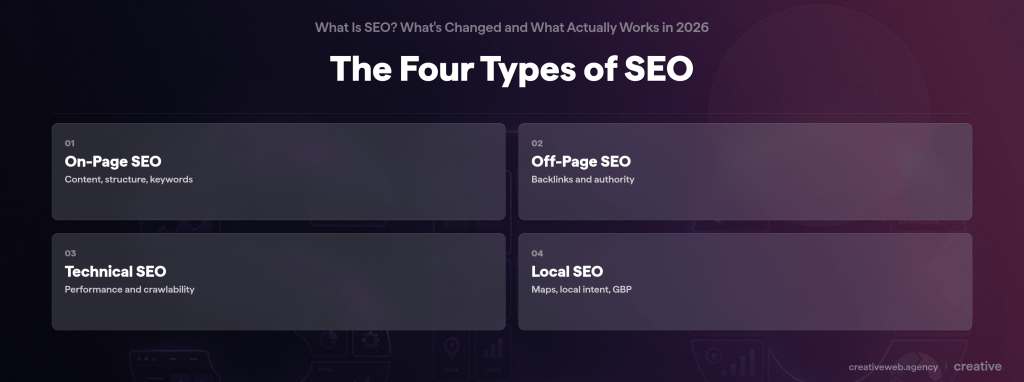
Ask five SEO professionals how many types there are and you’ll probably get five different answers. Some say three. Some say five. I find four covers it:
- On-page SEO: what you control on your own website
- Off-page SEO: what happens elsewhere that affects your rankings
- Technical SEO: the foundation everything sits on
- Local SEO: the one most small businesses miss entirely
On-Page SEO
This is everything on your own pages: titles, headings, meta descriptions, the actual content, URL structure, image alt text, keyword placement.
On-page is where keyword research matters most. It means understanding what your customers are actually searching for, then creating content that directly answers those queries. Well-written, genuinely helpful pages will always outperform thin, keyword-stuffed content.
Off-Page SEO
Everything happening away from your site that affects your rankings.
The big one is backlinks: other websites linking to yours.
Not all links are equal though. One link from a respected industry publication is worth more than fifty from random directories. Google treats backlinks like votes of confidence: the more credible the source, the more that vote counts.
Link building also covers brand mentions (think local press or guest articles), digital PR, and industry relationships. But the core is still quality links from relevant, authoritative sites.
Technical SEO
Technical SEO is the foundation.
If your site is slow, broken, or hard for Google to crawl then nothing else matters much.
The basics: fast loading (Google’s Core Web Vitals measure this), mobile-friendly design (Google uses mobile-first indexing), HTTPS, clean URLs, and a submitted XML sitemap.
Because we build the websites and do the SEO, we see this overlap more clearly than most agencies. A site that looks beautiful but takes six seconds to load on mobile is an SEO problem dressed up as a design success.
Local SEO (The One Most Small Businesses Miss)
This is where most UK small businesses should start.
And it’s consistently the most overlooked.
Local SEO is about appearing when someone searches for a service or product near them. 46% of all Google searches have local intent (Google). Nearly half.
Your Google Business Profile is the single most important tool here. It’s free, takes an afternoon to set up properly, and directly affects whether you appear in local map results.
Beyond that: consistent business name, address, and phone number (NAP) across directories. Real reviews from real customers. Locally relevant content on your site.
Top tip: if you have a physical location or serve a specific area and you haven’t optimised your Google Business Profile, do that before anything else. It’s the highest-ROI action most small businesses can take in an afternoon.
How AI Has Changed the Rules of Search
Ok, so here’s where things get interesting. And where most of the confusion comes from.
AI Overviews and What They Mean for Your Visibility
Google now shows AI-generated summaries (called AI Overviews) at the top of many search results. These pull information from multiple web pages and present a synthesised answer right there in the results.
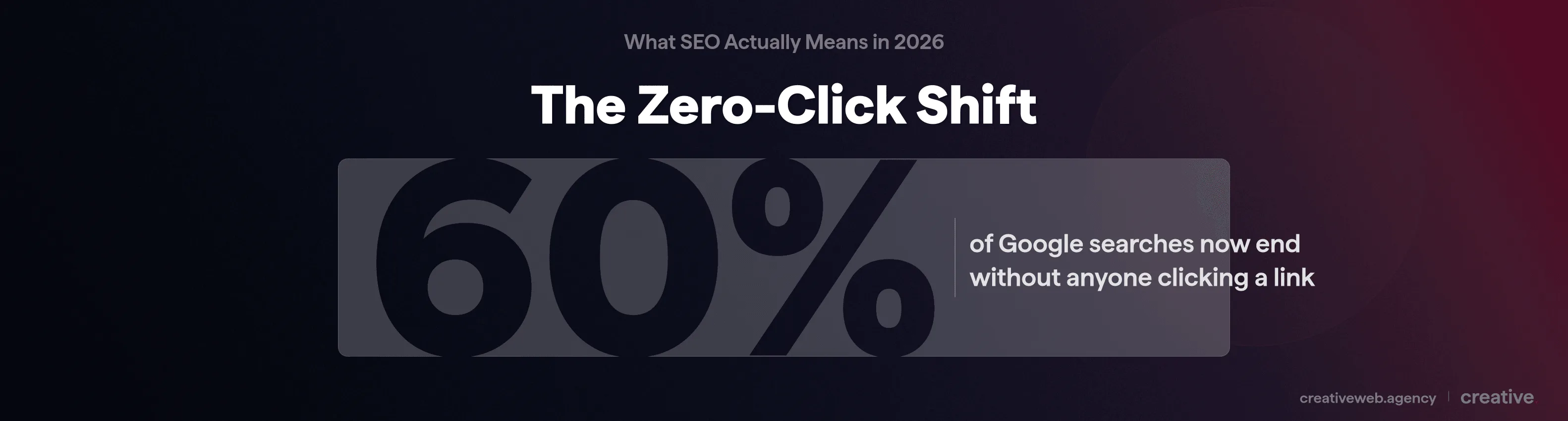
The impact is real. Around 60% of Google searches now end without anyone clicking a link (SparkToro, 2024). That number is growing as AI Overviews expand to more queries.
So is SEO dead then?
No. But the definition of “success” is shifting. Being cited in an AI Overview is becoming the new equivalent of position one.
Your content is still being used: just differently. Instead of driving a click, the AI references your content as its source.
From Clicks to Citations
This is the shift we’re seeing in our own campaigns.
And it’s the most important thing to understand about SEO right now.
The old model: rank well, get clicks, clicks become leads.
That still works.
But there’s a second model running alongside it now. AI tools (ChatGPT, Gemini, Perplexity) scan the web for authoritative content and cite it when answering questions.
The value isn’t always in the click anymore. It’s in being the source the AI trusts enough to reference.
Traffic volume is becoming less important than how often your content gets referenced by AI tools. That’s not a prediction we read somewhere. It’s what we’re observing in actual campaign data.
A page with declining organic clicks might simultaneously be gaining citations across AI platforms. Being citable is becoming the new rankable.
Content quality, E-E-A-T signals, and clearly structured information matter more now than they ever have.
AI doesn’t cite mediocre content.
SEO vs GEO: The Shift That Actually Matters
What GEO Actually Means
GEO stands for Generative Engine Optimisation. It’s the practice of structuring your content so AI-powered tools are more likely to reference it when generating answers.
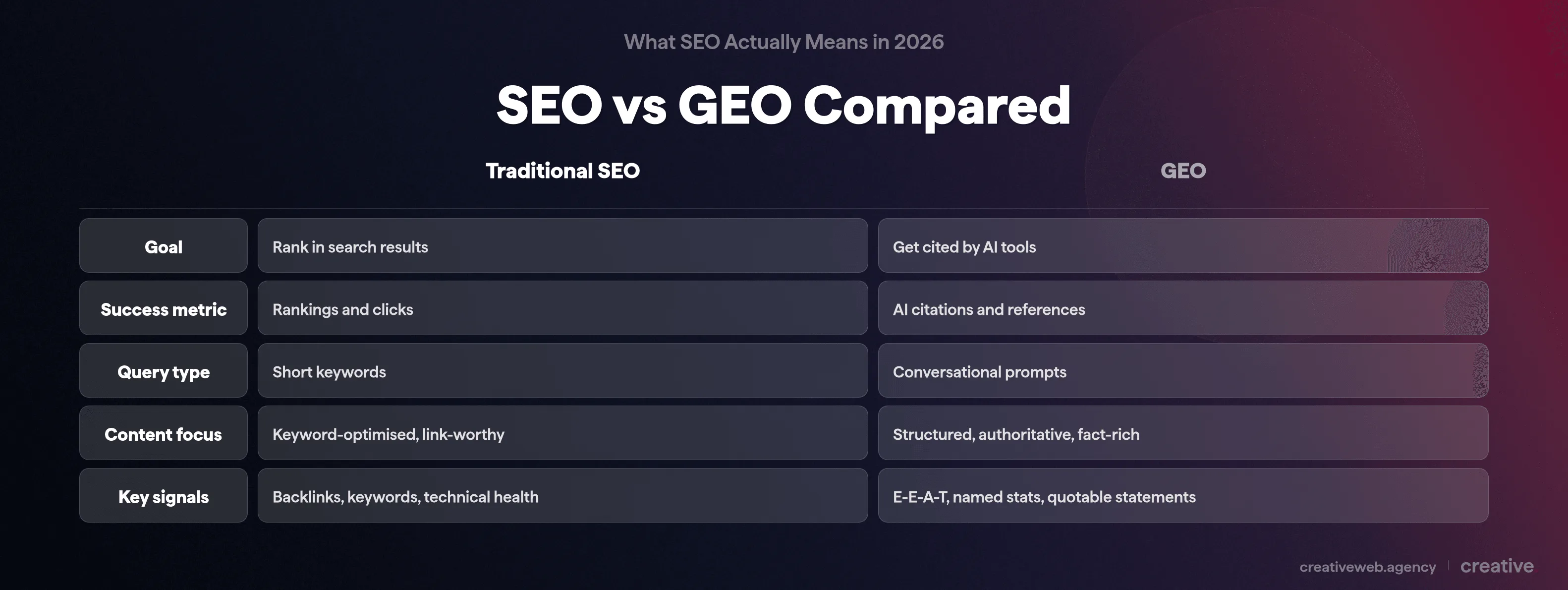
Traditional SEO focuses on ranking in search results to earn clicks. GEO focuses on making content citable to earn references.
The practical differences:
| Traditional SEO | GEO | |
|---|---|---|
| Goal | Rank in search results | Get cited by AI tools |
| Success metric | Rankings and clicks | AI citations and references |
| Query type | Short keywords (“seo agency london”) | Conversational prompts (“what should I look for in an SEO agency?”) |
| Content focus | Keyword-optimised, link-worthy | Structured, authoritative, fact-rich |
| Key signals | Backlinks, keywords, technical health | E-E-A-T, named statistics, quotable statements |
You’ll also hear the terms answer engine optimisation (AEO) and search everywhere optimisation. They’re all part of the same shift: optimising for where people actually find information now, not just where they used to.
Why the Future Is Both
So should you drop SEO and switch entirely to GEO? Not yet.
GEO doesn’t replace SEO. It adds a layer on top.
The content AI tools cite most is content with strong SEO foundations: well-structured, authoritative, well-linked, genuinely useful. You can’t skip straight to GEO without the basics in place.
In our view, SEO is becoming a hybrid of traditional search optimisation and generative engine optimisation. Over time this will likely shift further towards GEO as AI handles more of the search process. But businesses that abandon traditional SEO now will regret it when they realise their content has no foundation for AI to cite.
We’ve covered this evolution in depth: how generative search is changing online visibility.
Why SEO Still Matters for UK Businesses
The Numbers That Actually Matter
If you’re a UK business owner wondering whether SEO is worth the investment here are the numbers that should inform your decision:
- Google holds over 90% of the UK search market (Statista, 2025). Your customers are on Google. That hasn’t changed.
- 46% of Google searches have local intent (Google). Nearly half are people looking for something nearby.
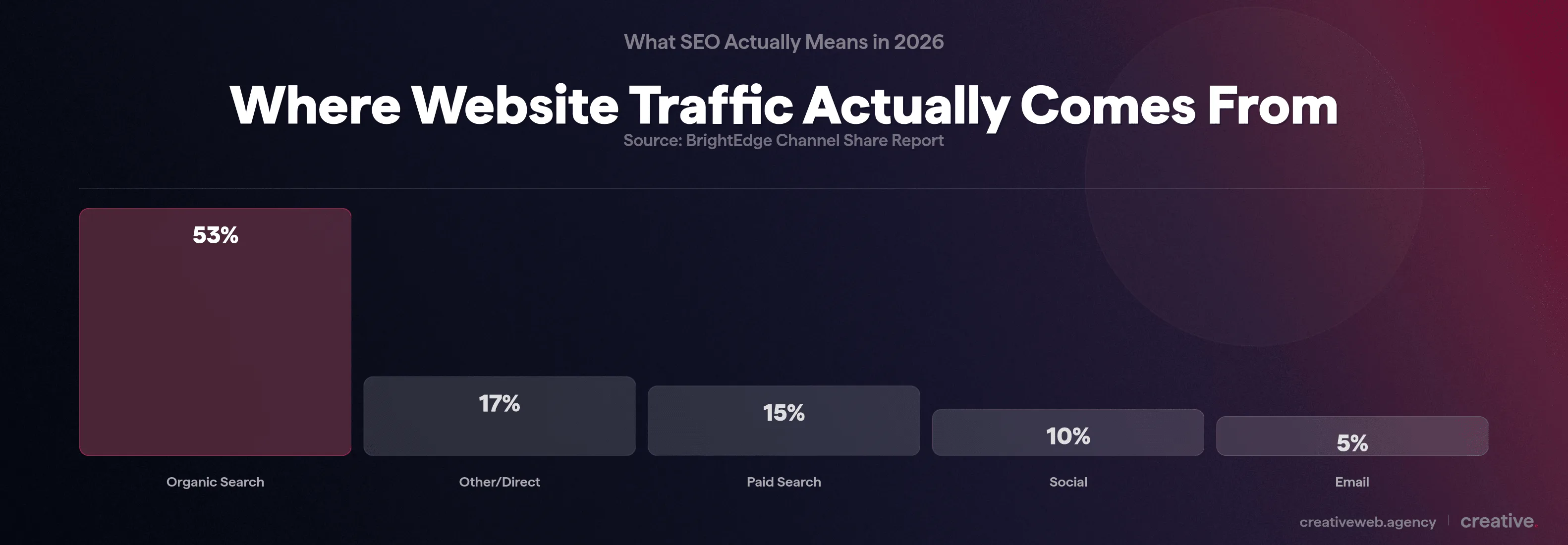
- Organic search drives 53% of all website traffic (BrightEdge). More than paid, social, and email put together.
- SEO delivers a median ROI of 748% (First Page Sage, 2024). For every pound invested, roughly £7.48 comes back.
SEO isn’t a nice-to-have. It’s the foundation. Social media builds awareness and paid ads generate immediate clicks, but organic search is where the compound returns live.
What UK Businesses Get Wrong About SEO
We regularly speak to businesses who’ve been paying for SEO and have absolutely nothing to show for it. Almost every time, one of these things has gone wrong.
Paying too little. In our experience, decent SEO in the UK starts at around £1,500 per month minimum. If you’re paying significantly less you’re probably getting templated work and automated reports rather than actual strategy.
We’ve seen businesses waste years on cheap monthly packages that generate activity but zero results.
That’s not investment, it’s overhead.
Expecting instant results. SEO is a long game.
Anyone promising page-one rankings in weeks is either overpromising or using tactics that’ll get your site penalised eventually. Neither ends well.
Treating it as a one-off. SEO isn’t something you do once.
Your competitors are publishing content, building links, and improving continuously. If you stop they don’t.
NB: not every business needs to spend thousands.
If you’re a local trades business competing in one town you might see real results from sorting your Google Business Profile, getting genuine reviews, and making sure your site loads properly on mobile. But cheap, generic SEO packages? They rarely deliver for anyone.
Want SEO That Actually Works for Your Business?
Talk to Our SEO TeamWhat Good SEO Actually Looks Like Now
Right, so what should you actually be doing? After years of running SEO and content marketing for UK businesses across different sectors, here’s what moves the needle.
The Five Factors That Actually Move the Needle
- Content that answers real questions. Not content for its own sake. Pages that directly answer what your customers search for, written by someone who knows the subject. E-E-A-T (Experience, Expertise, Authoritativeness, Trustworthiness) is how Google and AI tools decide whether content deserves to be shown.
In plain English: can the reader tell this was written by someone who’s done the work? - Technical basics. Fast loading (under 2.5 seconds), mobile-friendly, HTTPS, clean URLs, XML sitemap. These are table stakes, not competitive advantages. If your site fails here nothing else compensates.
- Local SEO and Google Business Profile. For most UK small businesses this is where the highest ROI lives. Claim your profile, fill it out completely, collect genuine reviews, keep your details consistent across directories.
- Quality backlinks. A handful of links from relevant, respected sources beats hundreds from random directories. Build them through useful content, local partnerships, and genuine industry relationships.
- AI citability. The new dimension. Content needs to be structured clearly enough that AI tools can parse and reference it: named statistics, clear definitions, quotable statements, genuine expertise signals. This isn’t separate from good content. It IS good content.
Where to Start (Based on Your Business Type)
Not every business should start in the same place. Here’s where we’d point you based on what we’ve seen work across different types of UK businesses:
| Business Type | Start Here | First Three Actions | Realistic Timeline | When GEO Matters |
|---|---|---|---|---|
| Local service (plumber, dentist, solicitor) | Local SEO | 1. Optimise Google Business Profile fully 2. Get 10+ genuine reviews 3. Fix NAP consistency across directories | 3-6 months for local map visibility | Later. Nail local visibility first. |
| E-commerce | Technical + On-page | 1. Fix site speed and mobile experience 2. Optimise product and category pages 3. Build internal linking structure | 6-12 months for organic traffic growth | When publishing buying guides and comparison content |
| B2B professional services | Content + Off-page | 1. Publish content answering your clients’ actual questions 2. Build authority via guest content and partnerships 3. Optimise GBP if you have a physical office | 6-12 months for lead generation | Early. B2B buyers use AI tools to research providers. |
| Content or media | On-page + GEO | 1. Audit existing content for E-E-A-T signals 2. Structure articles for AI citability (stats, quotes, clear structure) 3. Build topical authority in your niche | 4-8 months for meaningful growth | Immediately. Your content is your product. |
This isn’t a complete SEO strategy (we’ve put together a fuller guide on creating an SEO strategy for 2026 if you want to go deeper). It’s a starting point that stops you trying to do everything at once.
How Long It Actually Takes
The honest answer: 4 to 12 months for meaningful results.
New websites with no existing authority? Expect 6 to 12 months before you’re competing for anything beyond long-tail keywords. Established sites with some rankings? You might see movement in 3 to 6 months.
What affects the timeline: how competitive your market is, how much domain authority you already have (basically how trusted Google considers your site), how consistently you publish and build links, and whether your technical foundations are solid.
In our experience most UK businesses start seeing genuine traction around month six if the work is consistent. This is one of the best reasons to treat SEO as an ongoing commitment, not a project with an end date.
Anyone promising rankings in a fortnight is selling something you don’t want to buy.
What It All Comes Down To
SEO in 2026 means more than it used to. It’s no longer just about Google rankings (though those still matter). It’s about being visible and citable wherever your customers look for answers.
The fundamentals haven’t changed: build a fast, well-structured site and create content that genuinely helps your audience. Earn trust through real expertise and quality backlinks from relevant sources.
What’s new is the GEO layer: making your content structured and authoritative enough that AI tools actively choose to reference it. You can’t build AI visibility without the search fundamentals in place first.
If you’re not sure where your site stands right now, our website audit will show you what’s working and what needs fixing. Start with whichever priority matches your business type from the table above, and build from there.
Frequently Asked Questions
-
What does SEO stand for?
-
SEO stands for search engine optimisation. Itu0027s the process of improving your website so it appears higher in search results when people look for things related to your business. In 2026, that also includes being visible across AI tools and generative search platforms.
Did this answer your question? YesThat’s great glad we could help! Start a ProjectNoNo problem, one of our experts can give you a more in-depth answer. Ask our Experts -
How long does SEO take to work?
-
Typically 4 to 12 months for meaningful results. New sites need longer (6-12 months). Established sites might see movement within 3 to 6 months. Be cautious of anyone promising fast results.
Did this answer your question? YesThat’s great glad we could help! Start a ProjectNoNo problem, one of our experts can give you a more in-depth answer. Ask our Experts -
What is the difference between SEO and GEO?
-
SEO (search engine optimisation) focuses on ranking in search results to earn clicks. GEO (generative engine optimisation) focuses on structuring content so AI tools like ChatGPT and Gemini reference it when answering questions. Theyu0027re complementary: GEO builds on top of strong SEO foundations.
Did this answer your question? YesThat’s great glad we could help! Start a ProjectNoNo problem, one of our experts can give you a more in-depth answer. Ask our Experts -
Do I need SEO for my small business?
-
Yes. Nearly 46% of Google searches have local intent, which means people are looking for businesses near them. Local SEO (starting with your Google Business Profile) is the highest-ROI entry point for most small businesses and itu0027s often the quickest to show results.
Did this answer your question? YesThat’s great glad we could help! Start a ProjectNoNo problem, one of our experts can give you a more in-depth answer. Ask our Experts -
How much does SEO cost in the UK?
-
It varies, but decent SEO work in the UK starts at around u00a31,500 per month from our experience. Cheaper packages (under u00a31,000/month) typically deliver templated work rather than genuine strategy. The right investment depends on your competition level and business goals.
Did this answer your question? YesThat’s great glad we could help! Start a ProjectNoNo problem, one of our experts can give you a more in-depth answer. Ask our Experts -
Is SEO still relevant in 2026?
-
Absolutely. Google holds over 90% of the UK search market and organic search drives more than half of all website traffic. SEO now includes optimising for AI tools alongside traditional search. The businesses investing in both are the ones seeing the strongest returns.
Did this answer your question? YesThat’s great glad we could help! Start a ProjectNoNo problem, one of our experts can give you a more in-depth answer. Ask our Experts -
What are the main types of SEO?
-
There are four: on-page (your own website content and structure), off-page (backlinks and external signals), technical (site speed, mobile-friendliness, crawlability), and local (Google Business Profile and local visibility). Most small businesses should start with local SEO. It delivers the fastest returns for the least effort.
Did this answer your question? YesThat’s great glad we could help! Start a ProjectNoNo problem, one of our experts can give you a more in-depth answer. Ask our Experts -
How has AI changed how search engines work?
-
The biggest change is AI Overviews. Google now shows AI-generated summaries at the top of many searches, so your content can be referenced without anyone clicking through to your site. The shift is from ranking for clicks to being cited as a source. Being trusted enough for AI tools to reference your content is becoming as valuable as ranking on page one.
Did this answer your question? YesThat’s great glad we could help! Start a ProjectNoNo problem, one of our experts can give you a more in-depth answer. Ask our Experts