What Website Maintenance Actually Costs in 2026 (And Why Cheap Plans Fail)


You wouldn’t drive your car for two or three years without a service and then act surprised when the engine light comes on. So why do so many businesses do exactly that with their websites?
A properly built business website costs £10,000 to £50,000+. It generates leads, processes enquiries, and works harder than most of your sales team. But we still see businesses spending less per month on maintaining it than they do on their office coffee machine.
Then something breaks. And suddenly it’s not a maintenance conversation, it’s a recovery conversation (which is always more expensive).
This guide breaks down what website maintenance actually costs in the UK in 2026, what you should be getting at each price point, and why the cheapest option almost always ends up costing you more.
What Website Maintenance Actually Costs in 2026
Ok, let’s start with the numbers.
Here’s what UK businesses are typically paying for monthly website maintenance in 2026:
| Website Type | Monthly Cost | What’s Typically Included |
|---|---|---|
| Simple brochure site (5-10 pages) | £75-£150 | Hosting, updates, backups, basic security |
| WordPress business site | £129-£250 | Above + plugin management, staging, performance monitoring |
| Ecommerce (WooCommerce/Shopify) | £250-£500+ | Above + PCI-DSS compliance, payment gateway monitoring, stock management |
| Enterprise/custom build | £500-£1,500+ | Bespoke SLA, 24/7 monitoring, dedicated account manager, analytics reporting |
NB: these prices are typically quoted ex-VAT. If your business isn’t VAT-registered, add 20%. A £200 plan is really £240.
The UK website maintenance and support market is growing at 8.2% annually according to Grand View Research. Costs are rising, not falling. So if you haven’t reviewed your maintenance spend since 2024 you’re probably already underpaying for what you need.
So does that mean you need the most expensive plan? Not necessarily. But you do need to understand what drives the price.
What Actually Drives the Price
In our experience, five things determine where you land in those ranges:
- Site complexity: a 10-page brochure site is simpler to maintain than a 500-product WooCommerce store
- CMS platform: WordPress sites need more maintenance than static sites (more on that below)
- Security requirements: ecommerce sites need PCI-DSS compliance, which adds real cost
- Content update frequency: if you want fresh content monthly that’s extra labour hours on top of technical maintenance
- SLA and response time: 24/7 monitoring with a 2-hour response costs more than 9-to-5 with 48-hour turnaround
Location matters too. London agencies typically charge 20-30% more than providers in the North or Scotland (and freelancers are cheaper still, though in our experience you trade dedicated support and SLA guarantees for that saving). Worth keeping in mind if you’re comparing quotes.
Your Full Annual Website Budget
Maintenance isn’t your only ongoing website cost. Here’s what we typically budget for a properly built site:
- Domain renewal: £10-£25/year
- Hosting: often included in your maintenance plan, or £10-£50/month separately
- SSL certificate: usually included. Let’s Encrypt is free, premium certs are £50-£200/year
- Maintenance proper: £1,548-£6,000+/year depending on tier
- Content creation: variable, £200-£1,000+ per month if outsourced
- SEO: £300-£2,000 per month for ongoing optimisation
For a £15,000 business website you should realistically budget £3,000-£6,000 per year on maintenance and hosting alone. That sounds like a lot until you realise your website is probably generating more leads than your entire sales team (and costing less per lead than any of them).
If you want to understand how ongoing costs sit alongside the initial build, we’ve put together a web design cost estimator that breaks it down.
Hosting vs Maintenance: They’re Not the Same Thing
We see this confusion all the time.
Your £10/month hosting bill is not a maintenance plan. Hosting gives you server space: it keeps your website accessible on the internet. That’s it.
It doesn’t update your CMS, patch security vulnerabilities, monitor performance, or fix anything when it breaks.
Think of it this way: hosting is renting the building. Maintenance is hiring someone to keep the lights on, fix the plumbing, and stop the roof leaking.
Hosting alone: £10-£50/month. Maintenance including hosting: £129-£500/month.
Website hosting and website maintenance are fundamentally different services, and confusing the two is a mistake we see constantly.
That gap exists because ongoing maintenance involves actual labour. Someone has to test updates before they go live, monitor for security threats, run backups and verify they actually work, keep your site fast enough to satisfy Google’s Core Web Vitals. Your hosting provider isn’t doing any of that.
What You Should Get at Each Price Point
Right, so what do you actually get for your money? Here’s how we structure our website maintenance packages (and honestly, most decent UK agencies offer something similar).
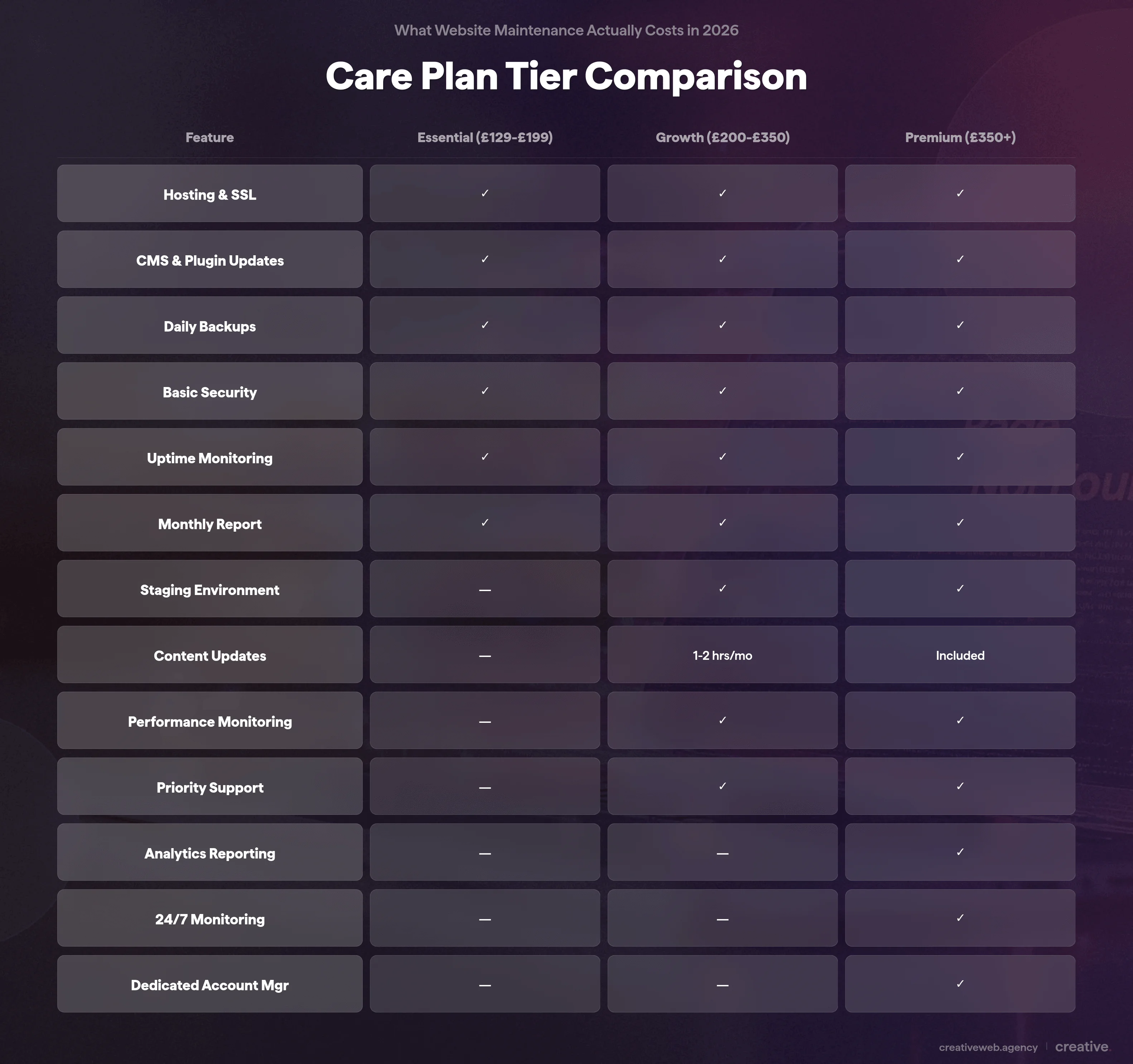
Essential Care (£129-£199/month)
You get: hosting, SSL, CMS and plugin updates, daily backups, basic security monitoring, uptime monitoring, and a monthly report.
What you don’t get: content changes, SEO work, performance optimisation, priority support, or a staging environment. If something breaks at 11pm on a Friday you’re waiting until Monday.
Is this enough? For a straightforward brochure site that doesn’t change often, probably. But if you have a site that generates leads or processes payments, you’ll want more.
Growth Care (£200-£350/month)
This is where we recommend most businesses with a properly built site should be. It adds: content update hours (usually 1-2 per month), performance monitoring, quarterly reviews, priority support, and a staging environment.
The staging environment alone is worth the upgrade. We’ve seen plugin updates break contact forms and crash checkout pages without warning.
Our team tests every update in staging before it touches your live site. That catches problems before your customers see them.
Most UK businesses with a properly built website should be on a growth-tier maintenance plan at £200-£350 per month as a minimum.
Premium and Enterprise (£350-£500+/month)
Adds proactive performance optimisation, analytics reporting (Google Analytics and Search Console), 24/7 monitoring, a dedicated account manager, compliance monitoring (GDPR, WCAG 2.2), and a disaster recovery plan.
NB: this tier covers reporting and monitoring, not full SEO. Proper ongoing SEO is a separate service (it starts at £1,200-£1,500 per month minimum). At our hourly rate, £350 isn’t even three hours of work. So if someone’s bundling “full SEO” into a £500/month maintenance plan, they’re either underdelivering on the SEO or undercharging for the maintenance.
Probably both.
Enterprise is bespoke (think financial services, healthcare, or high-traffic ecommerce). If you’re processing thousands of transactions monthly or have regulatory requirements beyond standard GDPR, this is the tier to discuss.
Actually, here’s a good test: ask any provider exactly what “monitoring” means in their plan. There’s a big difference between automated uptime pings (cheap) and someone reviewing security logs and performance trends weekly (not cheap).
WordPress Maintenance: Why It Costs More Than You Think
WordPress powers roughly 43% of all websites globally according to W3Techs. It also accounts for a disproportionate share of security incidents.
The Plugin Ecosystem Problem
A typical WordPress business site runs 15-30 plugins. Every single one is a potential security hole and a compatibility risk.
Patchstack’s 2024 State of WordPress Security report found that 97% of WordPress security vulnerabilities came from plugins, not WordPress core. So keeping WordPress itself updated is the easy bit. The hard part is managing 20+ plugins from different developers, each releasing updates on their own schedule, each potentially breaking something when it updates.

This is why wordpress website maintenance costs more than maintaining a static site or a simpler content management system. The testing burden (update in staging, check nothing breaks, push to live) takes real time. Multiply that by monthly update cycles and you can can see where the cost comes from.
WooCommerce Adds Another Layer
If you’re running WooCommerce, add PCI-DSS compliance on top of everything above. Payment gateway monitoring, product database maintenance, cart functionality testing, checkout flow verification.
Ecommerce WordPress sites typically cost 2-3x more to maintain than brochure WordPress sites. A standard WordPress business site might sit at £129-£250/month. A WooCommerce site with 500+ products and regular transactions? You’re looking at £250-£500+ depending on volume and complexity.
Not Sure If Your Maintenance Is Up to Standard?
Our free website audit checks your site’s security, performance, and maintenance setup. You’ll know exactly where you stand before committing to any plan.
Get a Free Website AuditDIY vs Professional Maintenance: The Real Trade-Off
So should you just handle it yourself?
EdTheDev estimates DIY maintenance takes 2-5 hours per month. If you’re a business owner whose time is worth £75/hour (conservative for someone running a company), that’s £150-£375 in opportunity cost. Every month.
And that is before you account for the fact that you probably do not have the technical depth to do it properly.
I say that from experience, not judgement. We had a client last year who’d been doing their own WordPress updates for two years. They had never used a staging environment, had not tested a single backup, and had three plugins with known security vulnerabilities sitting there for months.
Nothing had gone wrong yet.
But “nothing has gone wrong yet” is not a maintenance strategy.
You didn’t build your own website. You wouldn’t service your own company vehicles. Website maintenance service is a skilled job, and treating it like a weekend task is false economy. Especially if you have a site that’s actively generating business for you.
Why Cheap Maintenance Plans Are a False Economy
This is the bit most articles skip, and it is where we spend the most time in client conversations. They’ll tell you website maintenance costs £25-£500 and leave it at that. But the price difference between a £50 plan and a £200 plan is not just “more features.” It is the difference between reactive and proactive care.
What a £50/Month Plan Actually Gets You
Automated CMS updates (no manual testing), shared hosting, maybe weekly backups (rarely verified), and that’s basically it.
What it skips: manual update testing, security monitoring, performance optimisation, content support, priority response, staging environment. If a plugin update breaks your contact form on a £50 plan, nobody notices until a customer tells you.
And sometimes they do not tell you. They just leave.
The Real Numbers: 3 Years of Cheap vs Proper Maintenance
Let’s make this concrete. Take a £15,000 WordPress site for a UK business turning over £250,000-£500,000 a year.
Path A: cheap maintenance at £50/month
Year 1: £600 in fees. Things seem fine. (They usually do at first.)
Year 2: a security breach hits in month 14. The average cost of a cyber incident for a UK small business is £3,490 according to the UK Government’s Cyber Security Breaches Survey 2024. Your site goes down for 3 days while it’s cleaned up. You lose an estimated 15-20 leads at roughly £200 per lead: that’s £3,000-£4,000 in potential revenue gone. Total Year 2: £600 fees + £3,490 breach recovery + £3,500 lost leads = £7,590.
Year 3: the site’s patched up but sluggish. Core Web Vitals have tanked, rankings have dropped, and the accumulated technical debt means your developer quotes £8,000-£15,000 for a rebuild rather than keep patching. Total Year 3: £600 fees + £8,000 rebuild (conservative) = £8,600.
3-year total on the cheap path: approximately £16,790.
Path B: proper maintenance at £200/month
Year 1: £2,400. Updates tested in staging, security monitored, backups verified monthly, site performance maintained.
Year 2: £2,400. That vulnerability from Path A? Caught and patched in staging before it reached production. Zero downtime. Zero lost leads.
Year 3: £2,400. Site still performs well, rankings maintained, no rebuild needed.
3-year total on the proper path: £7,200.
| Cheap Path (£50/mo) | Proper Path (£200/mo) | |
|---|---|---|
| 3-year fees | £1,800 | £7,200 |
| Breach recovery | £3,490 | £0 |
| Lost leads | £3,500 | £0 |
| Rebuild | £8,000 | £0 |
| Total | £16,790 | £7,200 |
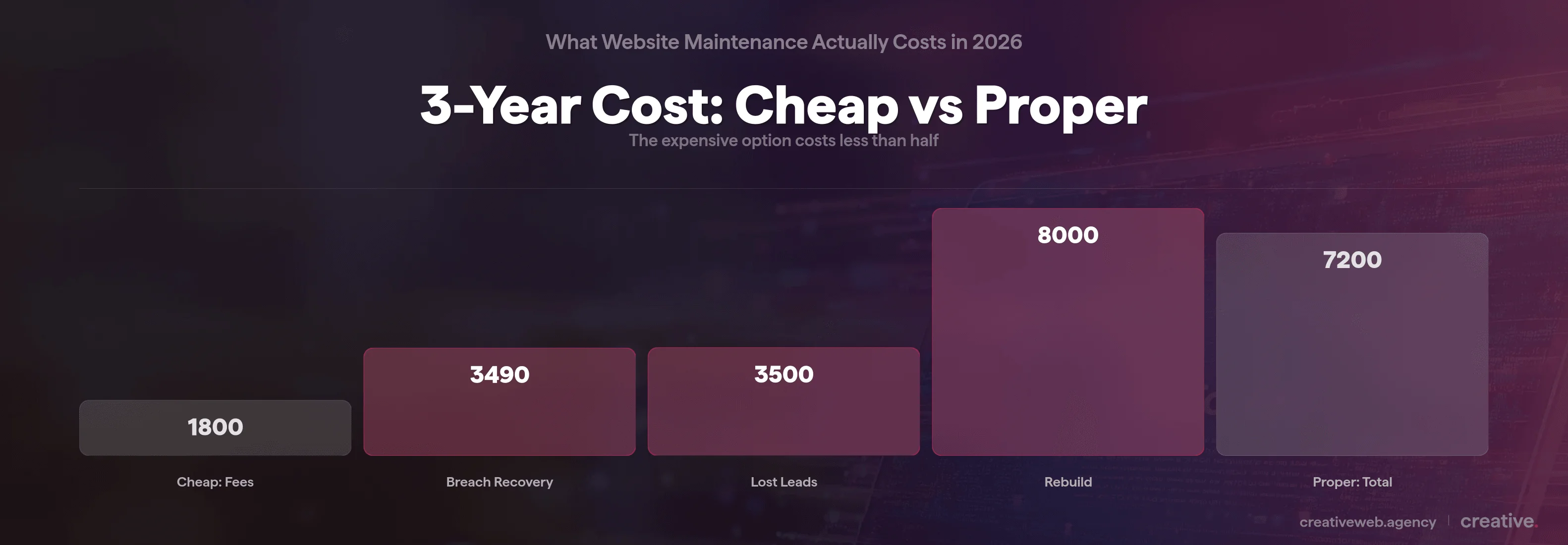
The “expensive” option costs less than half. Over three years, proper website maintenance at £200 per month costs £7,200 total: less than half the £16,790 that inadequate £50/month maintenance typically ends up costing once breach recovery and lost business are factored in.
That is the number to take to your finance director.
What It Costs When Things Go Wrong
The breach scenario above is actually conservative. If your site handles customer data and you’re found to have inadequate security measures, the ICO can issue GDPR fines of up to £17.5 million or 4% of global turnover (whichever is higher). Most SMEs won’t face maximum fines, but even a small enforcement action costs thousands in legal fees and reputation damage.
And SEO recovery isn’t quick. Google’s Core Web Vitals documentation confirms that significant performance degradation leads to ranking drops, sometimes within weeks. Recovery can take 3-6 months of focussed work. That’s months of reduced organic traffic and fewer enquiries.
TLDR: recovery costs 3-10x what ongoing maintenance would have cost. Every single time.
How to Tell If Your Provider Is Actually Doing Their Job
This is one of best questions you can ask, and nobody else seems to answer it properly. You’re paying for a website maintenance plan. How do you actually know the work is being done?
Eight Things Your Monthly Report Should Include
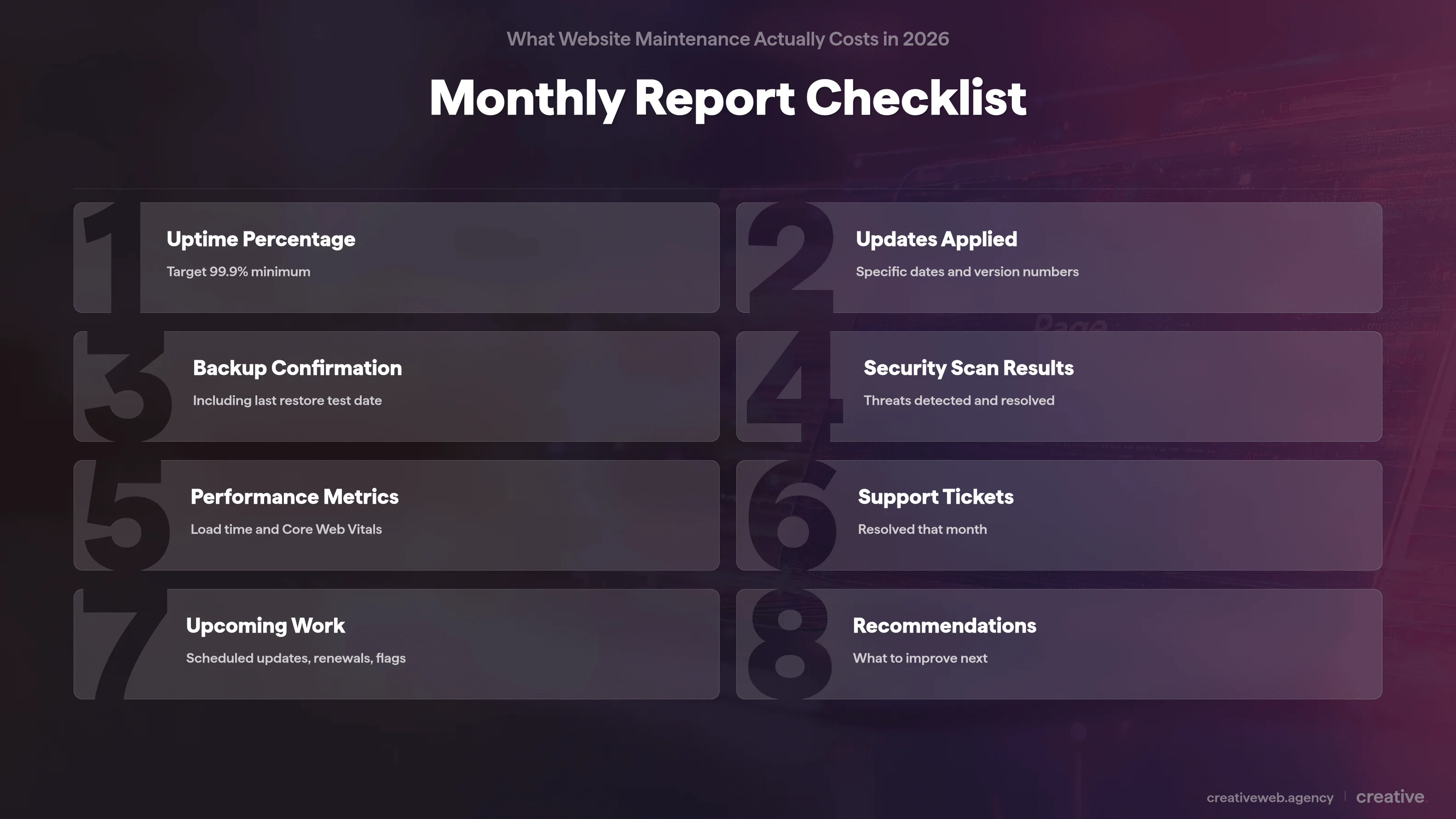
- Uptime percentage: target 99.9% minimum
- Updates applied: with specific dates and version numbers
- Backup confirmation: including when the last restore test was run
- Security scan results: threats detected and resolved
- Performance metrics: page load time and Core Web Vitals scores
- Support tickets: resolved that month
- Upcoming work: scheduled updates, renewals, anything flagged
- Recommendations: what should be improved next
If your provider cannot produce this, they are not doing the work. Simple, really.
Red Flags That Mean You Should Switch
Your CMS shows pending updates that are weeks old. No staging environment for testing. Response times regularly over 48 hours. Monthly reports that just say “everything’s fine” with no specifics. Site speed getting worse over time. They can’t tell you when they last tested a backup restore.
Any of these on their own is a concern. Two or more? Start looking elsewhere.
If you’re not sure where things stand, a website audit will give you a clear picture of your site’s security, performance, and user experience.
What Happens When You Stop Maintaining Your Website
The scariest failures are the ones you can’t see.
A broken contact form silently dropping enquiries, or a slow-loading page pushing visitors to competitors before your content even appears. An expired SSL certificate triggering a “Not Secure” warning that 85% of consumers say would make them leave, according to GlobalSign’s research.
And then there is the bigger picture: 60% of small businesses that suffer a significant cyber attack close within six months according to the National Cyber Security Centre.
Your website isn’t just a marketing tool. For most of our clients it’s the primary lead generation channel.
You insure your building, your vehicles, your stock. Your website probably generates more revenue than all of them combined. Treating its maintenance as optional isn’t saving money: it’s gambling with your most productive business asset.
If any of this has flagged something about your current setup, start by asking your provider for last month’s report. If they can’t produce one, you’ve got your answer. And if you want to talk through what proper care looks like for your site, get in touch: we’re always happy to have that conversation.
Frequently Asked Questions About Website Maintenance Costs
-
How much does website maintenance cost per month in the UK?
-
It depends on your site. A basic brochure site runs £75-£150/month, a WordPress business site £129-£250, and ecommerce from £250-£500+. Most UK businesses with a properly built site should expect to pay £129-£350/month for maintenance that actually includes testing, security monitoring, and backups that work. Anything under £100 usually means automated updates with no manual checking.
Did this answer your question? YesThat’s great glad we could help! Start a ProjectNoNo problem, one of our experts can give you a more in-depth answer. Ask our Experts -
What does website maintenance include?
-
At minimum: CMS and plugin updates, daily backups, basic security monitoring, SSL management, and uptime monitoring. Better plans add staging environment testing, performance monitoring, content updates, and priority support. The key difference between cheap and proper maintenance is whether someone actually tests updates before pushing them live and verifies that backups can be restored.
Did this answer your question? YesThat’s great glad we could help! Start a ProjectNoNo problem, one of our experts can give you a more in-depth answer. Ask our Experts -
What factors affect website maintenance costs?
-
Five main things: site complexity (a 10-page brochure vs a 500-product shop), your CMS platform (WordPress needs more work than static sites), security requirements (ecommerce adds PCI-DSS compliance costs), how often you need content changes, and your required response time. Location matters too. London agencies typically charge 20-30% more than providers outside the South East.
Did this answer your question? YesThat’s great glad we could help! Start a ProjectNoNo problem, one of our experts can give you a more in-depth answer. Ask our Experts -
Why is website maintenance important?
-
Because your website doesn’t stay secure or fast on its own. WordPress releases security patches monthly, and the 15-30 plugins on a typical business site all need regular updating and testing. Without maintenance, you’re accumulating security vulnerabilities, your site slows down, search rankings drop, and you risk a breach that costs far more to fix than maintenance would’ve cost to prevent.
Did this answer your question? YesThat’s great glad we could help! Start a ProjectNoNo problem, one of our experts can give you a more in-depth answer. Ask our Experts -
Should I handle maintenance myself or hire a professional?
-
You can, but most business owners shouldn’t. DIY maintenance takes 2-5 hours per month, and if your time’s worth £75/hour, that’s £150-£375 in opportunity cost alone. The bigger risk is the expertise gap: without a staging environment and proper testing process, a single plugin update can break your contact form or checkout page. And you might not notice for days.
Did this answer your question? YesThat’s great glad we could help! Start a ProjectNoNo problem, one of our experts can give you a more in-depth answer. Ask our Experts -
How much does it cost to maintain a WordPress website?
-
WordPress sites cost more to maintain than static sites because of the plugin ecosystem. A WordPress business site typically runs £129-£250/month. WooCommerce adds PCI-DSS compliance, payment monitoring, and checkout testing on top, pushing costs to £250-£500+. The main cost driver is testing: 97% of WordPress security vulnerabilities come from plugins, so every update needs checking in staging before it goes live.
Did this answer your question? YesThat’s great glad we could help! Start a ProjectNoNo problem, one of our experts can give you a more in-depth answer. Ask our Experts -
What happens if you don’t maintain your website?
-
Nothing obvious at first, which is the problem. Security vulnerabilities build up quietly, performance degrades gradually, and then something breaks: a plugin conflict, a security breach, an expired SSL certificate scaring visitors away. The average cyber incident costs UK small businesses thousands in recovery, and 60% of small businesses that suffer a significant cyber attack close within six months. Recovery always costs more than prevention.
Did this answer your question? YesThat’s great glad we could help! Start a ProjectNoNo problem, one of our experts can give you a more in-depth answer. Ask our Experts -
Is £100 a month enough for website maintenance?
-
For a very simple brochure site with 5-10 pages that doesn’t change often, possibly. But for a business site that generates leads or processes payments, probably not. A decent essential-tier plan starts around £129/month, and even that doesn’t include content changes, SEO, or priority support. If your site cost £10,000+ to build and actively brings in business, spending less than £129/month means you’re almost certainly missing staging environment testing, proper backup verification, and meaningful security monitoring.
Did this answer your question? YesThat’s great glad we could help! Start a ProjectNoNo problem, one of our experts can give you a more in-depth answer. Ask our Experts